
St Augustine (354-430 AD) in different works (De Genesi contra Manichaeos; De Genesi ad litteram liber imperfectus; Confessiones 11–13; De Genesi ad litteram; De civitate dei 11–14; De Genesi ad litteram) writes about his views on cosmology and creation:
- the Universe and all the Beings were created by the trinitarian God – with all the three persons taking part in the creation
- God does not create in time, but creates time, himself existing in in timeless eternity
- at first formless matter is created, then the form is given based on rational principles in God’s mind.
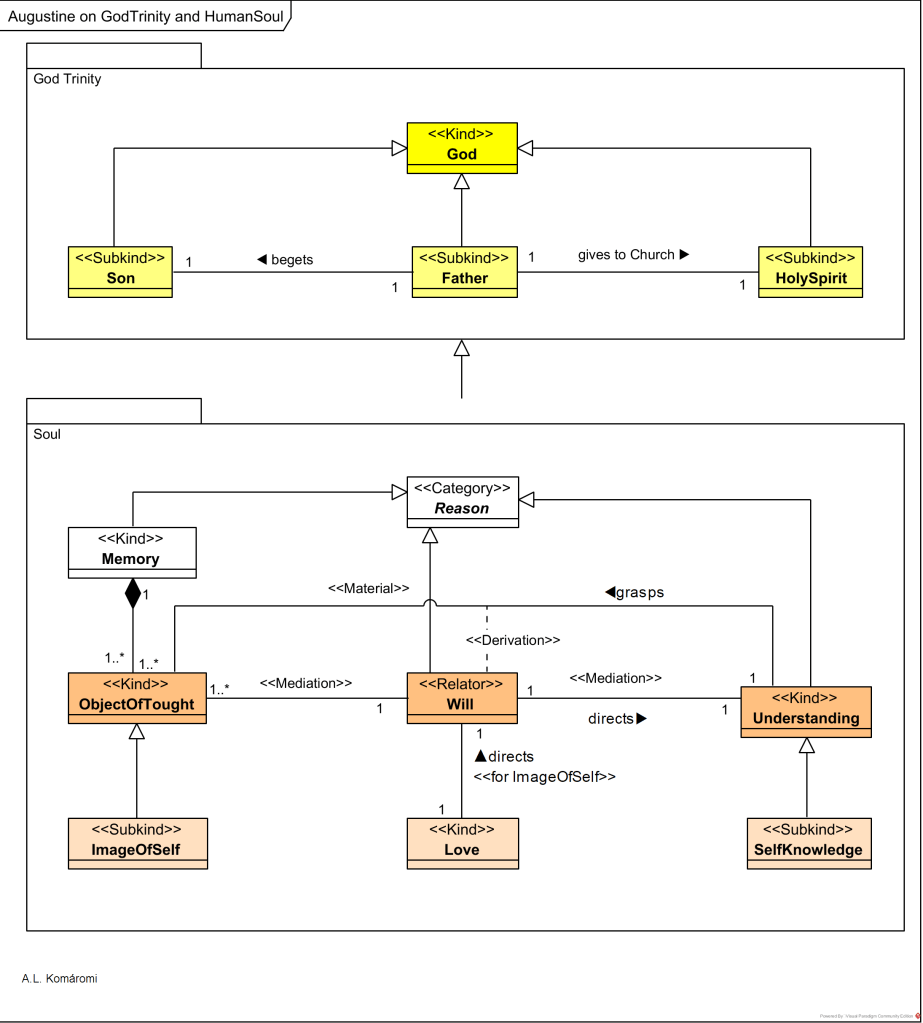
The OntoUML diagram below presents the main components of Augustine’s cosmology:

| Class | Description | Relations |
| God | Augustine’s god is the christian, trinitarian God. | creates Time; Matter; Being |
| Father | “In creation, all three persons of the Trinity are active, with, roughly, the Father accounting for the existence... (Confessiones 11.11; De civitate dei 11.24).” | is God; gives Existence |
| Son | “In creation, all three persons of the Trinity are active…the Son (to whom, in Augustine’s reading, the opening words of Genesis, in principio, refer) [accounting] for the form or essence…” | is God; forms Form based on RationalPriciple |
| HolySpirit | “In creation, all three persons of the Trinity are active… the Holy Spirit [accounting] for the goodness and orderliness of every created being” | secures Goodnes_Orderliness |
| Time | “God does not create in time but creates time together with changeable being while resting in timeless eternity himself (Confessiones 11.16; De Genesi ad litteram 5.5.12; the distinction of eternity and time is Platonic, cf. Timaeus 37c-38b; Plotinus, Enneads III.7.1). Creation occurs instantaneously; the seven days of creation are not to be taken literally but are a didactic means to make plain the intrinsic order of reality (Confessiones 12.40; De Genesi ad litteram 1.15.29). ” | relates to Universe |
| Existence | Existence | characterizes Being |
| Matter | “…God ‘first creates formless matter out of nothing (which is why matter in Augustine, unlike in the Neoplatonists, has a minimal ontological status…)” | |
| Form | “More precisely, God ‘first creates formless matter out of nothing… and ‘then’ forms it by conveying to it the rational principles (rationes) that eternally exist in his mind (De diversis quaestionibus 46.2) or, as Augustine prefers to put it, in his Word, i.e., the Second Person of the Trinity.” | characterizes Being |
| RationalPriciple | God forms matter looking to “rational principles (rationes) that eternally exist in his mind (De diversis quaestionibus 46.2) or, as Augustine prefers to put it, in his Word, i.e., the Second Person of the Trinity.” | part od Son [is in the Son’s mind] |
| Goodness_Orderliness | Goodness, orderliness is provided by the Holy Spirit. | characterizes Being |
| Love | “Like the demiurge in the Timaeus, God creates out of goodness, i.e., out of his good will and his gratuitous love for his creation (De civitate dei 11.24).” | relates God with Being |
| Being | “As the causality of the Trinity makes itself felt everywhere in creation, Augustine likes to describe created beings in their relation to the divine cause in a triadic manner, using, e.g., the categories ‘measure’, ‘form’ and ‘peace/order’ (e.g., De vera religione 13; De natura boni 3; De civitate dei 12.5; cf. Schäfer 2000 and, for a very thorough discussion, du Roy 1966). These ‘traces’ of the Trinity in creation must not be confused with the Trinitarian structure of the human intellect, which, alone among all created beings, is an image of God. Changeable being is not generated from God (which, according to the Nicene Creed, is true only of the Son) but created out of nothing, a fact that partly accounts for its susceptibility for evil.” | part of the Universe |
| CorporealBeing | “Corporeal being is created when the Forms or rational principles contained in God and contemplated by the angels are even further externalized so as to inform not only intelligible but also physical matter (De Genesi ad litteram 2.8.16; 4.22.39).” | |
| IncorporealBeing | “Incorporeal and purely intellectual beings, i.e., the angels, are created from intelligible matter which is created out of nothing and converted to the creator so as to be formed through the “hearing” of God’s word, i.e., by their contemplation of the Forms contained in God (De Genesi ad litteram 1.4.9–1.5.11, an idea inspired by the Neoplatonic pattern of abiding, procession and return).” | |
| Universe | The Universe contains all God’s corporeal and incorporeal creatures, beings. |
Sources
- All citations from: Mendelson, Michael, “Saint Augustine“, The Stanford Encyclopedia of Philosophy (Winter 2018 Edition), Edward N. Zalta (ed.)
First published: 2/1/2020
 Philosophy Models