[2.5] Porphyry on Universals

Neoplatonic philosopher Porphyry, the Phoenician (234?–305? BC) in his work Isagoge commented on Aristotle’s Categories (see [1.3.2]), where:

  • he listed the predicables (universals) as genus, species, difference, property, and accidents
  • and raised (but did not answer) paradigmatic questions about universals: “I shall abstain from deeper enquiries and aim, as appropriate, at the simpler ones. For example, I shall beg off saying anything about (a) whether genera and species are real or are situated in bare thoughts alone, (b) whether as real they are bodies or incorporeals, and (c) whether they are separated or in sensibles and have their reality in connection with them.” (Porphyry, Isagoge, in Spade 1994)

Porphyry’s model of universals is in the following OntoUML diagram:

Description/PackagDescriptionRelations
Predicables (Universals)Porphyry “proceeds not by talking about the ten Aristotelian categories directly, but instead by discussing five words or notions that he says are important for a clear understanding of the Categories. These five notions are: genus, difference, species, property and accident.
They came to be known as the five “predicables” — praedicabilia, not to be confused with the predicaments, which are the ten Aristotelian categories.
Although there is considerable doubt about it, people sometimes say that Porphyry’s list of five predicables is based on a similar list of four items that Aristotle presents in his Topics I.4 101b23–25, and again in more detail in Topics I.5 101b37–102b26. There Aristotle discusses: definition, property, genus and accident.
Porphyry’s list differs from Aristotle’s by adding difference, which Aristotle doesn’t have on his list, and by substituting species for definition.”
Genus“The genus is the part of the real definition that answers the broad question What is it? What is man? Man is an animal. Now in Latin, the interrogative pronoun ‘What?’ is ‘quid’. And so the genus of a thing is said to be predicated “in quid” of that thing. The phrase ‘in quid’ is a kind of horribly abbreviated way of saying “with respect to what the thing is,” or “in a way that answers the question ‘What is it’” — or in effect, “in a way that gives you the genus.”is in a recursive association with itself; each level splits the superior level in 2 or more, based on the attributes marked in Difference
Difference“On the other hand, the difference is the part of the real definition that answers the question What kind of a _ is it?, where the pause is filled in with the genus. What is man? Man is an animal. What kind of animal? A rational one. In Latin, the interrogative pronoun ‘What kind of?’ or ‘What manner of?’ is ‘quale’. And so the difference of a thing is said to be predicated of it not in quid, but rather in quale.”defines Species;
Species“Man is a most specific species. Below man there are only individual men, not yet lower species. What this means, of course, is that the differences among individual men are not essential differences but accidental ones. If they were essential differences, then we would have lower species after all.”relates to itself recursively
Property“In Aristotle and in Porphyry, and in medieval metaphysical discussions generally, the word ‘property means, first of all, something that is not essential to a thing (genus, difference and species are the essential predicables), but that nevertheless belongs to it and to it alone. (So exclusive ownership is only part of the story.) Now we’re not talking primarily about individuals here. In fact, Porphyry has very little to say about individuals at all in the Isagoge. We’re talking at the level of genera and species. And when we say something is a property of a certain species, we mean that it belongs to exactly the things in that species, and to nothing else. So we say, for instance, that it is a property of the species man to be risible — that is, to have the ability to laugh.”characterizes Species
Accident“the differences among individuals are accidental ones, not essential ones. […] Accident is what comes and goes without the destruction of the
substrate.”
characterizes Individual
Individual“Below man [as species] there are only individual men, not yet lower species. What this means, of course, is that the differences among individual men are not essential differences but accidental ones.”subkind of Species

Related posts in theory of Universals: [1.2.1], [1.3.1], [1.3.2], [2.5], [2.7.3], [4.3.1], [4.3.2], [4.4.1][4.5.2][4.9.8]

Sources

  • All citations from: Spade, Paul Vincent, “History of the Problem of Universals in the Middle Ages”, Indiana University 2009
  • Emilsson, Eyjólfur, “Porphyry”The Stanford Encyclopedia of Philosophy (Winter 2019 Edition), Edward N. Zalta (ed.)
  • Adamson, Peter,“92 – King of Animals: Porphyry”, History of Philosophy without any Gaps podcast

First published: 28/05/2020
[2.4.2] Plotinus: Neoplatonist Metaphysics

“Plotinus (204-270 AD) is considered to be the founder of Neoplatonism. Taking his lead from his reading of Plato, Plotinus developed a complex spiritual cosmology involving three foundational elements: the One, the Intelligence, and the Soul. It is from the productive unity of these three Beings that all existence emanates, according to Plotinus. The principal of emanation is not simply causal, but also contemplative. In his system, Plotinus raises intellectual contemplation to the status of a productive principle; and it is by virtue of contemplation that all existents are said to be united as a single, all-pervasive reality.”

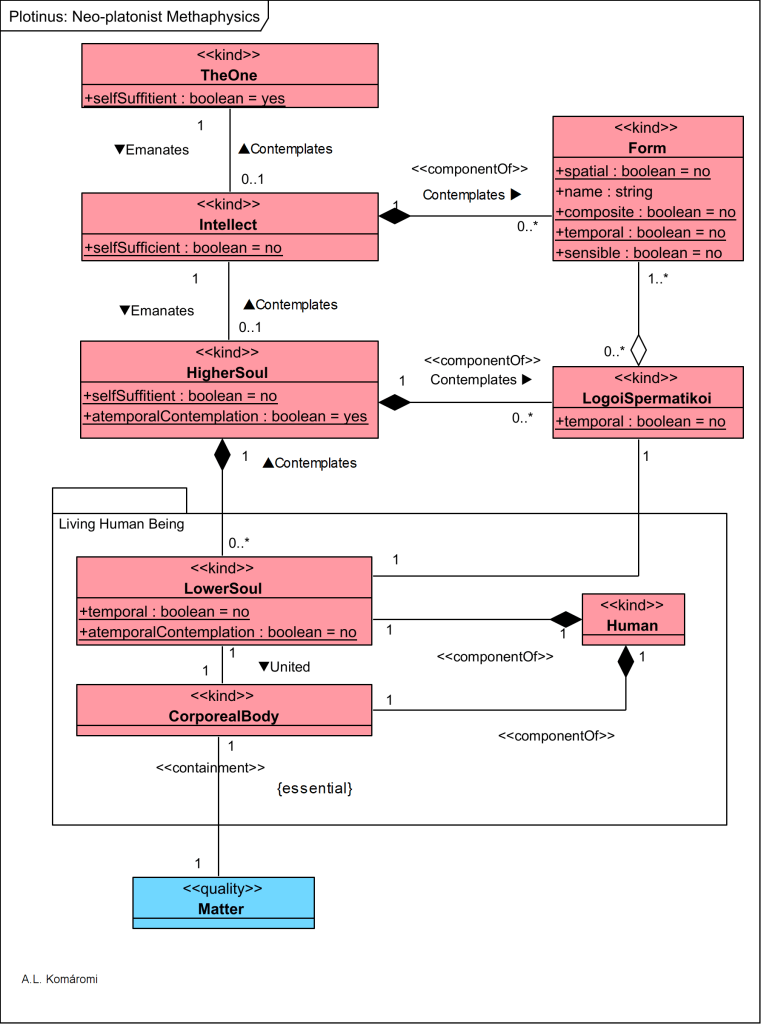
The following OntoUML diagram shows the main entities in the metaphysical scheme of Plotinus.

Plotinus metaphysics
Class/(Package)
Description
TheOne_
TheGood
“the One, which is neither being nor essence, but the source, or rather, the possibility of all existence. In this capacity, the One is not even a beginning, nor even an end, for it is simply the disinterested orientational ‘stanchion’ that permits all beings to recognize themselves as somehow other than a supreme ‘I’…” Is in 1:1 relation with the Intellect;
Intellect“The Intelligence (Nous) is the true first principle — the determinate, referential ‘foundation’ (arkhe) — of all existents; for it is not a self-sufficient entity like the One, but rather possesses the ability or capacity to contemplate both the One, as its prior, as well as its own thoughts, which Plotinus identifies with the Platonic Ideas or Forms (eide)… The Intelligence may be understood as the storehouse of potential being(s), but only if every potential being is also recognized as an eternal and unchangeable thought in the Divine Mind (Nous). Plotinus states that “to think and to be are one and the same” Existentially depending
on the TheOne_
TheGood; contains a multitude of Forms(p).
Form“The Ideas (Forms) reside in the Intelligence as objects of contemplation. Plotinus states that: “No Idea is different from The Intelligence but is itself an intelligence”
HigherSoul“The Soul, like the Intelligence, is a unified existent, in spite of its dual capacity as contemplator and actor. The purely contemplative part of the Soul, which remains in constant contact with the Intelligence, is referred to by Plotinus as the ‘higher part’ of the Soul1:1 relation with Intellect; on which existentially depends. Contains LogoiSpermatikoi.
Logoi
Spermatikoi
“through the contemplation of the One via the (Forms) Ideas, the Intelligence produces the logoi spermatikoi (‘seminal reasons’) that will serve as the productive power or essence of the Soul, which is the active or generative principle within Being.”LogoiSpermatikoi are a combination of Forms (many:many – 0..*:1..* relation).
Human “What Plotinus calls the “living being” (zoon) is what we would refer to, roughly, as the human being, or the individual possessed of a distinct personality. This being is the product of the union of the lower or active part of the soul with a corporeal body… Each “particular being” is the product, as it were, of an intelligence (a logos spermatikos)”
LowerSoul
“that part which actively descends into the changeable (or sensible) realm in order to govern and directly craft the Cosmos, is the ‘lower part (of the Soul),’ which assumes a state of division as it enters, out of necessity, material bodies… Yet the lower (or active), governing part of the Soul, while remaining, in its essence, a divine being and identical to the Highest Soul, nevertheless, through its act, falls into forgetfulness of its prior, and comes to attach itself to the phenomena of the realm of change, that is, of Matter.” Is part of the HigherSoul; associated with a CorporealBody.
CorporealBody CorporealBody is part of the Matter, made of Matter.
MatterMatter, for Plotinus, may be understood as an eternally receptive substratum (hupokeimenon), in and by which all determinate existents receive their form. Since Matter is completely passive, it is capable of receiving any and all forms, and is therefore the principle of differentiation among existents.”

OBSERVATION: according to my sources Plotinus’s thinking about the granularity of Forms/Ideas is not clarified, meaning if there is a different Form for any specific Particular, like any human being or not. (E.g.: is there a separate Form for Socrates or not?).
To overcome this issue I set one-one multiplicity for the LogoiSpermatikoi-LowerSoul_IndividualSoul relation, presuming that the HigherSoul is the level where the individual LowerSouls for different LivingBeings are created; and I used many-many multiplicity for the Form-
LogoiSpermatikoi relation, supposing that the Intellect thinks in higher categories (e.g. Humans, Genders etc.)

You can find a related post about [1.2.1] Plato’s Forms here. It is interesting to observe the increased complexity of Plotinus’s system.

Sources:

  • Edward Moore, Plotinus, Internet Encyclopedia of Philosophy

First published: 23/02/2019

  • Updated: 03/07/2019 Diagram modified to OntoUML standard.
  • Updated: 10/01/2022