
Aristotle (384-322 BC) writes about motion in the books 5-8 of his Physics. In his analysis he uses the concepts of Potentiality, Actuality, and Causes (see in [1.3.4]), and introduces the idea of Nature (of a thing, object), based on which he sets apart natural from forced motion.
“A major presupposition on Aristotle’s part is that this division is exhaustive: there are no changes to which the nature of the entity would be indifferent or neutral. The major consideration behind such a presupposition is that natures regulate the behaviour of the entities to which they belong in a comprehensive manner, and not merely partially. Any influence the entity is exposed to interacts with its nature in a substantive manner. The entity does not possess potentialities for change which would not be directly related to the tendencies emerging from its nature.”
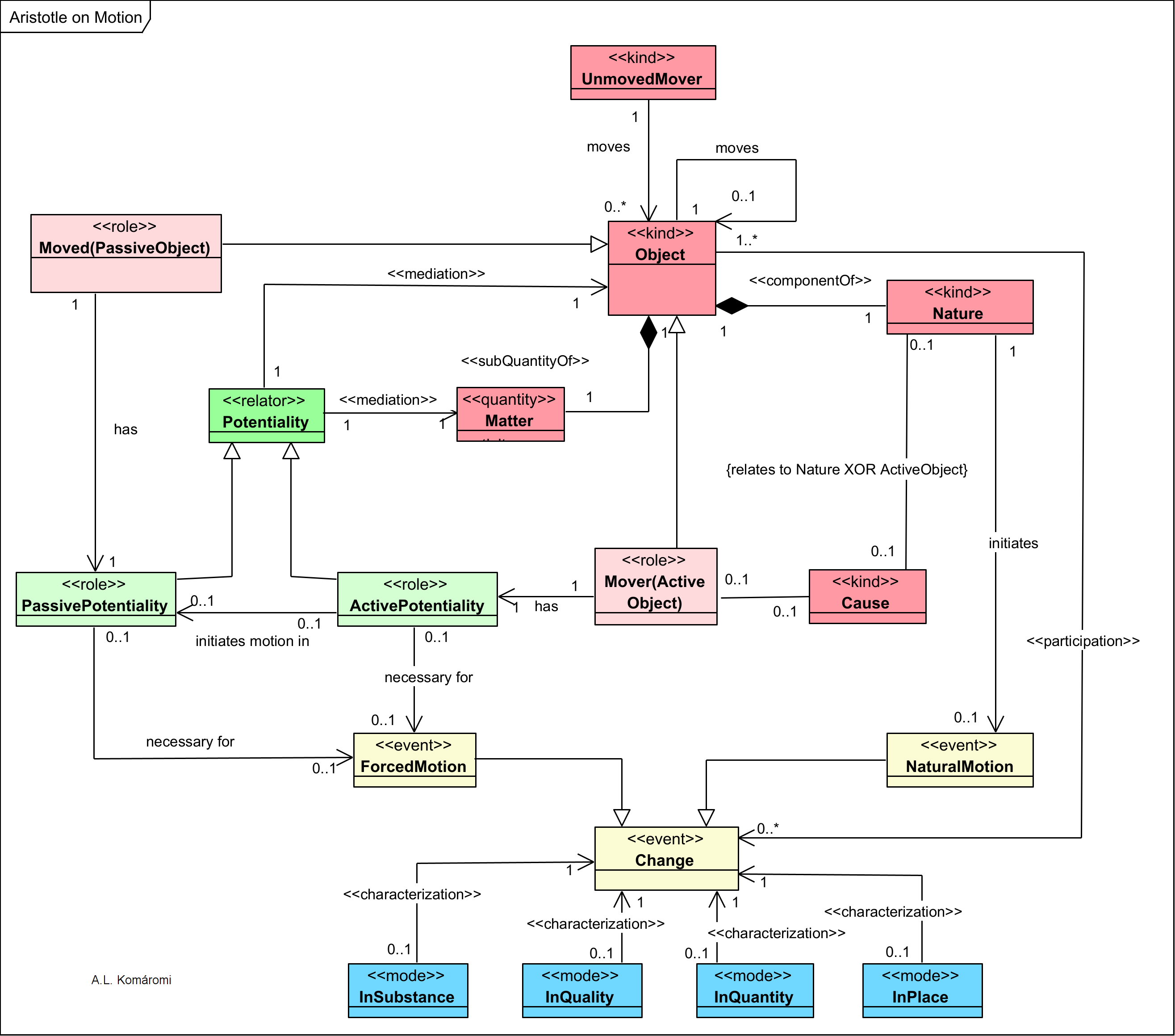
The following OntoUML diagram shows the main classes in this model:
| Class | Description | Relations |
|---|---|---|
| UnmovedMover | The unmoved movers are methaphysiscal, non-material entities, which are not part of the physical world. “Aristotle postulates that the processes of the universe depend on an eternal motion (or on several eternal motions), the eternal revolution of the heavenly spheres, which in turn is dependent on one or several unmoved movers” | moves Object |
| Object | Objects are essential particulars (see [3.1]), like statues and houses, horses, and humans. | moves Object; participates in Change |
| Mover (ActiveObject) | Mover (Active Object) includes (Active) Potentiality which initiates motion, change in a Passive Object through its Passive Potentiality. | is role of Object; has ActivePotentiality |
| Moved (PassiveObject) | Moved (Passive Object) is set in motion, changed by the Active Object. | is role of Object; has PassivePotentiality |
| Nature | “Nature [of an Object], according to Aristotle, is an inner principle of change and being at rest… This means that when an entity moves or is at rest according to its nature reference to its nature may serve as an explanation of the event… Natures, then, in a way do double duty: once a nature is operative, neither a further active, nor a further passive capacity needs to be invoked.” | is component of the Object; initiates NaturalMotion |
| Cause | “Natures,.. can feature in any… four causal functions. However, when the matter of an entity functions as its nature—i.e., when its natural motion and rest are explained in terms of the matter it is made of—this matter must possess some causally relevant features, bestowed upon it by its own formal aspect.” | relates to Nature XOR ActiveObject |
| Matter | Matter provides the Potentiality for the Object. | is sub-quantity of the Object |
| Potentiality | “change always requires the existence of a potentiality which can be actualised… Aristotle’s formulation strongly suggests that the potentiality actualised in the process of change is not a separate and independent potentiality for motion… Accordingly, potentialities of change are admitted into the ontology. They, nevertheless, do not need to feature as potentialities in their own right, but as the incomplete variants of the fundamental potentiality for an end result… The definition of motion as the actuality of a potentiality of the entity undergoing motion in so far as it is potential requires that in each case the passive potentiality for the change is present in the changing object.” | relates between Matter and Object |
| ActivePotentiality | “active powers or potentialities (dunameis),,, are external principles of change and being at rest (Metaphysics 9.8, 1049b5–10), operative on the corresponding internal passive capacities or potentialities (dunameis again, Metaphysics 9.1, 1046a11–13)… | role of Potentiality; initiates motion in PassivePotentiality |
| PassivePotentiality | “the passive potentiality, is in the object undergoing change” | role of Potentiality; |
| Change | Change is “the actuality of a potentiality of the entity undergoing motion.” “Aristotle speaks about four kinds of motion and change only—those in substance, in quality, in quantity and in place…” | event |
| NaturalMotion | “when the matter of an entity functions as its nature—i.e., when its natural motion and rest are explained in terms of the matter it is made of—this matter must possess some causally relevant features, bestowed upon it by its own formal aspect… The presence of the potentiality can, nevertheless, be in accordance with the nature of the object—in which case the change is natural (phusei)” | is a Change |
| ForcedMotion | “When a change, or a state of rest, is not natural [is Forced Motion], both the active and the passive potentiality need to be specified… The presence of the potentiality… can happen in the face of a contrary disposition on the part of the nature of the entity—in which case the change is forced (biâi) or contrary to nature (para phusin).” | is a Change; relates to ActivePotentiality and PassivePotentiality |
| InSubstance | is a characterization of the Motion (Change) | characterizes Change |
| InQuantity | is a characterization of the Motion (Change) | characterizes Change |
| InQuality | is a characterization of the Motion (Change) | characterizes Change |
| InPlace | is a characterization of the Motion (Change) | characterizes Change |
Sources
- All citations from: Bodnar, Istvan, “Aristotle’s Natural Philosophy”, The Stanford Encyclopedia of Philosophy (Spring 2018 Edition), Edward N. Zalta (ed.)
First published: 26/9/2019
Updated: 8/12/2021
Updated: 28/12/2021


 Philosophy Models