[1.3.11] Aristotle on Equality and Justice

“In his Politics, Aristotle (384-322 BC) further considers political justice and its relation to equality.  We can admit that the former involves the latter but must carefully specify by maintaining that justice involves equality ‘not for everyone, only for equals.’  He agrees with Plato that political democracy is intrinsically unjust because, by its very nature, it tries to treat unequals as if they were equals.  Justice rather requires inequality for people who are unequal.” (see UML Activity Diagram below)
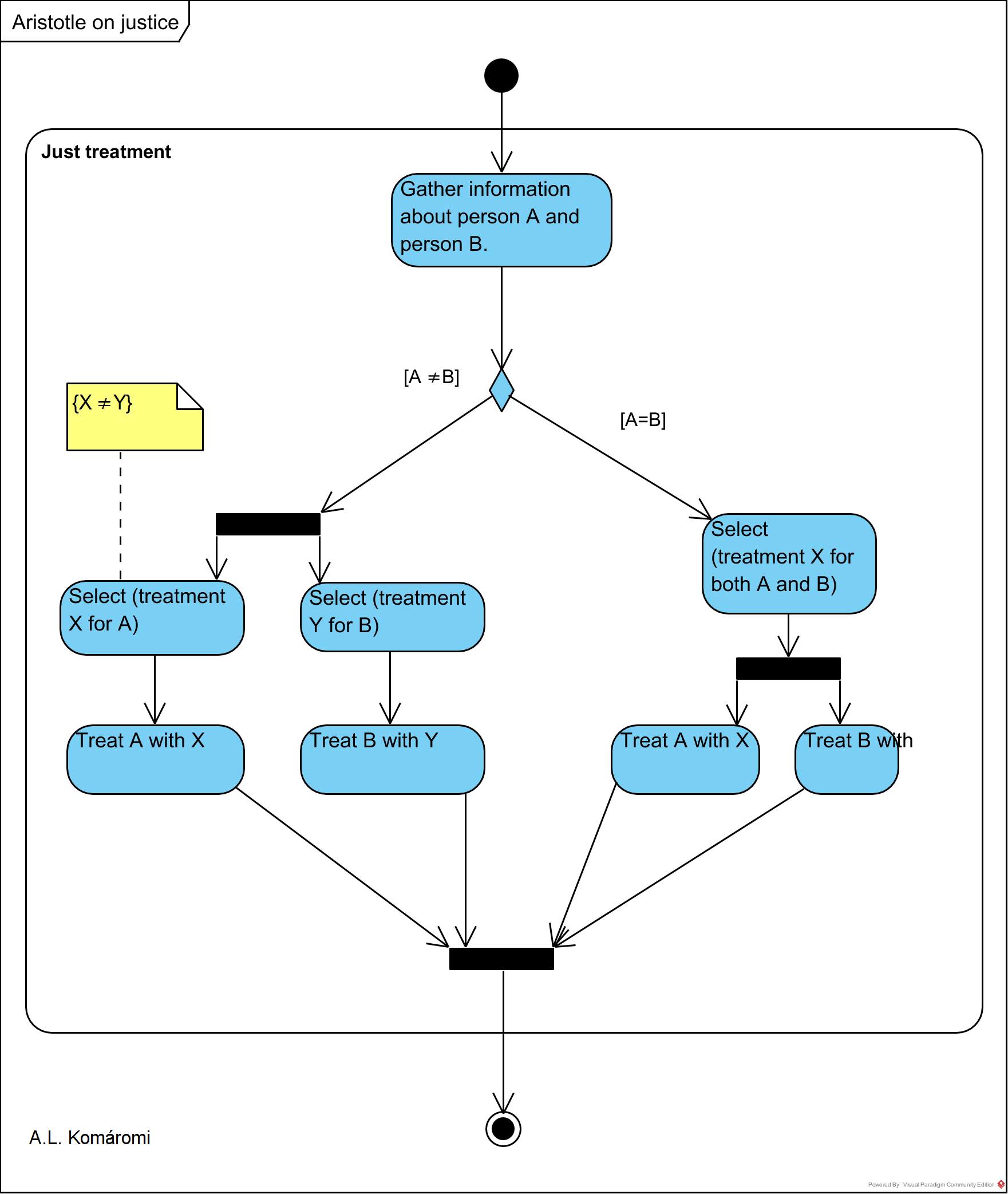
Aristotle on equality and justice

Sources:

First published: 09/05/2019

[1.3.10] Aristotle’s Categorization of Sciences

“Aristotelian sciences divide into three: (i) theoretical, (ii) practical, and (iii) productive. The principles of division are straightforward: theoretical science seeks knowledge for its own sake; practical science concerns conduct and goodness in action, both individual and societal; and productive science aims at the creation of beautiful or useful objects ….”

Aristotle’s (384-322 BC) categorization of sciences

Science or knowledge (epistemê) is about universal, necessary things with identified causes. Logic in this sense is not a science, it is “just” a tool.
You can find more about Aristotelian Science [1.3.8] and Causes [1.3.4] by following the links.

The source of all citations and more about the topic in: Shields, Christopher, “Aristotle“, The Stanford Encyclopedia of Philosophy (Winter 2016 Edition), Edward N. Zalta (ed.)

First published: 1/5/2019