[4.6] John of Salisbury on Body Politic

John of Salisbury (1115/20–1180 AD) was one of the first medieval authors who wrote about political philosophy. In his work Policraticus, he presents a famous analogy, where posits the commonwealth as a “body which is animated.” He compares the structure of the commonwealth with that of the human body:

  • he paired different groups of people (organs of body politic) with the organs of the human body, where each organ has a function to perform for the good of the whole organism
  • his theory was not intended to “justify hierarchy and division within society […]. Rather, the body politic found in the Policraticus is the expression of a principle of cooperative harmony.”

John’s model of body politic is pictured in the following OntoUML diagram:
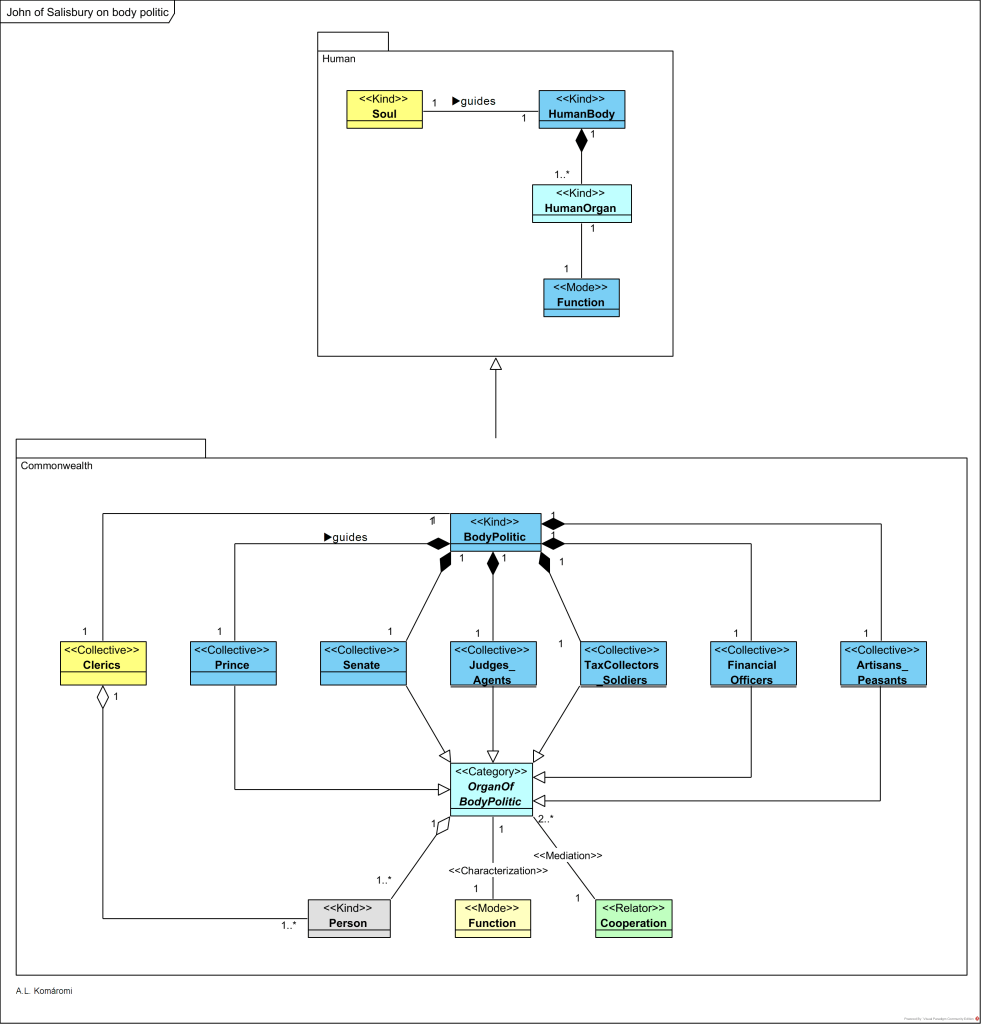
John of Salisbury on body politic

Class/PackageDescriptionRelations
HumanA human has a human body, guided by the soul. The body is composed of organs; each of them has functions.
BodyPolitic“John’s naturalistic conception of cooperative association informs the famous organic analogy that he proposes and develops in the Policraticus. Ascribing his insight to a letter of instruction (John’s creation) purportedly by Plutarch to Emperor Trajan, John commences with the simple observation that the commonwealth may be likened to a ‘body which is animated’ [body politic] […]. The different offices of political society are represented as analogous to the distinct parts of the human anatomy.”
Prince“Because the political creature is an essentially secular entity, the body politic is ruled by the prince, who ‘occupies the place of the head‘ (PC: 69)”is exclusive part of BodyPolitic; OrganOfBodyPolitic
Clerics“Like all bodies, the commonwealth is guided by a soul, which John assigns to ‘those who direct the practice of religion’ (PC: 67). Yet, just as the eternal human soul is not coextensive with the mortal physical organism within which it resides, the clerical soul of the polity is not, strictly speaking, a member of the commonwealth”guides BodyPolitic
Senate“The senate, composed of the prince’s counselors, functions as the commonwealth’s heart.” is exclusive part of BodyPolitic; OrganOfBodyPolitic
Judges_
Agents
“The senses correspond to the royal judges and local agents who exercise jurisdiction in the king’s name.”is exclusive part of BodyPolitic; OrganOfBodyPolitic
Finacial
Officers
“The financial officers constitute the body’s stomach and intestinesis exclusive part of BodyPolitic; OrganOfBodyPolitic
TaxCollectors_
Soldiers
“the tax-collector and the soldier represent the two handsis exclusive part of BodyPolitic; OrganOfBodyPolitic
Artisans_
Peasants
“Finally, John compares the feet to the artisans and peasants ‘who erect, sustain and move forward the mass of the whole body'”is exclusive part of BodyPolitic; OrganOfBodyPolitic
OrganOf
BodyPolitic
Group of people with a specific function in the republic.
Function“Each part [organ] of the organism, according to the Policraticus, has its own definite function, fixed by its location within the overall scheme of the body. None of the members may be excluded or removed without serious damage to the whole.”characterizes OrganOf
BodyPolitic
PersonA human person, member of the body politic.is part of OrganOf
BodyPolitic and Clerics
Cooperation“the body politic found in the Policraticus is the expression of a principle of cooperative harmony through which otherwise disparate individuals and interests are reconciled and bound together. John adopts a ‘physiological’ approach to the political organism, according to which all of the organs cooperate reciprocally in order to achieve a common purpose.”mediates between instances of OrganOf
BodyPolitic

Sources

  • All citations from: Bollermann, Karen and Nederman, Cary, “John of Salisbury”The Stanford Encyclopedia of Philosophy (Fall 2016 Edition), Edward N. Zalta (ed.)

First published: 16/07/2020
[4.5.2] Gilbert of Poitiers on Universals

Gilbert of Poitiers (Gilbert de la Porrée, 1085?–1154 AD) in different commentaries to Boethius’s De Trinitate, De Hebdomadibus, and Contra Eutychen et Nestorium proposes an anti-realist theory of universals, according to which:

  • universals (like genus and species) are sets (collectiones)
  • these sets are based on the resemblance of some essential properties (subsistentiae) of individuals.

Here are Gilbert’s responses to Porphyry’s questions (see [2.5]):

Porphyry’s questionsUniversals according to Gilbert
(a) whether genera and species [universals] are real or are situated in bare thoughts aloneare situated in thoughts (as sets)
(b) whether as real they are bodies or incorporealsthey are not real things
(c) whether they are separated or in sensibles and have their reality in connection with themthey are not real things

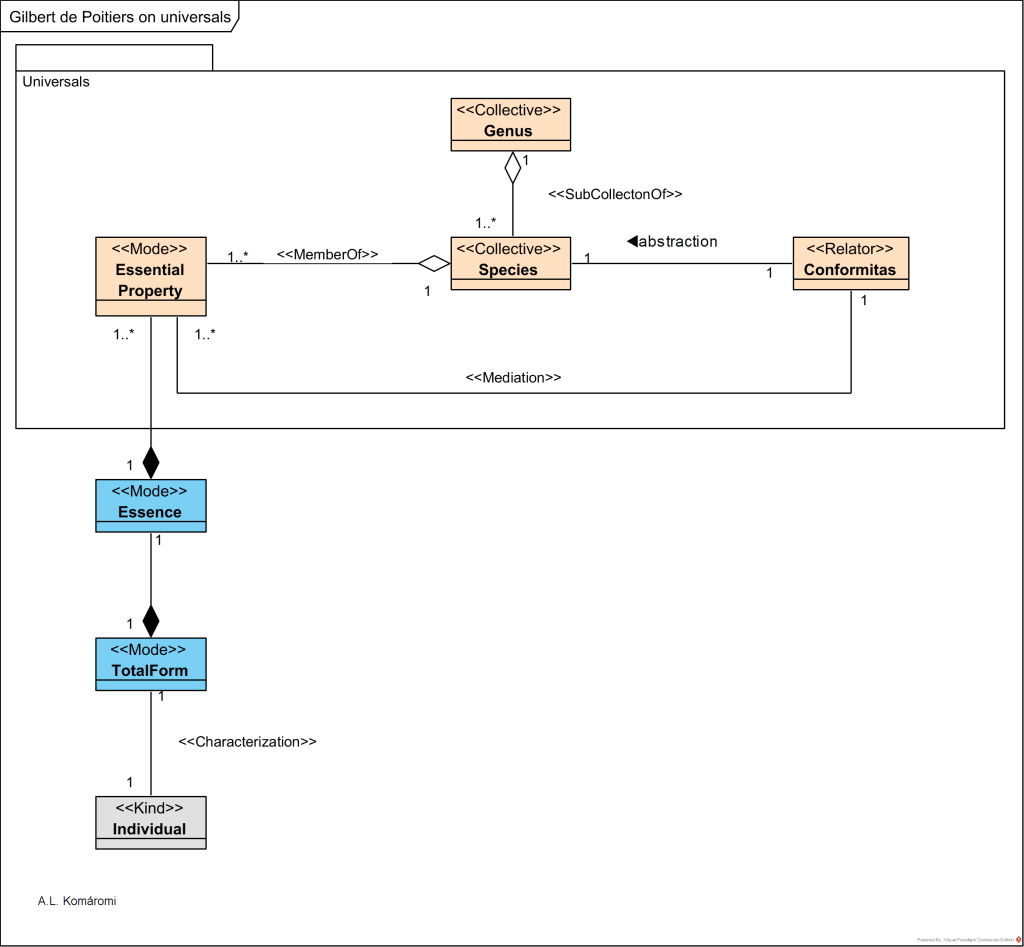
Gilbert’s model of universals is pictured in the following OntoUML diagram:

Gilbert of Poitiers on universals
ClassDescriptionRelations
GenusGenus is a collection of Species
SpeciesSpecies is a collection of EssientialProperites (substancia), based on their resemblance (Conformitas)is subcollection of Genus
Conformitas“For Gilbert, a universal is a collection of properties on the basis of resemblance. His theory is based upon the notion of conformitas. There are many subsistentiae of a given kind, the number of which is the same as that of the subsistents of which they are the being (this thesis is summarized clearly by the author of the Compendium Logicae Porretanum in the formula ‘there are as many humanities as there are men’), and their natural conformity causes their generic or specific union. Gilbert notes that universals are ‘collected from particulars by the intellect.’ The intellect is able to abstract on the basis of conformitas, which is naturally given and may be observed through the manifest resemblance that exists between things in the sensible world. The universal is the union of subsistentiae in virtue of their conformity—union, but not unity.”mediates between EssentialProperies; Species is abstracted (by the Intellect) form Conformitas
Essential Property“An id quo —that is, an essential property—is also called subsistentia, a particular essential property or substantial form determining the being of just one individual. Each individual, or subsistens, is constituted of several subsistentiae. The interest and originality of Gilbert’s position lie in the fact that each of these subsistentiae is particular.”
E.g. The animality of Felix, the cat.
component of Essence
Essence“All these subsistentiae taken together constitute the essence of an individual, which Gilbert calls tota substantia.component of TotalForm
TotalForm“Gilbert offers a very interesting theoretical tool for the consideration of an individual seen over a whole lifetime. He probably pursues the doctrinal aim of ensuring personal identity across time and of avoiding that an individual undergoing qualitative or quantitative change becomes a different individual. Gilbert introduces the concept of forma tota [total form] to refer to the set of all the properties that might be true of a given subject, including also those that will never be actualized. The sum of the essential properties and accidents thus constitutes the forma tota of the individual; the sum of the characteristics of Socrates is called Socrateitas and the sum of those of Plato, Platonitas. According to Gilbert, the tota forma of an individual—for example, Plato’s Platonitas— includes all its subsistences (its substantia tota) but also its quantitative and qualitative accidents—not only those it possesses actually (actu), but also those it possessed in the past and those it will or could possess in future according to the potentiality of its own nature. Expressed as bundle, the forma tota could be understood as the most comprehensive possible bundle. This total form belongs to just one concrete being. The individuality of a concrete being or, in Gilbert’s words, its numerical diversity, is caused by the particularity of its essential properties and rendered manifest by the fact that it possesses its own total form. An anonymous Porretan treatise is explicit when it speaks of the case of the individual Peter. The form which is composed of all the various properties, both essential and accidental, which are in Peter, and which make Peter different from all the other men, is called petritas. This form is particular, and explains how Peter is a being discrete from all other men”.characterizes Individual
Individual“An id quod est is an independent individual, such as Peter, my cat Felix, or this apple. Gilbert uses an alternative terminology: an id quod est, an individual, is also called a subsistens, a subsisting entity. […]
An individual is the sum, the collection of all its essential subsistentiae and particular accidental properties.”

Related posts in theory of Universals: [1.2.2][1.3.1][1.3.2][2.5][2.7.3][4.3.1][4.3.2], [4.4.1], [4.4.1][4.5.2], [4.9.8]

Sources

  • All citations from: Erismann, Christophe, “Explaining Exact Resemblance: Gilbert of Poitiers’s Conformitas Theory Reconsidered”, Oxford Studies in Medieval Philosophy, Volume 2, Edited by ROBERT PASNAU,2014
  • Adamson, Peter, “216. One of a Kind: Gilbert of Poitiers on Individuation“, History of Philosophy without any Gaps podcast

First published: 07/07/2020