[4.9.2] St Thomas Aquinas on Essence and Existence in Material Substances

St Thomas Aquinas ( “Doctor Angelicus”, 1225 – 1274 AD), in his work On Being and Essence analyzes substances using concepts like matter, form, hylomorphism, actuality, potentiality (developed by Aristotle, see [1.3.5]), essence, and existence (developed by Avicenna, see [3.3.1]).

  • Substances are enduring primary existents, which can be material or immaterial.
  • Substances are a composition of essence (which makes the substance what is) and existence (which is the act of being “esse“).
  • The essence of material substances contains both matter and form.
  • Actuality and potentiality (in conformity with Aristoele’s model) relate form and matter to the essence of the material substance.
  • God, an immaterial substance gives existence to all the other substances, be it material or immaterial.

The following OntoUML diagram presents Aquinas’s model of material substances:
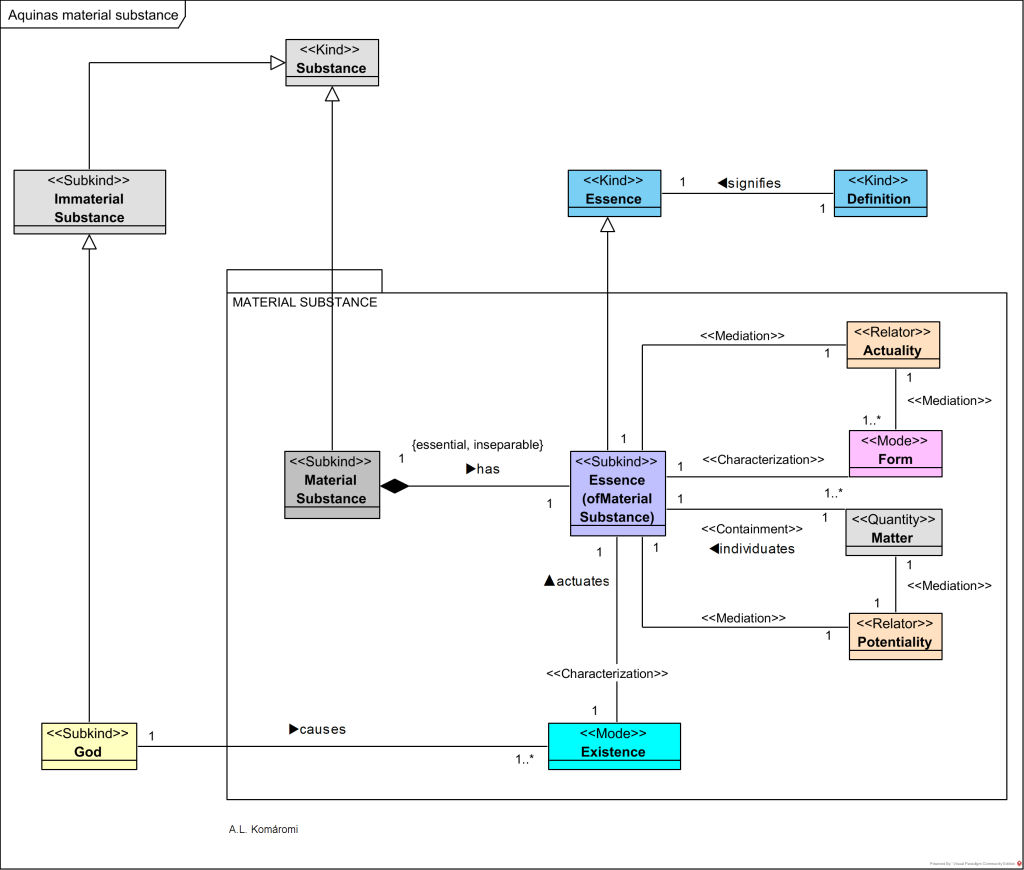
Aquinas material substance
ClassDescriptionRelations
SubstanceAccording to Aquinas substances are what are primarily said to exist. They are enduring things like trees, horses, humans.
“Some substances are simple [immaterial], others are composite [material]”.
MaterialSubstanceMaterial substances [composite substances] are like: Socrates, a horse, a tree, a stone etc.
“Some substances are simple, others are composite, and both sorts have their essence, but the simple ones in a more genuine and excellent way, just as they have a more excellent way of being. For they are the cause of the composite ones; at least this is true of the first, simple substance, which is God.
However, since the essences of these substances are quite hidden from us, we should begin with the essences of composite substances, so that our discussion may more suitably proceed from the easier subjects.”
subkind of Substance
ImmaterialSubstanceImmaterial substances [simple substances] have their essence “in a more genuine and excellent way, just as they have a more excellent way of being. For they are the cause of the composite ones; at least this is true of the first, simple substance, which is God.”subkind of Substance
Essence“For on the basis of what has been said so far it is clear that the essence of a thing is what its definition signifies.”
Essence(ofMaterial Substance)Essence (ofMaterial Substance): “But the definition of things of nature contains not only form, but matter as well; otherwise natural definitions would not differ from mathematical definitions. And it cannot be said that matter is included in the definition of a natural substance as something added to its essence, or as something existing outside of its essence, for this sort of definition is proper to accidents, which do not have perfect essence, and therefore they have to receive in their definition their subject, which is outside their essence. It is clear, therefore, that essence comprises both matter and form. […]
The name “quiddity,” on the other hand, is derived from the fact that it is signified by the definition; but it is called “essence” [essentia], because it is that through which and in which a thing has its being [esse].”
subkind of Essence; contains Matter; exclusive part of MaterialSubstance
Definition“the definition of things of nature contains not only form, but matter as well; otherwise natural definitions would not differ from mathematical definitions.”
The definitions are in the mind.
signifies Essence
Form“For by the form, which is the actuality of matter, matter is made into an actual being and this [particular] thing [hoc aliquid]. Therefore, whatever supervenes does not give actual being to matter absolutely speaking, but it makes it actual in some respect, just as accidents do, as whiteness makes something actually white. So, when a form of this sort is acquired, the thing is not said to be generated absolutely speaking, but only in some respect.”characterizes Form
MatterMatter, e.g. wood, bronze, or human flesh.individuates Essence(ofMaterial Substance)
Existence“And reason agrees with this as well, for the act of being [esse, existence] of a composite substance is neither of the form alone, nor of matter alone, but of the composite itself; and the essence is that on account of which the thing is said to be.”characterizes and actuates Essence(ofMaterial Substance)
Actuality“For by the form, which is the actuality of matter, matter is made into an actual being and this [particular] thing [hoc aliquid].”relates Form with Essence(ofMaterial Substance)
PotentialityPotentiality is “possibility” that a thing can have.relates Matter with Essence(ofMaterial Substance)
GodGod, the first cause.
“Now, everything that a thing has is either caused in it by its own principles, as the ability to laugh in man, or it comes to the thing from an external source, as the light in the air is coming from the sun. But the existence of a thing cannot be caused by its form or quiddity itself (I mean, as by an efficient cause), for then a thing would be its own cause, and would bring itself into existence, which is impossible. Therefore, all such things, namely, those that have their existence as something distinct from their nature, have to have their existence from something else. However, since everything that is through something else [per aliud] is reduced to what is through itself [per se] as its first cause, there has to be something that is the cause of existence for everything, since it is existence only. For otherwise the series of causes would go to infinity, since every thing that is not existence only has a cause for its existence, as has been said. It is clear, therefore, that an intelligence is both form and existence, and that it has its existence from the first being that is existence only; and this is the first cause, which is God.”
subkind of ImmaterialSubstance; causes Existence

Sources

  • All citations from:  Thomas Aquinas, “On Being and Essence”, in Medieval Philosophy: Essential Readings with Commentary, Edited by Gyula Klima with Fritz Allhoff and Anand Jayprakash Vaidya, Blackwell Publishing Ltd, 2007
  • Kerr, Gaven : “Aquinas: Metaphysics”, Internet Encyclopedia of Philosophy
  • McInerny, Ralph and John O’Callaghan, “Saint Thomas Aquinas”The Stanford Encyclopedia of Philosophy (Summer 2018 Edition), Edward N. Zalta (ed.)
  • The Cambridge Companion to Aquinas, CAMBRIDGE UNIVERSITY PRESS, Edited by  Norman Kretzmann and Eleonore Stump, 2010
  • Joshua P. Hochschild, “Form, Essence, Soul: Distinguishing Principles of Thomistic Metaphysics”

First published: 17/09/2020
Updated: 19/09/2020 added Actuality, Potentiality
Updated: 23/09/2020 added God
[4.9.1] St Thomas Aquinas on Substance and Change

St Thomas Aquinas (“Doctor Angelicus”, 1225 – 1274 AD) in his works On Being and Essence and The Principles of Nature writes about substance as a primary metaphysical category.

  • His model is an evolved version of Aristotelian hylomorphism (see [1.3.5], and for humans [1.3.7]), where substances are enduring primary existents composed of prime matter and substantial form.
  • The soul is the form of the living human body.
  • Incidental (or accidental) changes modify the substance’s incidental forms (or properties) like quality, quantity, place, while substantial change modifies its existence.

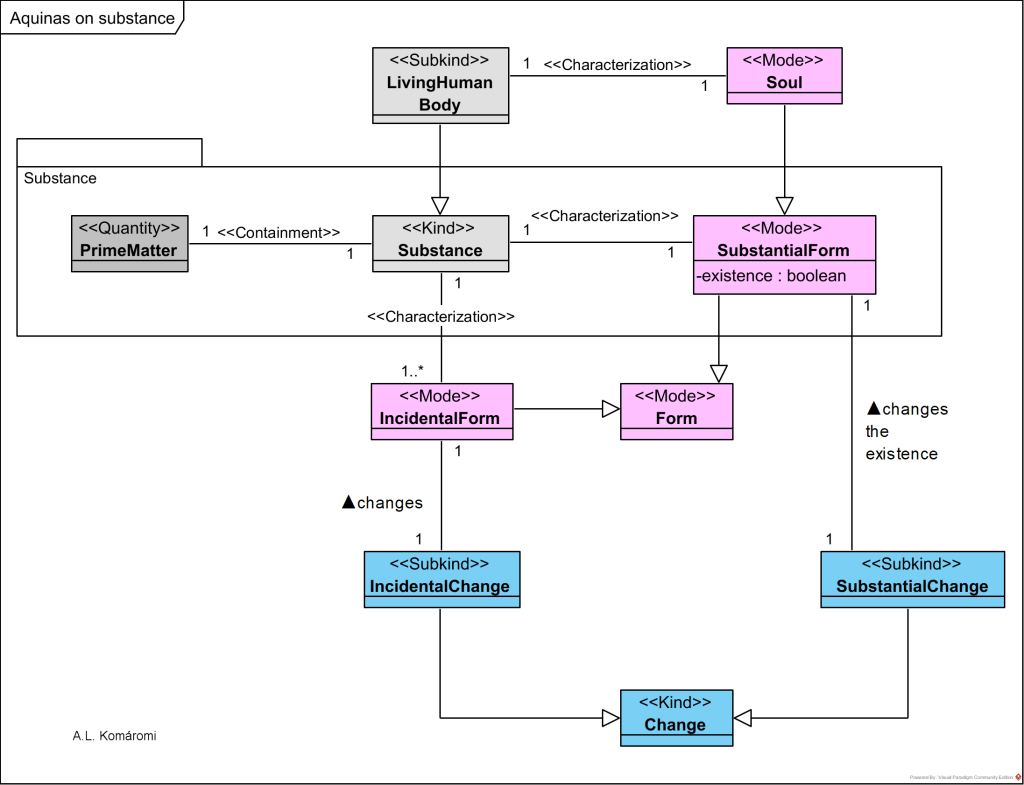
The following OntoUML diagram presents Aquinas’s model of substance and change:

Aquinas on substance and change
ClassDescriptionRelations
SubstanceAccording to Aquinas substances are what are primarily said to exist.
“[…] enduring things like men and trees and horses and the like have also come into being and are destined some day to cease to be. Such things are called substances.
contains PrimeMatter
PrimeMatter“The subject of a surface or incidental change is a substance [its incidental form]. The subject of a substantial change cannot be a substance; if it were, the result would be a modification of that substance, that is, an incidental change. But we are trying to understand how a substance itself comes into being as the result of a change. There must be a matter or subject but it cannot be matter in the sense of a substance. In order to signal this, we can call the matter prime matter, first matter. But it is important to recognize that this prime matter is not a substance, and does not exist apart from any particular substance. It is always the matter of some substance that exists.”
SubstantialForm“The form in a substantial change must be that which makes the substance to be what it is. Call it substantial form.”characterizes Substance; inherits from Form
IncidentalFormIncidental form (or accidental form) can be: “like size or location or temperature” characterizes Substance; inherits from Form
FormThe “elements of the change get the names that stick from another example, whittling wood. The term for wood in Greek is hyle and the term for shape, the external contours of a thing, is morphe. In English, form, a synonym of shape, is used to express the characteristic that the subject acquires as the result of the change, e.g. musical.”
LivingHumanBodyA living human bodysubkind of Substance
Soul“When the discussion moves on from what may be said of all physical objects as such to an inquiry into living physical things, the analyses build upon those already completed. Thus, “soul” will be defined as the form of living [human] bodies. […]
Thomas merely concludes from this fact that the soul is a ‘particular thing’ and thus a subsistent after the death of the body. He argues that what belongs to the notion of ‘this particular thing’ is only that it be a subsistent, and not that it be a substance complete in a nature. A subsistent is something with an operation of its own, existing either on its own or in another as an integral part, but not in the way either accidental or material forms exist in another. Existing on its own is not distinctive of substances alone. A chair is a particular thing, and thus a subsistent. But on Aquinas’ account it is not a substance; it is rather an accidental unity of other subsistents which may or may not be substances. A hand has an operation distinctive of it as an integral part of a living body, an operation different from the operation of the stomach; it is a particular thing and also a subsistent. (Summa Theologiae Ia.75.2 ad1; also Quaestiones Disputate de Anima 2.) And yet being an integral and functional part of a substance, it does not have the complete nature of a substance.”
inherits from SubstantialForm; characterizes LivingHumanBody
ChangeChange is can be a change of one substance into another substance, or a modification of an already existing substance.
“Aristotle had to begin with a particular example of change, one so obvious that we would not be distracted by any difficulties in accepting it as such. ‘A man becomes musical.’ Someone acquires a skill he did not previously have. Thomas pores over the analysis Aristotle provides of this instance of change and its product.
The change may be expressed in three ways:
[1] A man becomes musical.
[2] What is not-musical becomes musical.
[3] A not-musical man becomes musical.
These are three different expressions of the same change and they all exhibit the form A becomes B. But change can also be expressed as From A, B comes to be. Could 1, 2 and 3 be restated in that second form? To say ‘From the not-musical the musical comes to be’ and ‘From a not-musical man the musical comes to be’ seem acceptable alternatives, but ‘From a man musical comes to be’ would give us pause. Why? Unlike ‘A becomes B’ the form ‘From A, B comes to be’ suggests that in order for B to emerge, A must cease to be. This grounds the distinction between the grammatical subject of the sentence expressing a change and the subject of the change. The definition of the subject of the change is ‘that to which the change is attributed and which survives the change.’ The grammatical subjects of 2 and 3 do not express the subject of the change. Only in 1 is the grammatical subject expressive of the subject of the change.
This makes clear that the different expressions of the change involve two things other than the subject of the change, namely, the characteristics of the subject before (not-musical) and after (musical) the change. These elements of the change get the names that stick from another example, whittling wood. The term for wood in Greek is hyle and the term for shape, the external contours of a thing, is morphe. In English, form, a synonym of shape, is used to express the characteristic that the subject acquires as the result of the change, e.g. musical. The characterization of the subject prior to the change as not having the form is called privation. Using this language as canonical, Aristotle speaks of the subject of the change as its hyle or matter, the character it gains as its morphe or form, and its prior lack of the form as its privation. Any change will involve these three elements: matter, form and privation. The product of a change involves two things: matter and form.”
IncidentalChange“The analysis of change and the product of change begins with surface [incidental] changes [or accidental changes]. Some enduring thing changes place or quality or quantity. […]
As the analysis of incidental change makes clear, the substance previously existed without the form it acquires in the change and it could lose it and still be itself.”
inherits from Change; changes IncidentalForm
SubstantialChange“In a substantial change, the substance itself simply comes to be, or ceases to be.” inherits from Change; changes existence of SubstantialForm

Sources

  • All citations from: McInerny, Ralph and John O’Callaghan, “Saint Thomas Aquinas”The Stanford Encyclopedia of Philosophy (Summer 2018 Edition), Edward N. Zalta (ed.)
  • Kerr, Gaven : “Aquinas: Metaphysics”, Internet Encyclopedia of Philosophy
  • The Cambridge Companion to Aquinas, CAMBRIDGE UNIVERSITY PRESS, Edited by  Norman Kretzmann and Eleonore Stump, 2010

First published: 10/09/2020