[2.7.1] Boethius Semiotics

Boethius (477-525 AD), in his comments on the Aristotelian opus Peri hermeneias treats the relations between things, mental concepts, spoken words, and written words. These semiotic elements are forming an ontological chain of dependence, called by Boethius “order of speaking” (ordo orandi), and also a chain of signification:

Chain of dependenceChain of signification
Without existence of things, there would be no mental concepts.
Things can exist without mental concepts.
Mental concepts signify things.
Without existence of mental concepts, there would be no spoken words.
Mental concepts can exist without spoken words.
Spoken words signify mental concepts.
Without existence of spoken words, there would be no written words.
Spoken words can exist without written words.
Written words signify spoken words.

The OntoUML diagram below shows the main semiotic elements in the order of speaking:
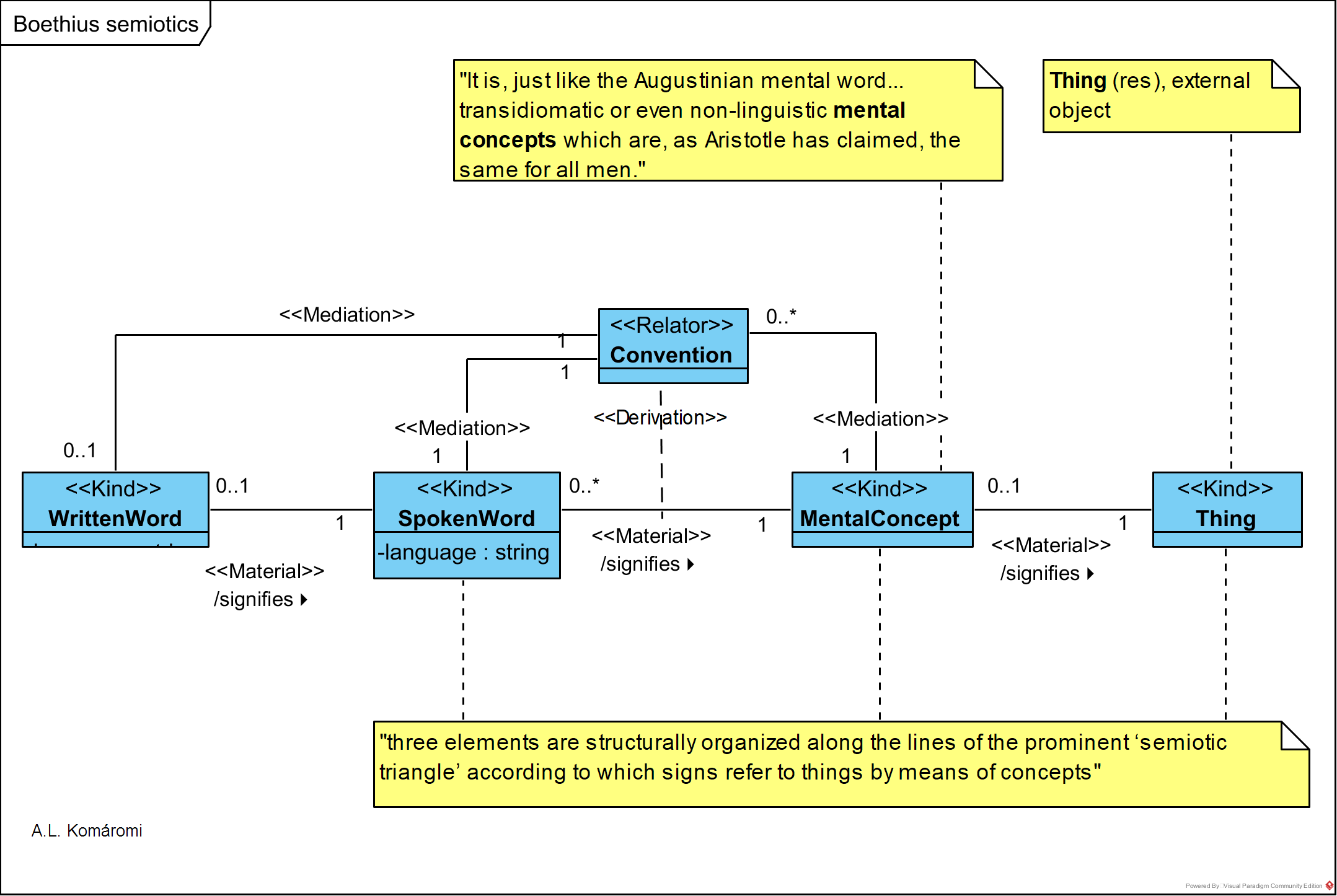
Boethius semiotics
ClassDescriptionRelations
ThingThing, (res) or external object.Assotiation with ends of 1:0..1 showing that Thing is necessary while MentalConcept is contingent.
MentalConceptMental Concept (passiones, intellectus): “It is, just like the Augustinian mental word… transidiomatic or even non-linguistic mental concepts which are, as Aristotle has claimed, the same for all men.”Assotiation with ends of 1:0..* showing that MentalConcept is necessary while SpokenWord is contingent, and can have more instances depending on language.
ConventionConvention: Boethius, as Aristotle [1.3.3] thinks that MentalConcepts are linked to SpokenWords by convention in a specific language.
SpokenWordSpokenWord (voces) Assotiation with ends of 1:0..1 showing that SpokenWord is necessary while WrittenWord is contingent.
WrittenWordWrittenWord (scripta)

Sources

  • All citations from: Meier-Oeser, Stephan, “Medieval Semiotics“, The Stanford Encyclopedia of Philosophy (Summer 2011 Edition), Edward N. Zalta (ed.)
  • Nöth , Winfried: Handbook of Semiotics, Indiana University Press, 1990

First published: 20/06/2019

[2.6.8] St Augustine’s Just War Theory

St Agustine (354-430 AD) in the City of God (De Civitate Dei) and other works proposes a theory of how to initiate and conduct a just war. He thinks that:

  • Because of the pride, vanity, and fallen nature of man, wars between political states (see [2.6.7]), sects, religions are present in the world.
  • Wars have a coercive role in God’s plan for humanity.
  • Killing in wars is permissible even for Christian soldiers – as agents of the law, if the killing avoids a greater evil.
  • Christians involved in wars should decide and conduct wars in a just way.

In the UML Activity Diagram below, I propose a representation of the “business” process of decision-making and conducting a just war. The actions marked with yellow and cyan are St Augustine’s criteria.

Augustine’s just war theory
ACTIVITY/ActionAction/Description
DECISION ABOUT JUST WAR Check if there is a just cause for war: “such as to defend the state from external invasion; to defend the safety or honor of the state, with the realization that their simultaneous defense might be impossible; to avenge injuries; to punish a nation for failure to take corrective action for wrongs (legal or moral) committed by its citizens; to come to the defense of allies; to gain the return of something that was wrongfully taken; or to obey a divine command to go to war (which, in practice, issues from the political head of state acting as God’s lieutenant on earth); and in any case, the just cause must be at least more just than the cause of one’s enemies”.

Check if there is a rightly intended will for war: “which has the restoration of peace as its prime objective, takes no delight in the wickedness of potential adversaries, views waging war as a stern necessity, tolerates no action calculated to provoke a war, and does not seek to conquer others merely for conquest’s sake or for territorial expansion”.

Check if the war is declared by a competnet authority

Check if the war is the last resort in order to achieve the objective of the just cause.
Declare war Declare war by a competent authority
CONDUCT JUST WAR Plan military action

Check if the military action is proportional to “the wrong to be avenged, with violence being constrained within the limits of military necessity”

Check if the military action discriminates between objects of violence (that is, combatants) and noncombatants, such as women, children, the elderly, the clergy”

Check if the military action observes good faith in its interactions with the enemy, by scrupulously observing treaties and not prosecuting the war in a treacherous manner.”

Conduct military action

Check if war’s objective is reached

Sources

First published: 30/1/2020