[2.3] The Sceptic Mind according to Carneades

“The contribution for which Carneades (214-129/8 BC) is best known, however, came in response to the Stoics’ counter-argument in defense of the cognitive impression [2.2.1]. They contended that, without cognitive impressions, human beings would be deprived of any basis for action or inquiry. In reply Carneades argued that such a basis could be found in so-called probable impressions (from “probabilis,” that which lends itself to or invites approval, Cicero’s Latin for the Greek “pithanos,” persuasive).”

The following UML Use Case diagram shows the main concepts in the Sceptic epistemology:
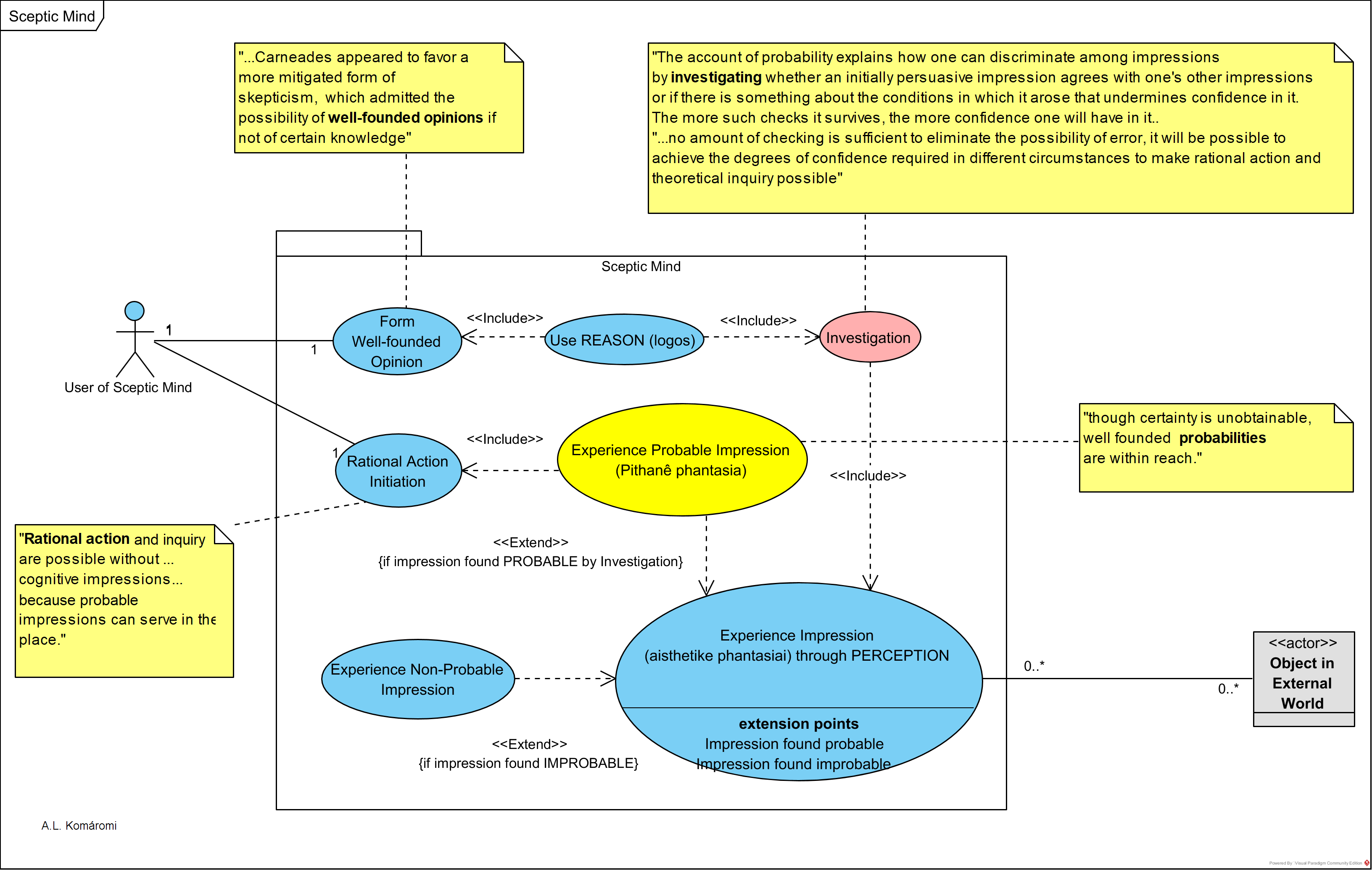
The sceptic mind according to Carneades
FacultyRelated Use Case
PERCEPTIONExperience Impression (aisthetike phantasiai) through PERCEPTION
PERCEPTIONExperience Probable Impression (Pithanê phantasia): “though certainty is unobtainable, well founded  probabilities are within reach.” – Experience Non-Probable Impression
PERCEPTIONExperience Non-Probable Impression – if impression found IMPROBABLE
PERCEPTIONRational Action Initiation: “Rational action and inquiry are possible without… cognitive impressions… because probable impressions can serve in their place.”
REASONUse REASON (logos)
REASON Investigation: “The account of probability explains how one can discriminate among impressions by investigating whether an initially persuasive impression agrees with one’s other impressions or if there is something about the conditions in which it arose that undermines confidence in it. The more such checks it survives, the more confidence one will have in it..
“…no amount of checking is sufficient to eliminate the possibility of error, it will be possible to achieve the degrees of confidence required in different circumstances to make rational action and theoretical inquiry possible”
REASON Form Well-founded Opinion: “…Carneades appeared to favor a more mitigated form of skepticism,  which admitted the possibility of well-founded opinions if not of certain knowledge”

The source of all citations and more about the topic in: Allen, James, “Carneades“, The Stanford Encyclopedia of Philosophy (Winter 2012 Edition), Edward N. Zalta (ed.)

First published: 02/02/2019

Updated:

  • 06/02/2019: changed relationships of Investigation and Use Case names
  • 20/03/2019: changes relation of Rational Action Initiation

[2.2.7] Virtue, Vice and Indifferent in Stoic Ethics

Stoic virtue ethics teaches that relative to the goal of living for a sage (see [2.2.1]):

  • virtue is the only good thing, necessary and sufficient for a happy life,
  • however, there are preferred indifferent things, those who hold value.

The OntoUML diagram below presents the main categories of stoic virtue ethics:

Virtue, vice and indifferent in stoic ethics
ClassDescriptionRelations
Human A human person has a goal of living. has GoalOfLiving; participates in Indifferent
GoalOfLiving“Aristotle’s ethics provides the form for the adumbration of the ethical teaching of the Hellenistic schools. One must first provide a specification of the goal or end (telos) of living.is (relates to) Happiness
Happiness“A bit of reflection tells us that the goal that we all have is happiness or flourishing (eudaimonia). But what is happiness?… Zeno’s answer was ‘a good flow of life’ or ‘living in agreement,’ and Cleanthes clarified that with the formulation that the end was ‘living in agreement with nature’. Chrysippus amplified this to (among other formulations) ‘living in accordance with experience of what happens by nature;’ later Stoics inadvisably, in response to Academic attacks, substituted such formulations as ‘the rational selection of the primary things according to nature.'”characterizes Human
Knowledge“Stoics identify the moral virtues with knowledge. […] Thus a specific virtue like moderation is defined as ‘the science (epistêmê) of what is to be chosen and what is to be avoided and what is neither of these’ (Arius Didymus, 61H). More broadly, virtue is ‘an expertise (technê) concerned with the whole of life’ (Arius Didymus, 61G). Like other forms of knowledge, virtues are characters of the soul’s commanding faculty which are firm and unchangeable.”characterizes Human
Virtue“The only things that are good are the characteristic excellences or virtues of human beings (or of human minds): prudence or wisdom, justice, courage and moderation, and other related qualities. “subkind of Knowledge
Prudence, Wisdom, Justice, Courage, ModerationPrudence, wisdom, justice, courage and moderation are virtuessubkind of Virtue
Good“The best way into the thicket of Stoic ethics is through the question of what is good, for all parties agree that possession of what is genuinely good secures a person’s happiness. The Stoics claim that whatever is good must benefit its possessor under all circumstances.” characterizes Virtue
Vice“only vice is genuinely bad” characterizes Human
Bad“only vice is genuinely badcharacterizes Vice
Indifferent “there are situations in which it is not to my benefit to be healthy or wealthy. (We may imagine that if I had money I would spend it on heroin which would not benefit me.) Thus, things like money are simply not good, in spite of how nearly everyone speaks, and the Stoics call them indifferents’ – i.e., neither good nor bad.” participates in Human
NotGood
NotBad
Not good and not bad characterizes Indifferent
Preferred
Indifferent
“Some indifferent things, like health or wealth, have value (axia) and therefore are to be preferred [indifferent], even if they are not good, because they are typically appropriate, fitting or suitable (oikeion) for us.”is Indifferent
Value Value (axia) is a property of being “appropriate, fitting or suitable (oikeion)”. characterizes PreferredIndifferent
NotPreferred Indifferent Indifferents not characterized by Value.is Indifferent

Sources

  • All citations from: Baltzly, Dirk, “Stoicism”The Stanford Encyclopedia of Philosophy (Spring 2019 Edition), Edward N. Zalta (ed.)

First published: 5/12/2019
Updated: 27/11/2020
Updated: 21/2/2022