[4.9.6] St Thomas Aquinas on the Composition of the Human Being

St Thomas Aquinas ( “Doctor Angelicus”, 1225 – 1274 AD), in his book Summa Theologiae, explains the structure of the human being and of the soul:

  • Humans (like other living beings) have vital activities, like nutrition, growth, sense perception. Intellection is a specific human vital activity. Principles of life are explanations of the vital activities, e.g., eyes are the principle of sight.
  • Human organs/body and soul are principles of life. The soul can not be reduced to the function of any organ/body.
  • The human is a composition of body and soul, following the Aristotelian hylomorphic structure (see [1.3.7]).
  • The human soul is the substantial form (see [4.9.1]) of the human.
  • The human soul is incorporeal, subsistent, and immortal.

The following OntoUML diagram presents Aquinas’s explanation of the structure of the human being:
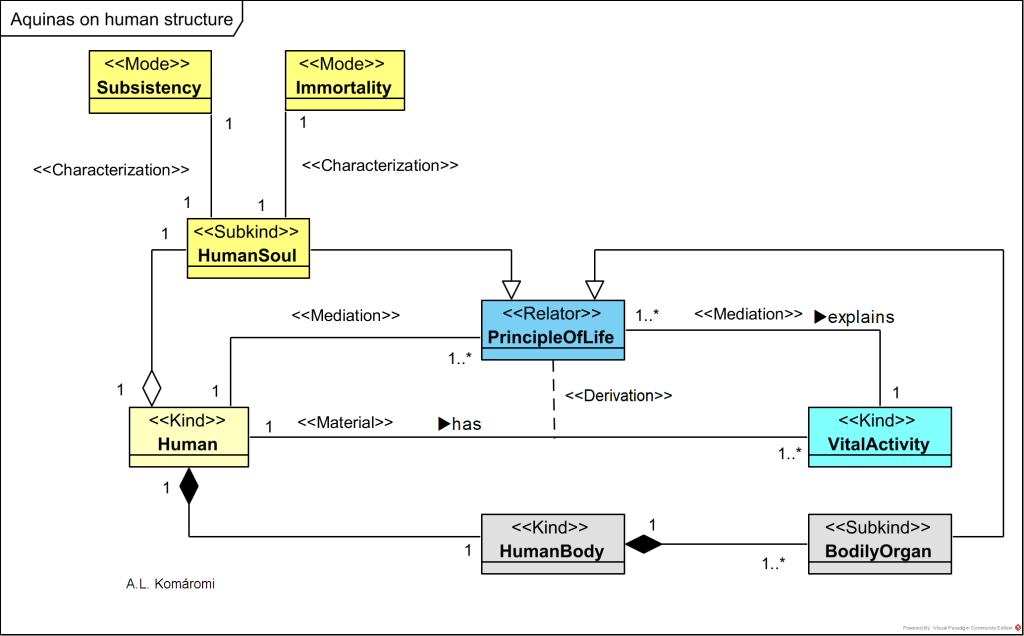
Aquinas on the composition of the human being
ClassDescriptionRelations
HumanA human being, rational animal.has VitalActivity
HumanBodyA human body. is exclusive part of Human
BodilyOrgan“Of course, eyes must be included in a correct explanation of vision – and, he might have said, skin in the explanation of touch, roots or stomachs in explanations of growth, and so on. That is, vital activities typically do have bodies [BodilyOrgans] among their principles. And since a principle of a particular vital activity may indeed be considered a principle of life (although only in that particular respect and to an appropriately restricted extent), it may be granted that some bodies-such as a living animal’s normal eyes – are principles of life. It is in that special, limited sense that the ancient materialists were on the right track. But no one, Aquinas thinks, would call an eye (or a root, or a stomach) a soul. So, he says, some principles of life clearly are bodies, but those that are aren’t souls.”is PrincipleOfLife; is exclusive part of HumanBody
HumanSoul“In order to inquire into the nature of the soul, we have to presuppose that [human] ‘soul’ (anima) is what we call the first principle of life in things that live among us; for we call living things ‘animate’ [or ‘ensouled’], but things that are devoid of life ‘inanimate’ [or “not ensouled”] (Aquinas, Summa Theologiae)
“Therefore, the first principle of life in a living body, its soul, is no bodily part of that body, but rather its form, one of the two metaphysical parts of the composite of matter and form
that absolutely every body is. […]
Aquinas thinks of the human soul not as three nested, cooperating substantial forms, however, but as the single form that gives a human being its specifically human mode of existence, including potentialities and functions, from its genetic makeup on up to its most creative talents. […]
We have already seen Aquinas arguing that no soul considered as the ultimate (or first) intrinsic principle of a corporeal creature’s vital activities can be identified with anything corporeal. And since he here expressly identifies the soul of a human being with the principle of the distinctively human vital activity of intellection, we could have anticipated his claim that that principle must be incorporeal. Like the human hand, the human soul is in the human being not as heat is in a coal but as a part is in a whole, and so it is ‘capable of subsisting on its own’ […] the soul’s status is subtler and loftier than the hand’s. […] unlike the hand or any other bodily part of the rational animal, the human soul ‘as the [substantial] form of the body has the role of fulfilling or completing (perficiens) the human species’ – that is, the soul is not only the rationality but, indeed, the full rational animality of the human body, specifying that corporeal thing as a human being. Without the soul that body is a corpse, which can be called a human body only equivocally.”
is PrincipleOfLife; is part of Human
Subsistency“he reveals not only what distinguishes human beings from all other animals but also what makes the human soul peculiar: its status as ‘subsistent,’ a necessary condition for its existing apart from the body whose form it is. […]
According to Aquinas, the subsistence of the human soul follows from this strong thesis of its incorporeality. The vital activity of intellective cognition, which distinguishes the human soul from all other terrestrial souls, is one that it performs ‘oil its own (per se), in which the body does not share,’ not even to the extent of supplying an organ for the activity. But nothing can operate on its own in this strong sense except something ‘that subsists on its own.’ A glowing coal, which does subsist on its own, can warm something else; but heat, an accidental form whose real existence is utterly dependent on its occurring in some matter, is just for that reason incapable of warming anything on its own. The human soul, therefore, is ‘something incorporeal and subsistent’ (ST Ia.75.2c).”
characterizes HumanSoul
Immortality“Aquinas’s subsistence thesis, which clearly is incompatible with materialism of any sort, brings with it both an advantage and a difficulty for his theory of the soul. On the positive side, it establishes a necessary condition of immortality: if the distinctively human, personal aspect of the human animal is something incorporeal and subsistent, biological death need not be the death of the person. The human soul’s subsistence on its own is the philosophical basis for a reasoned account of personal immortality.”characterizes HumanSoul
PrincipleOfLifePrinciples of life (principia) are explanations of vital activities.relates Human with VitalActivity; (explains VitalActivity)
VitalActivity“the presence in living things of certain distinctive activities, which, because they naturally imply life (vita) at some level or other, are called “vital” [activities]– for example, growth or cognition.”

Sources

  • All citations from:  The Cambridge Companion to Aquinas, CAMBRIDGE UNIVERSITY PRESS, Edited by  Norman Kretzmann and Eleonore Stump, 2010
  • Kerr, Gaven : “Aquinas: Metaphysics”Internet Encyclopedia of Philosophy
  • McInerny, Ralph and John O’Callaghan, “Saint Thomas Aquinas”The Stanford Encyclopedia of Philosophy (Summer 2018 Edition), Edward N. Zalta (ed.)

First published: 15/10/2020

[4.9.4] St Thomas Aquinas on the Classification of Sciences

St Thomas Aquinas ( “Doctor Angelicus”, 1225 – 1274 AD), in his book On The Divisions and Methods of the Sciences: Questions V and VI of his Commentary on the De Trinitate of Boethius writes about the division of sciences (see also [1.3.10])

  • Sciences can be speculative or practical, depending on their relation to truth. Speculative sciences contemplate, while practical sciences apply truth.
  • We can analyze the object of study of the speculative sciences based on their dependence on the existence and understanding of matter and motion.
  • Based on this analysis, the complete list of speculative sciences is physics, mathematics, and metaphysics.
  • Ethics, economics and politics are practical sciences.

The following OntoUML diagram presents Aquinas’s division of sciences:

Aquinas on the division of sciences
ClassDescriptionRelations
Science“There are [..] two distinct classes of science: speculative science and practical science. Speculative sciences are those that contemplate truth whereas practical sciences are those that apply truth for some practical purpose. The sciences are then further distinguished through differentiating their various subject-matters.”studies SubjectMatter
Understanding“Working within the Aristotelian tradition, Thomas holds that something is understood when it is separated from matter and is necessary to thing in some respect. For instance, when we understand the nature of a tree, what we understand is not primarily the matter that goes to constitute the tree in question, but what it is to be a tree, or the structuring principle of the matter that so organizes it and specifies it as a tree rather than a plant. Furthermore, assuming our understanding is correct, when we understand a thing to be a tree, we do not understand it to be a dog, or a horse, or a cat. Thus, in our understanding of a tree, we understand that which is necessary for the tree to be a tree, and not of anything that is not a tree. Hence, our understanding of a thing is separated from its matter and is necessary to it in some respect. Now, what is in motion is not necessary, since what is in motion can change. Thus, the degree to which we have understood something is conditional upon the degree to which it is separated from matter and motion. It follows then that speculative objects, the subject-matter of the speculative-sciences, insofar as they are what are understood, will be separated from matter and motion to some degree. Any distinctions that obtain amongst speculative objects will in turn signify distinctions amongst the sciences that consider those objects; and we can find distinctions amongst speculative objects based upon their disposition towards matter and motion.”relates between Science and SubjectMatter
PracticalSciencepractical sciences are those that apply truth for some practical purpose.”subkind of Science; applies Truth
Ethics; Economics PoliticsEthics, economics and politics are practical sciences.subkind of PracticalScience
SpeculativeScienceSpeculative sciences are those that contemplate truth […]
There are three divisions that can apply to speculative objects, thereby permitting us to differentiate the sciences [to physics, mathematics and metaphysics…]
Thomas takes this division of the speculative sciences as exhaustive. For Thomas, there could be no fourth speculative science; the reason for this is that the subject-matter of such a science would have to be those things that depend on matter and motion for their being understood but not for their being, for all other combinations have been exhausted. Now, if a thing depends on matter and motion for its being understood but not for its being, then matter and motion would be put into its definition, which defines a thing as it exists. But if a thing’s existence is so defined as to include matter and motion, then it follows that it depends on matter and motion for its being; for it cannot be understood to be without matter and motion. Hence, all things that include matter and motion in their definitions are dependent on matter and motion for their being, but not all things that depend on matter and motion for their being depend on matter and motion for their being understood. There could be no fourth speculative science since there is no fourth class of speculative objects depending on matter and motion for their being understood but not for their being. Thomas thus sees this threefold division of the speculative sciences as an exhaustive one.”
subkind of Science; contemplates Truth
Physics“(i) physical science considers those things that depend on matter and motion both for their being and for their being understood”subkind of SpeculativeScience; studies ObjectOfStudy OfPhysics
Mathematics “(ii) mathematics considers those things that depend on matter and motion for their being but not for their being understood”subkind of SpeculativeScience; studies ObjectOfStudy OfMathematics
Metaphysics“(iii) metaphysics or theology deals with those things that depend on matter and motion neither for their being nor for their being understood.”subkind of SpeculativeScience; studies ObjectOfStudy OfMetaphysics
SubjectMatter“In order to ascertain the subject-matter of any particular science, Thomas distinguishes between the different intellectual operations that we use when engaged in some particular scientific endeavor. Broadly speaking, these fall into two categories: the speculative and the practical. Concerning some sciences, the intellect is merely speculative  by contemplating the truth of some particular subject-matter; while concerning other sciences, the intellect is practical, by  ascertaining the truth and seeking to apply. There are thus correspondingly two distinct classes of science: speculative science and practical science. Speculative sciences are those that contemplate truth whereas practical sciences are those that apply truth for some practical purpose. The sciences are then further distinguished through differentiating their various subject-matters.”
ObjectOfStudy OfPhysics“(i) there is a class of speculative objects [object of study of physics] that are dependent on matter and motion both for their being and for their being understood, for instance, human beings cannot be without matter, and they cannot be understood without their constituent matter (flesh and bones)”subkind of SubjectMatter
ObjectOfStudy OfMathematics“(ii) there is a class of speculative objects [object of study of mathemathics] that depend on matter and motion for their being, but not for their being understood, for instance, we can understand lines, numbers, and points without thereby understanding the matter in which they are found, yet such things cannot be without matter”subkind of SubjectMatter
ObjectOfStudy OfMetaphysics” (iii) there is a class of speculative objects [object of study of metaphysics] that depend on matter and motion neither for their being nor for their being understood.
[…] As it is a purely rational science, not dependent on or presupposing the truths of revelation, metaphysics will be a study of the neutrally immaterial aspects of things, that is, a study of those modes of being that apply to all beings, whether they are material or immaterial. 
Thomas does not adopt the Aristotelian phrase (being qua being) as the subject-matter of metaphysics, he offers his own term. According to Thomas, ens commune (common being) is the proper subject-matter of metaphysics. Through an investigation of ens commune, an investigation into the aspects of being common to all beings, the metaphysician may indeed come to a knowledge of the causes of being and might thereby be led to the affirmation of divine being, but this is only at the end of the metaphysical inquiry, not at the beginning.”
subkind of SubjectMatter

Sources

  • All citations from:  Kerr, Gaven : “Aquinas: Metaphysics”Internet Encyclopedia of Philosophy
  • McInerny, Ralph and John O’Callaghan, “Saint Thomas Aquinas”The Stanford Encyclopedia of Philosophy (Summer 2018 Edition), Edward N. Zalta (ed.)
  • The Cambridge Companion to Aquinas, CAMBRIDGE UNIVERSITY PRESS, Edited by  Norman Kretzmann and Eleonore Stump, 2010

First published: 01/10/2020