[4.20.1] Marsilius of Padua on the Role the of Supreme Ruler

Marsilius of Padua (1243? – 1316) in the work Defensor pacis (1324) rejected the doctrine of absolute papal power of Boniface VIII. sustained by Giles of Rome. He thinks that:

  • There is one and only one supreme ruler who holds all coercive power in a community.
  • “The supreme ruler cannot be a cleric, since Christ has forbidden the clergy to become involved in temporal affairs (113–40/159–92). And the supreme ruler does not enforce divine law as such, since God wills that divine law should be enforced by sanctions only in the next world, to give every opportunity for repentance before death (164, 175–9/221, 235–9).”
  • Clerics, members of the general council, and the Pope all have doctrinal authority.
  • All people have the right to ownership and property except Clerics.
  • Coercive power, doctrinal authority, and property are subkinds of power.

See also Giles of Rome on Papal Power.

The following OntoUML diagram explains the view Marsilius of Padua power:
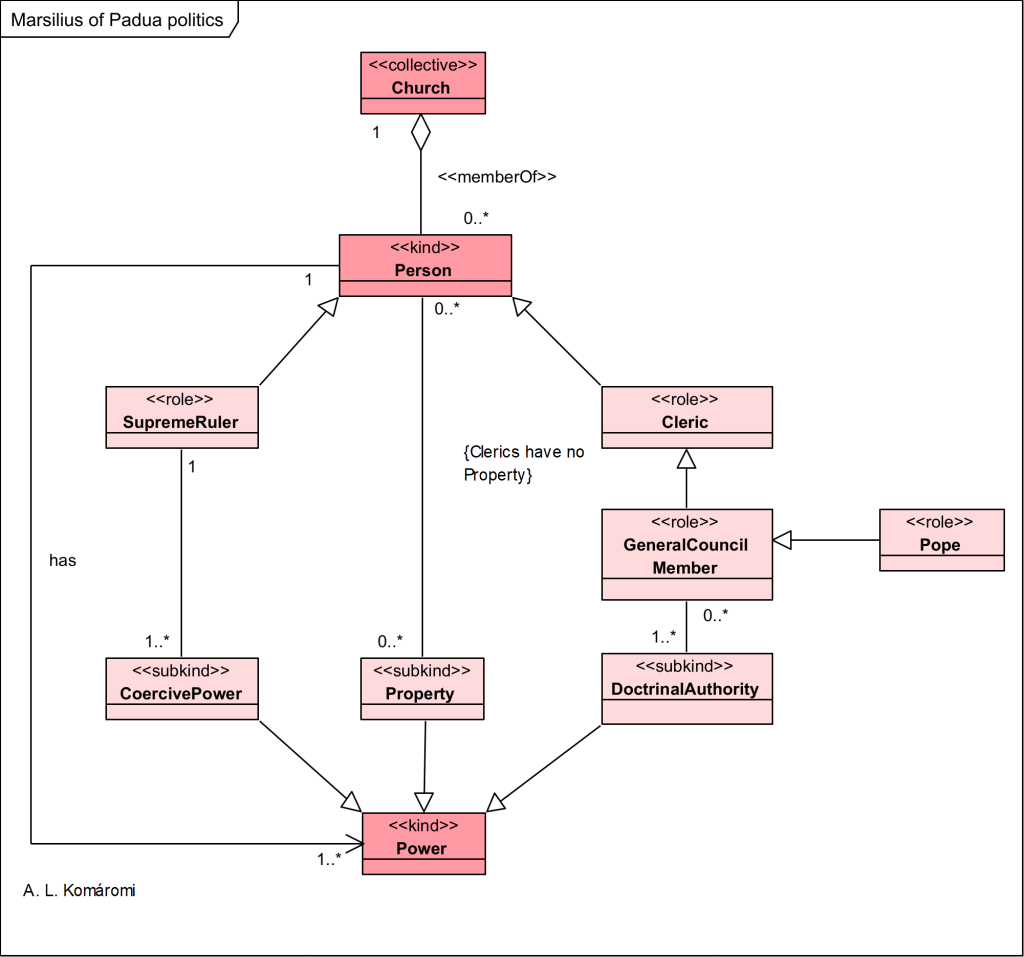
Marsilius on power
ClassDescriptionRelations
ChurchThe church has members.
PersonA human personmember of Church; has Power
SupremeRuler“He argues that all coercive power comes from the people (44–9, 61–3/65–72, 88–90), and that no people can have more than one supreme ruler, who is the source of all coercive power in that community (80–6/114–22). The supreme ruler cannot be a cleric, since Christ has forbidden the clergy to become involved in temporal affairs (113–40/159–92). And the supreme ruler does not enforce divine law as such, since God wills that divine law should be enforced by sanctions only in the next world, to give every opportunity for repentance before death (164, 175–9/221, 235–9). The supreme ruler is therefore not an enforcer of religion and his rule is not subject to direction by the clergy.”role of Person
Cleric“the pope has from Christ no more authority than any other clericrole of Person
GeneralCouncilMemberMarsilius did believe that the Church exercised some authority over its members, but, so far as this was a doctrinal authority, it was exercised not by the pope but by a general council member (Marsilius held that the Bible and general councils are infallible, but not the pope (274–9/360–66)).”role of General Council Member
Pope“Within the Church, the Pope has from Christ no more authority than any other cleric. Christ did not appoint Peter as head of the Church, Peter never went to Rome, the bishop of Rome is not Peter’s successor as head of the Church (pp. 44–9/61–3)”role of Pope
CoercivePower“He argues that all coercive power comes from the people (44–9, 61–3/65–72, 88–90), and that no people can have more than one supreme ruler, who is the source of all coercive power in that community (80–6/114–22).” subkind of Power
DoctrinalAuthority“Marsilius did believe that the Church exercised some authority over its members, but, so far as this was a doctrinal authority, it was exercised not by the pope but by a general council (Marsilius held that the Bible and general councils are infallible, but not the pope (274–9/360–66)). Now that Europe is Christian a general council cannot be convened or its decisions enforced except by the Christian lay ruler (287–98/376–90).” subkind of Power
PropertyAll people have the right to ownership and property except Clerics.
“As for religious poverty, Marsilius sides with the Franciscans and takes their doctrine further: not only is it legitimate for religious to live entirely without ownership of property (they can use what they need with the owner’s permission), but this is what Christ intended for all the clergy (183–4, 196–215/244–6, 262–86). Thus on his view the pope and clergy should have no lordship at all, either in the sense of coercive jurisdiction or in the sense of ownership of property. His position is diametrically opposite that of Giles of Rome.”
subkind of Power
PowerPower

Sources

  • All citations from: Kilcullen, John and Jonathan Robinson, “Medieval Political Philosophy“, The Stanford Encyclopedia of Philosophy (Winter 2019 Edition), Edward N. Zalta (ed.)

First published: 4/4/2022

[4.16.2] Meister Eckhart on Analogy and Univocity

Meister Eckhart (Eckhart von Hochheim 1260 – 1328 AD) in different works written in Latin and German language (Opus Tripartitum, Rechtsfertigungschrift/Defense Document, Essential Sermons, Commentary on Genesis and Commentary on St John) writes about two types of relations with an important role in the process of creation:

  • The analogy relates the uncreated thing to the created (see also [4.16.1]), while the univocal causality has a role when a thing creates itself.
  • Analogy describes the relation between God (uncreated) and all his creatures (created things).
  • We have Univocal causality when the active principle of a thing causes its passive principiate; and this way the thing creates itself. We have this kind of relationship between the persons of Trinity, sight, and object of sight, intellect and object of intellect, just man and justice, free man and freedom etc.

The following OntoUML diagram shows Eckhart’s model of analogy:

Eckhart’s model of analogy
ClassDescriptionRelations
ThingAn existent, a thing.
UncreatedAn uncreated thing, i.e. God.subkind of Thing; creates Created
CreatedA created thing.subkind of Thing
Analogy“Between the uncreated and the created the predominant relationship is one of  analogy, a relationship involving as well the disjunction of the two terms.”  (Mojsisch, Summerell)relates Uncreated with Created
Temporal“The univocal relation is atemporal while the analogue relation is temporal.”
(Hackett, Hart Weed)
characterizes Analogy

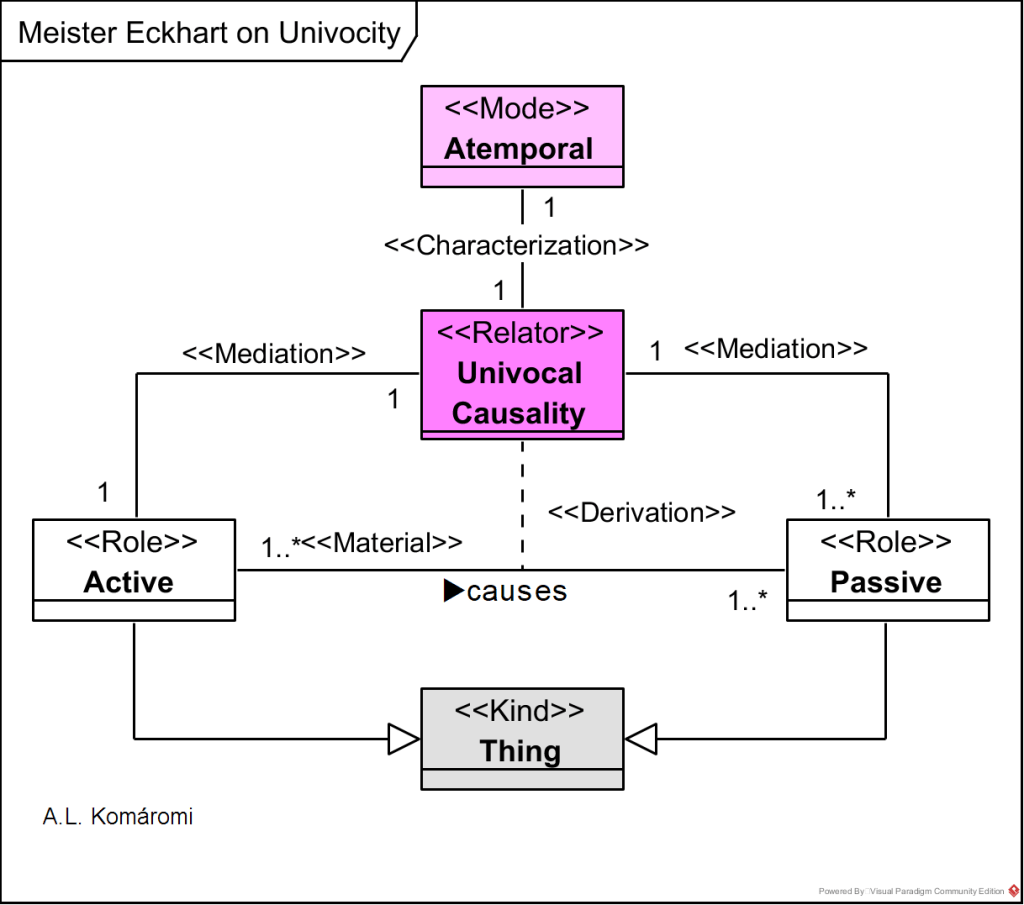
The following OntoUML diagram shows Eckhart’s model of univocal causality:

Eckhart’s model of univocal causality
ClassDescriptionRelations
ThingAn existent, a thing.
Active“This means that the active (principle) is at the same time active and passive, being affected in the course of its activity (as principle). In turn, the passive (principiate) is at the same time passive  and active, being active in the course of its passivity (as principiate). Accordingly, a central proposition of Eckhart reads as follows: ‘[Principium et principiatum]… opponuntur relative: in quantum opponuntur, distinguuntur, sed in quantum relative, mutuo se ponunt …‘ (Echardus, In Ioh. n. 197; LW III, 166, 10–12: ‘[The principle and the principiate] … are opposed to one another relatively: Insofar as they are opposed, they are distinguished, but insofar as they are relative, they reciprocally posit themselves …’).  (Mojsisch, Summerell) role of Thing; causes Passive
Passive“This means that the active (principle) is at the same time active and passive, being affected in the course of its activity (as principle). In turn, the passive (principiate) is at the same time passive  and active, being active in the course of its passivity (as principiate). Accordingly, a central proposition of Eckhart reads as follows: ‘[Principium et principiatum]… opponuntur relative: in quantum opponuntur, distinguuntur, sed in quantum relative, mutuo se ponunt …‘ (Echardus, In Ioh. n. 197; LW III, 166, 10–12: ‘[The principle and the principiate] … are opposed to one another relatively: Insofar as they are opposed, they are distinguished, but insofar as they are relative, they reciprocally posit themselves …’).  (Mojsisch, Summerell) role of Thing;
Univocal causality“Eckhart, however, breaks through that metaphysics of being with its analogical base by thinking through the relation of causality informing absolute being. We can assume at least hypothetically that a cause causes not only something dependent on it, but also something equal to it, namely that the cause causes in such a manner that it causes itself.
But if it causes itself, it causes something which is itself also cause and at the same time cause of its cause. Such a mode of causality is called ‘univocal causality’. Our hypothesis of what could be thought in these terms turns into a certainty when we explore the structures of intellectual causality, for example, the relation between the act of thinking and what is thought, or between an ethical principle and an ethical principiate. Their relation is precisely what Eckhart takes advantage of in developing his theory of univocal causality. In these cases, it holds that the principle causes its principiate, and the principiate causes its principle. Even more: The principiate is in its principle nothing other than its principle. […]”  (Mojsisch, Summerell)

“The breakthrough that Eckhart attains through his theory of univocal causality is exemplified by the relation between thinking and thought. For Eckhart, thinking presupposes no origin because a presupposed origin could only be thought by thinking and hence would be a thought of thinking, that is, itself thinking. Thinking is, then, for itself a presuppositionless origin, that is, it is its own principle: principium (Echardus, In Ioh. n. 38; LW III, 32, 11: “… ipsum principium semper est intellectus purus …”: “The principle itself is always pure intellect …”). Any thinking without act, however, is no thinking at all. Consequently, its own originative activity accrues to thinking, that is, insofar as it is a principle, the dynamics of its principiating: principiare. In this activity, however, thinking directs itself towards a thought that it has originated, that is, towards the product that is its principiate: “principiatum. But since this thought is a thought of thinking, it is itself nothing other than thinking. The act of this thinking that has been thought is, then, retrograde. This thought, as thinking, is in turn principle, principiating and principiate, whereby this last is the original thinking. In this way, thinking thinks itself as thought and is therewith active thinking, while thought, insofar as it thinks its thinking, is itself thinking, and its thinking now thought. Consequently, both thinking and thought are at the same time active and passive.
[…]
The result of this analysis: Over against the external relationality of analogue relata, univocal correlationality involves an immanent relationality. Eckhart emphasizes the mutual relatedness of the moments univocal-casually interpenetrating one another . . . The agent imparts to the passive everything which it is able to impart, and the passive receives what has been imparted as its inheritance, not as something merely lent.” (Hackett, Hart Weed)
relates Active with Passive
Atemporal“The univocal relation is atemporal while the analogue relation is temporal.” (Hackett, Hart Weed) characterizes Univocal causality

Sources:

  • Mojsisch, Burkhard and Orrin F. Summerell, “Meister Eckhart“, The Stanford Encyclopedia of Philosophy (Summer 2011 Edition), Edward N. Zalta (ed.)
  • Hackett, Jeremiah and Hart Weed, Jennifer: “From Aquinas to Eckhart on Creation, Creature, and Analogy”, A companion to Meister Eckhart, Brill 2013, edited by Jeremiah M. Hackett.

First published: 16/7/2021