
St Bonaventure ( the “Seraphic Doctor”, 1217 – 1274 AD), in his work “Disputed Questions on the Knowledge of Christ”, writes about the epistemological role of divine light:
- God created all things (creatures) based on the Logos, its divine world. We perceive these worlds as divine ideas.
- In Bonaventure’s epistemological situation, there are “not only an object and a knowing subject, but also a third term, namely, the Divine Light“, that links the object, the subject, and the divine idea, conferring certainty for the knowledge.
- Divine Light can be of two types: natural illumination that provides knowledge and supernatural illumination that gives faith.
- Divine Light provides the certainity of the knowledge (see also [4.10.3]).
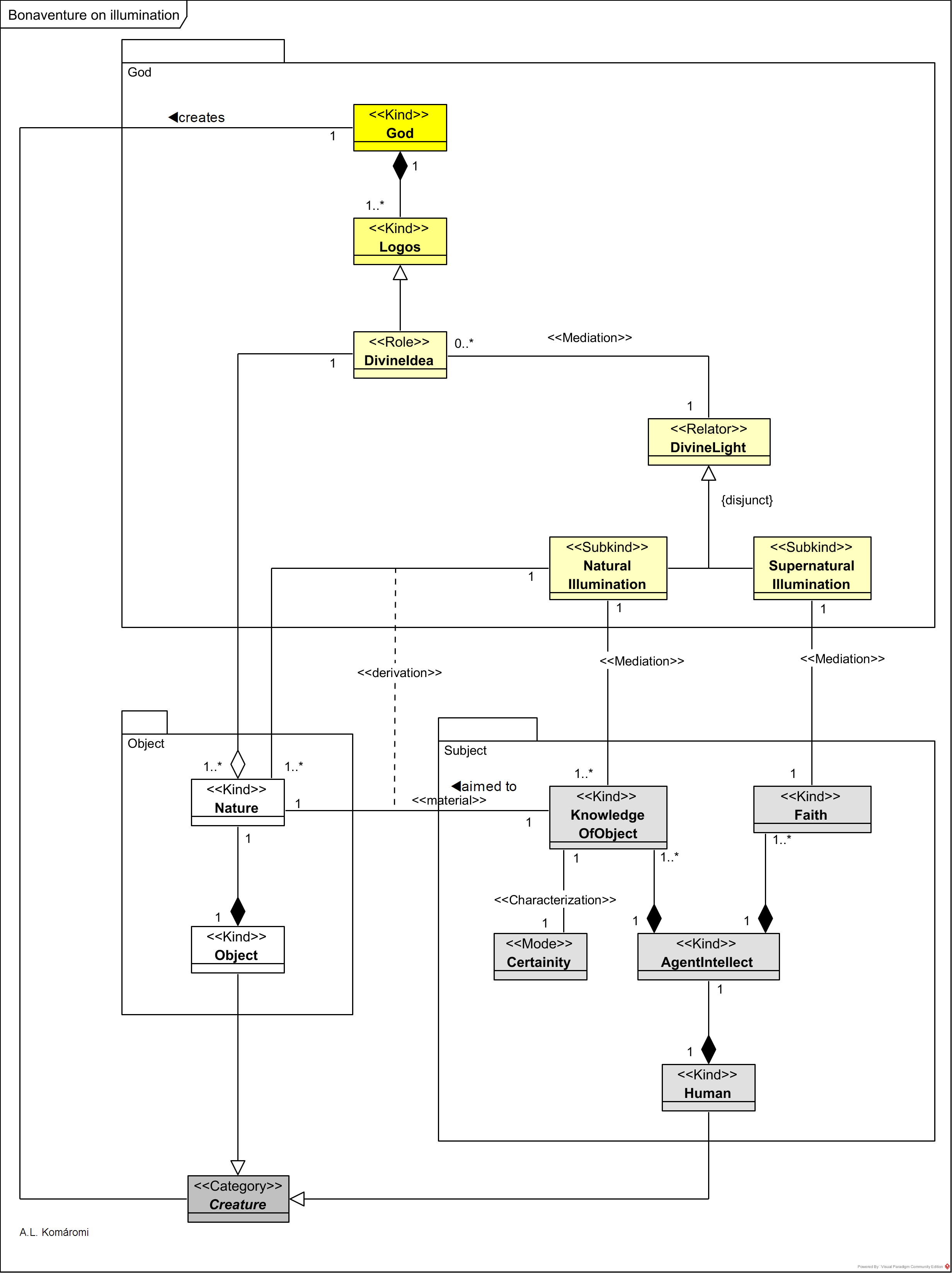
The OntoUML diagram below presents Bonaventure’s illumination model:
| Class | Description | Relations |
|---|---|---|
| God | God creates the creatures whose existence depends on him. | creates Creature |
| Logos | “If from an anthropological standpoint we can differentiate these two forms of illumination, as regards their source they ultimately arise from the same principle, namely, the divine. Though significant differences obtain between these sorts of illumination, there is a similarity in telos: both forms of illumination are ways of cognitively partaking of the divine, one naturally, another by faith. The key concept here for understanding the unity of these two forms of illumination is that of the Logos. The Logos, spoken by the Father from the beginning, has an essential, we could almost say ‘metaphysical’, characteristic which Bonaventure insists on: the Logos is the absolute Center.” (White 2008) | exclusive part of God |
| DivineIdea | “How does this cognitive participation render philosophical cognition possible? It does so by giving the archetypal source of both the being of the object and the subject’s knowledge. For Bonaventure, the divine Ideas are not self-standing entities, along the lines of typical interpretations of Plato, but are themselves the divine Logos, though looked at from a human standpoint. The Ideas are not autonomous, independent or separate but appear as such through the limited perspective of the human mind; in fact, however, they are the Logos itself. But because all things are created both by the divine and also through the divine, the creator creates according to the Ideas as exemplary ways through which finite being partakes of the perfection of the divine Logos. In other words, it is because the Ideas are perfect exemplars of things – because they are actually the Logos itself – they also illuminate the imperfect imitations of the Logos. The key issue, then, is not only that the Logos is the principle of all being and knowing but that specifically its perfection renders both the subject and the object capable of knowing and being known with certainty.” (White 2008) | role of Logos |
| DivineLight | “Bonaventure, like Augustine, distinguished between two forms of illumination: that which is foundational for philosophical knowledge and that which is foundational for the knowledge of God and his mysteries. […] For Bonaventure then, and for classical illumination theory generally, the basic cognitive situation includes not only an object and a knowing subject. but also a third term, namely, the divine light. In this respect, the light symbol should be interpreted as that by which one ‘sees’, analogous to how natural light is not necessarily the object of perception but is the means by which vision is possible.” (White 2008) | has two subkinds: NaturalIllumination and Supernatural Illumination |
| Natural Illumination | “It is a way of understanding the natures of things which does not suffer from the more extreme limits embedded in our cognitive powers and suggests a partaking in a higher intelligibility, the heavenly light. At the same time, this ‘light’ is not something which is ‘turned on’ by illuminating grace or by a divine act: it is alight ever present in the cosmos. In this context Bonaventure posits a mode of knowing which he terms ‘contuition’, a concept which suggests a “co-intuition” of both specific nature in a sensuously perceived object and the divine Idea in terms of which this object was created and according to whose intelligibility this object is thereby known. […] In any case, what this concept certainly does suggest is that the philosopher, in performing philosophical cognition, sees the object in a different light: the act permits the philosopher to grasp not only an obiect but understand it in the light of the divine Idea, which is the exemplar of its being and the ultimate source of its intelligibility. This also helps us to understand why it is that one is net always illuminated: it is because one has to learn how to see in this light, something which typically occurs only when one has been properly trained as philosopher. The crucial point in this natural or philosophical illumination, therefore, does not consist in a supernatural light being necessary for philosophical knowledge but in seeing by means of a natural light, the radiation of the divine, expressed in the cosmos. Illumination is not a new activity performed by God; it is a purification of the intellect sothat one can see what is already there.” (White 2008) | relates DivineIdea with Nature and Knowledge of object; subkind of DivineLight |
| Supernatural Illumination | “Supernatural or theological illumination, in contrast, needs to be understood on the model of an infusion. Faith is a supernatural virtue, one which is infused at baptism. And through this infusion, one partakes of God’s own life, something which is not simply an addition to human nature, but implies a participation in a higher order of being and life. As we have seen, insofar as humans act in grace, they are not only co-operators with the divine but precisely such that they act according to the infused gifts. In this respect, we can say that the ‘co- operation’ includes a far more robust activity on the part of the divine, which acts more as a principle of activity than a co-operating partner.” (White 2008) | relates DivineIdea with Faith; subkind of DivineLight |
| Object | The object of knowledge | descendant of Creature |
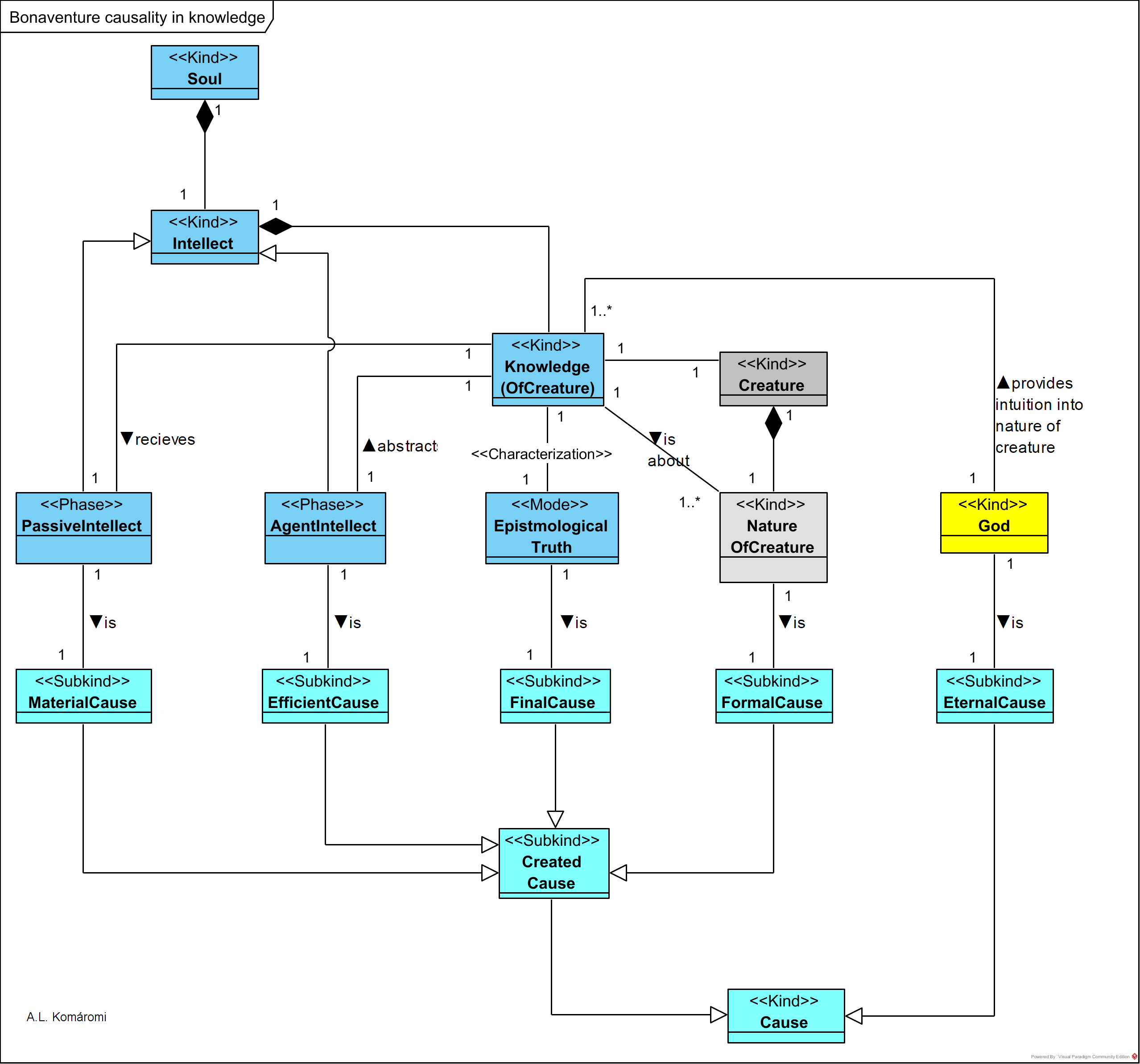
| Nature | “To explain the contribution of the ‘created’ causes of knowledge, Bonaventure noted that the content of human knowledge comes from four kinds of “created” causes: the essence [nature] of an individual creature known as formal cause, for the creature is ‘what’ we know.” (Noone, Tim, Houser, 2020) | exclusive part of Obect |
| Human | A human person | descendant of Creature |
| AgentIntellect | “Hence, unlike his contemporaries, who often thought of the human possible intellect as being illumined by God functioning as an agent intellect, Bonaventure assigns each human being an agent intellect. […] “the individual agent intellect for efficient cause, for it abstracts the content of knowledge from sensation” (Noone, Tim, Houser, 2020) | Exclusive part of Human |
| Knowledge | “For certain knowledge, eternal reason is necessarily involved as a regulative and motive cause, however, not as the sole cause or in its full clarity, but along with a created cause and as contuited by us ‘in part’ in accord with our present state of life. (Noone, Tim, Houser, 2020) | Exclusive part of the AgentIntellect |
| Certainity | The certainity of the knowledge is provides by the divine light. | characterizes Knowledge |
| Faith | “By faith, therefore, human beings participate in a higher order of being and life, an order characteristic of the angels confirmed in grace and proper to human beings only insofar as they are possessed of grace or charity. Benaventure teaches that ‘faith makes the soul or intelligence… [go] beyond every reason and investigation of the mind. It makes [the soul or intelligence] stable, because it excludes doubt and vacillation; it makes it visible because it displays its multiformed light.'” (White 2008) | Exclusive part of the AgentIntellect |
| Creature | A creature of God |
Sources
- John R. White, “The Illumination of Bonaventure: Divine Light in Theology, Philosophy and History According to Bonaventure”, Fides quaerens intellectum, 2001, vol. 1, no. 2, 201-223
- Noone, Tim and R. E. Houser, “Saint Bonaventure“, The Stanford Encyclopedia of Philosophy (Winter 2020 Edition), Edward N. Zalta (ed.)
- John R White, “Divine light and human wisdom: Transcendental elements in Bonaventure’s illumination theory,” International Philosophical Quarterly, Vol. 48, no. 2, June 2008, 175-185
First published: 7/1/2021
 Philosophy Models