[4.18.8] Wiliam Ockham on Virtues and Will

William Ockham (1285-1349 AD), in the treatise On the Connection of the Virtues and other works, elaborates a will-based ethics, where acts of will (intentions), and not actions have ethical value:

  • Human beings have a natural tendency to achieve their ultimate good, like at Aristotle [1.3.17] and Augustine [2.6.5]
  • The human will creates acts of will (intentions), which on their turn initiate ethically neutral actions. Acts of will can be virtuous and evil.
  • Virtuous acts of will manifest moral virtue, and are subordinated to the ultimate good. Ockham “measures” moral virtue in a five-grade scale. Even pagans can have moral virtue, howeve that is not enough for salvation.
  • Despite the human inclination towards the ultimate good, the human will is free to deliberately go against the zltimate good, and the choose evil. This theory antagonizes with the view on the limitations of the will held by Aquinas [4.9.9], [4.9.13].

The following OntoUML diagram presents Ockhams’s model of virtues and free will:
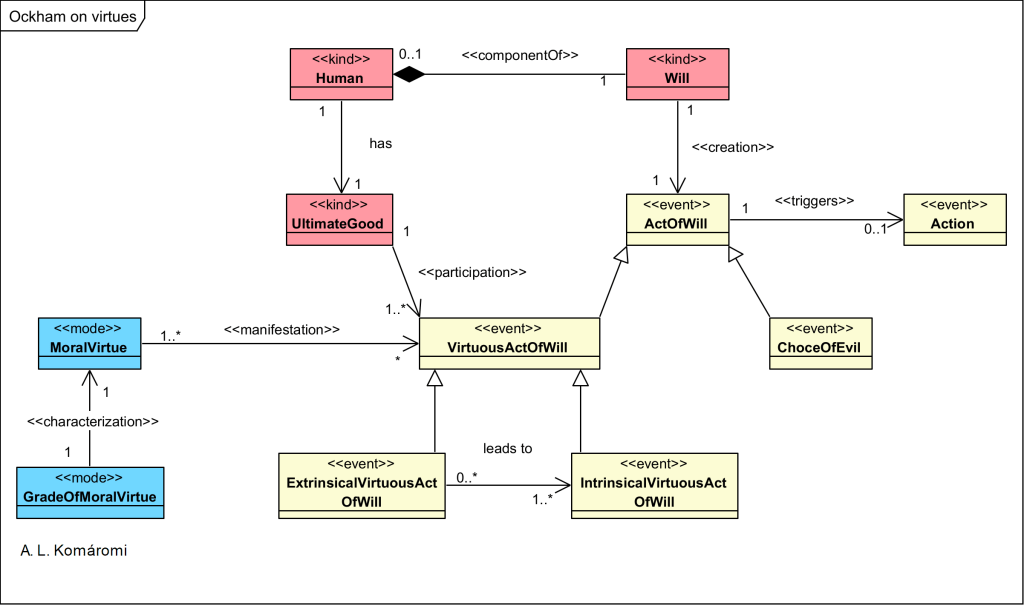
Ockham on virtues and will
ClassDescriptionRelations
HumanA human personhas UltimateGood
UltimateGood“Ockham [..] is very suspicious of the notion of final causality (teleology) in general, he thinks it is quite appropriate for intelligent, voluntary agents such as human beings. Thus the frequent charge that Ockham severs ethics from metaphysics by denying teleology seems wrong. Nevertheless, while Ockham grants that human beings have a natural orientation, a tendency toward their own ultimate good, he does not think this restricts their choices.”participates in VirtuousActOfWill
Will“Ockham’s ethics combines a number of themes. For one, it is a will-based ethics in which intentions [will] count for everything and external behavior or actions count for nothing. In themselves, all actions are morally neutral.”component of Human; creates ActOfWill
ActOfWillFor Ockham, acts of will are morally virtuous either extrinsically, i.e. derivatively, through their conformity to some more fundamental act of will, or intrinsically. On pain of infinite regress, therefore, extrinsically virtuous acts of will must ultimately lead back to an intrinsically virtuous act of will. That intrinsically virtuous act of will, for Ockham, is an act of “loving God above all else and for his own sake.”ActOfWill initiates Action
Action“In themselves, all actions are morally neutral.”
VirtuousActOfWill“For Ockham, acts of will are morally virtuous [virtuous act of will] either extrinsically, i.e. derivatively, through their conformity to some more fundamental act of will, or intrinsically.”inherits from ActOfWill
ExtrinsicalVirtuousActOfWill“On pain of infinite regress, therefore, extrinsically virtuous acts of will must ultimately lead back to an intrinsically virtuous act of will. ”inherits from VirtuousActOfWill; leads to IntrinsicalVirtuousActOfWill
IntrinsicalVirtuousActOfWill“That intrinsically virtuous act of will, for Ockham, is an act of ‘loving God above all else and for his own sake.’inherits from VirtuousActOfWill
MoralVirtuemoral virtue is possible even for the pagan, moral virtue is not by itself enough for salvation. In short, there is no necessary connection between virtue—moral goodness—and salvation. Ockham repeatedly emphasizes that ‘God is a debtor to no one‘; he does not owe us anything, no matter what we do.”manifests in VirtuousActOfWill
GradeOfMoralVirtueIn his early work, On the Connection of the Virtues, Ockham distinguishes five grades or stages of moral virtue, which have been the topic of considerable speculation in the secondary literature:
1/ The first and lowest stage is found when someone wills to act in accordance with “right reason”—i.e., because it is “the right thing to do.”
2/ The second stage adds moral “seriousness” to the picture. The agent is willing to act in accordance with right reason even in the face of contrary considerations, even—if necessary—at the cost of death.
3/ The third stage adds a certain exclusivity to the motivation; one wills to act in this way only because right reason requires it. It is not enough to will to act in accordance with right reason, even heroically, if one does so on the basis of extraneous, non-moral motives.
4/ At the fourth stage of moral virtue, one wills to act in this way “precisely for the love of God.” This stage “alone is the true and perfect moral virtue of which the Saints speak.”
5/ The fifth and final stage can be built immediately on either the third or the fourth stage; thus one can have the fifth without the fourth stage. The fifth stage adds an element of extraordinary moral heroism that goes beyond even the “seriousness” of stage two.
characterizes MoralVirtue
ChoiceOfEvil“For Ockham, as for Aristotle and Aquinas, I can choose the means to achieve my ultimate good. But in addition, for Ockham unlike Aristotle and Aquinas, I can choose whether to will that ultimate good. The natural orientation and tendency toward that good is built in; I cannot do anything about that. But I can choose whether or not to to act to achieve that good. I might choose, for example, to do nothing at all, and I might choose this knowing full well what I am doing. But more: I can choose to act knowingly directly against my ultimate good, to thwart it. I can choose evil as evil. [choice of evil]inherits from ActOfWill

Sources:

  • All citations from: Spade, Paul Vincent and Claude Panaccio, “William of Ockham”The Stanford Encyclopedia of Philosophy (Spring 2019 Edition), Edward N. Zalta (ed.)

First published: 13/1/2022

[4.15.11] John Duns Scotus on Natural Law

John Duns Scotus (the “Subtle Doctor,” 1265/66–1308 AD), in his work “Ordinatio” writes about the natural law in the context of the Decalogue (Ten Commandments):

  • Natural law, in the strict sense, contains only the self-evident moral propositions, along with those that can be derived from them deductively. These are necessary, non-contradictory propositions, unchangeable even by God’s will. These are the commandments I, II, and probably III.
  • The natural law in the wider sense contains moral propositions that agree with those in the strict sense, but their opposites not. These are the commandments from the second tablet (VI-X).
  • The natural laws in the wider sense are contingent; they depend entirely on God’s free will.
  • Some commandments prescribing ceremonies and customs belong to the positive law.

The following UML Use Case diagram presents Scotus’s model of natural law:

Scotus on natural law
ClassDescriptionRelations
LawLaw
NaturalLaw“The ‘nature’ appealed to by classical and medieval theories of natural law – however it might have been conceived by any particular thinker – was invariably associated with two criteria: it represented an authoritative standard, with determinate content, that was understood as both universal (that is, not prescriptive for just one individual) and accessible to human beings through their natural powers. Because natural law rests on a nature that cannot be changed by human action, it has universal validity. Because human beings themselves belong to that nature, they are in principle capable of knowing the corresponding law. […]
This linking of natural law to eternal law does not merely place the natural law beyond the power of human beings to change. It also raises most pointedly the question of whether, and in what way, the natural law can be changed by divine action. […]
Scotus follows the main thread of this way of posing the problem when he devotes Ordinatio 3, d. 37, the central text in which he develops his conception of natural law, to the question of whether all the commandments of the Decalogue belong to the natural law. […]
Scotus understands all the commandments, both those that belong to natural law in the strict sense and those that belong to it only in the wider sense, as practical truths (vera practica): the former because they are self-evident, the latter because of their accordance or agreement (consonantia) with the former”
subkind of Law
NaturalLawStrictSense“Scotus first offers a purely formal criterion for belonging to natural law: a commandment belongs to natural law in the strict sense if, simply on the basis of the content expressed in the commandment, it is conceptually necessary that the commandment be valid. Nowhere in his work does Scotus trace the content of the natural law back to the eternal law; in fact, the doctrine of eternal law has
no importance in his system. […]
Neither the context in which a commandment is operative, nor the intention with which it is laid down, is relevant to its validity, if it is to count as belonging to the natural law in the strict sense. Scotus then makes clear what he means by this conceptual necessity when he goes on to discuss whether following the commandments is necessary for attaining the ultimate end. Only for these self-evident principles, he concludes, is it the case that what they prescribe is unqualifiedly necessary in order to attain the ultimate end. ‘Unqualifiedly necessary,’ as the context makes clear, means that it is inconceivable that one could repudiate the goodness prescribed in these commandments without thereby also repudiating the goodness of the ultimate end itself. Since the ultimate end of all action is the attainment of the highest good, and the highest good is identical with God, the only commandments that can belong to natural law in the strict sense are those that have God himself as their object. As far as the Decalogue is concerned, the result of Scotus’s reflections is that only the commandments of the first table belong to natural law in the strict sense. So only the first two commandments – Scotus is uncertain about the third – belong to the natural law in the strict sense, since only ‘these regard God immediately as object.’ The content of the natural law in the strict sense can be summarized in the formulation that ‘God is to be loved’ or rather, in the more precise negative formulation, that ‘God is not to be hated.’ This commandment meets the formal criterion of self-evidence because in essence (as Scotus emphasizes in Ord. 3, d. 27) it simply states that ‘what is best must be loved most.’ On this interpretation it becomes obvious that the commandment to love God is a self-evident practical principle and therefore meets the formal criterion for belonging to the natural law. […]”
A natural law in the strict sense is necessary.
subkind of NaturalLaw
NaturalLawWiderSenseNatural law in a wider sense: “The criterion in virtue of which they belong is not their conceptual necessity but their broad agreement (consonantia) with natural law in the strict sense. […] As Scotus makes clear in another context, this conception of consonantia allows for two interpretations. On the one hand, there are commandments that accord with general commandments but whose opposites would also be compatible with those same general commandments; on the other hand, there are those whose opposites are not compatible with the overarching general principles. Only the latter belong to the natural law in the wider sense. […] The commandments of the second table can be counted as belonging to the natural law only in a looser sense.”
These laws are contingent.
subkind of NaturalLaw; in agreement with NaturalLawStrictSense
FreedomFrom Contradiction“The only limit is the limit of God’s absolute power itself; there can be no dispensation from commandments whose validity is outside the domain of God’s absolute power. And the only constraint on God’s absolute power is the requirement of freedom from contradiction. […] Applied to the doctrine of natural law, this means that the natural law in the strict sense comprises all commandments that are such that any dispensation from them would involve a contradiction.”characterizes NaturalLawStrictSense
Agreement”‘Scotus’s concept of agreement is defined negatively insofar as it implies that there is no strict deductive connection that would permit a necessary inference from overarching self-evident principles.
More positively, these commandments can be understood as elaborations (declaratio) or explanations (explicatio) of some overarching general commandment – as Scotus makes clear in an example. Commandments with this sort of consonantia extend general commandments by making them applicable to specific cases.”
relates NaturalLawStrictSense with NaturalLawWiderSense
DivineWillGod’s Will
PositiveLaw“As Scotus makes clear in another context, this conception of consonantia allows for two interpretations. On the one hand, there are commandments that accord with general commandments but whose opposites would also be compatible with those same general commandments; on the other hand, there are those whose opposites are not compatible with the overarching general principles. Only the latter belong to the natural law in the wider sense; the former belong only to positive law. On this understanding, a commandment prescribing certain ceremonies or customs belongs to positive law, since a comparable commandment prescribing other ceremonies – and perhaps even forbidding the practice of ceremonies of the first sort – can also be conceived as being in accordance with natural law in the strict sense.”subkind of Law
  • All citations from: Möhle, Hannes, “Scotus’s Theory of Natural Law”, The Cambridge Companion to Duns Scotus, Cambridge University Press 2003, ed. Thomas Williams
  • Williams, Thomas, “John Duns Scotus“, The Stanford Encyclopedia of Philosophy (Winter 2019 Edition), Edward N. Zalta (ed.)

First published: 24/6/2021