[2.1.3] Epicurus on Happiness, Sensation and State of Mind

Epicurus (341-271 BC) establishes the goal of living is happiness, defined on two levels, (closely interrelated with his psychology [2.1.1] and physics [2.1.2]):

  • happiness is a static pleasure on the level of sensations (perception)
  • happiness is a lack of perturbation on the level of the state of mind.

The OntoUML diagram below presents the main concepts of Epicurean ethics:

Epicurus on happiness, sensation and state of mind
ClassDescriptionRelations
PersonA human person has a goal of living. has GoalOfLiving; experiences PhysicalSensation; has StetOfMind
GoalOfLivingThe unique goal in life happiness.is Happiness
HapinessEpicurus “the unique goal in life happiness based on freedom from physical pain and mental anxiety” [lack of perturbation] and enjoyment of static pleasure.is StaticPleasure and LackOfPerturbation
PhysicalSensation“Epicurus, it appears, uses the terms pleasure and pain (hêdonê, algêdôn) strictly in reference to physical pathê or sensations, that is, those that are experienced via the non-rational soul that is distributed throughout the body…
soul atoms are particularly fine and are distributed throughout the body, and it is by means of them that we have sensations (aisthêseis) and the experience of pain and pleasure…”
Pleasure“The elementary sensations of pleasure and pain, accordingly, rather than abstract moral principles or abstract concepts of goodness or badness, are the fundamental guides to what is good and bad, since all sentient creatures are naturally attracted to the one and repelled by the other.”is PhysicalSensation
StaticPleasure“happiness (eudaimonia), according to Epicurus, is not simply a neutral or privative condition but rather a form of pleasure in its own right — what Epicurus called catastematic or (following Cicero’s Latin translation) ‘static’ as opposed to ‘kinetic’ pleasure…”
Static “(catastematic) pleasure… is (or is taken in) a state rather than a process: it is the pleasure that accompanies well-being as such. The Cyrenaics and others, such as Cicero, maintained, in turn, that this condition is not pleasurable but rather neutral — neither pleasurable nor painful.”
is Pleasure
KineticPleasurekinetic pleasures seem to be of the non-necessary kind, such as those resulting from agreeable odors or sounds, rather than deriving from replenishment, as in the case of hunger or thirst…
Epicurus objected that such pleasures are necessarily accompanied by distress, for they depend upon a lack that is painful… In addition, augmenting desires tends to intensify rather than reduce the mental agitation (a distressful state of mind) that Epicurean philosophy sought to eliminate.”
is Pleasure
PainPain is an elementary sensation.is PhysicalSensation
StateOfMindstate of mind
LackOfPerturbation The absence of fear is ataraxy, lack of perturbation.is StateOfMind
Perturbation“fear is one source of perturbation (tarakhê), and is a worse curse than physical pain itself”is StateOfMind
Fear“Most prominent among the negative mental states is fear, above all the fear of unreal dangers, such as death. Death, Epicurus insists, is nothing to us, since while we exist, our death is not, and when our death occurs, we do not exist; but if one is frightened by the empty name of death, the fear will persist since we must all eventually die.”is StateOfMind; causes Perturbation
Joy“There are also positive states of mind, which Epicurus identifies by the special term khara (joy), as opposed to hêdonê (pleasure, i.e., physical pleasure).” is StateOfMind

Sources

  • All citations from: Konstan, David, “Epicurus”The Stanford Encyclopedia of Philosophy (Summer 2018 Edition), Edward N. Zalta (ed.)

First published: 12/12/2019
[1.3.18] Aristotle on Continence, Incontinence (Akrasia), Impetuosity and Weakness

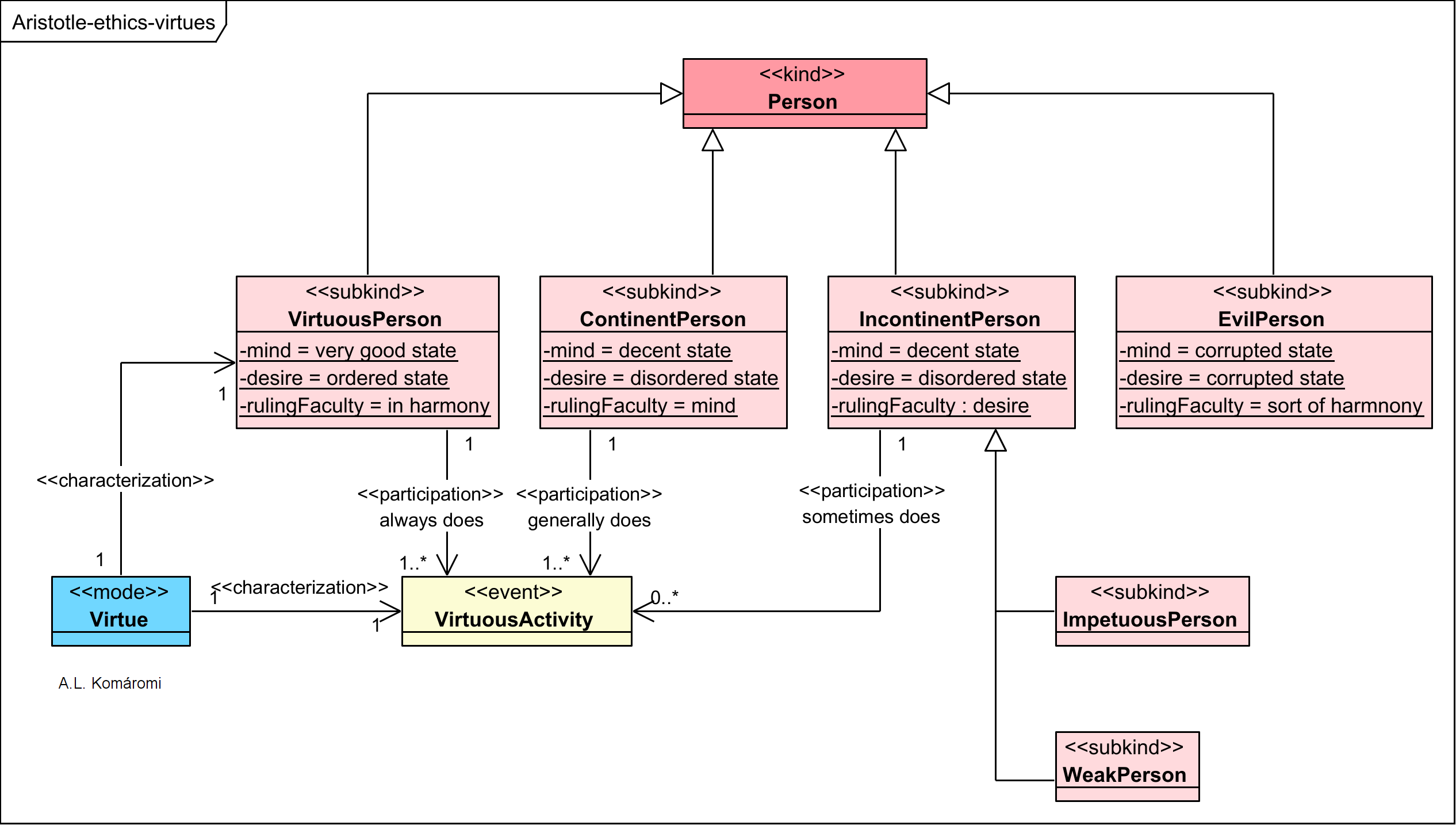
Aristotle (384-322 BC) in the Nicomachean Ethics writes about a personality typology grounded on the state of mind (rational part), and desire (affective part – see also [1.3.6]), and the power relation of these two faculties. Based on these main attributes, he defines four main types, and with further analysis, two sub-types of personalities.

The OntoUML diagram below presents the personality traits of Aristotelian ethics:

Aristotle on virtues and personality traits
ClassDescriptionRelations
Person A human person 
VirtuousPerson“Like anyone who has developed a skill in performing a complex and difficult activity, the virtuous person takes pleasure in exercising his intellectual skills. Furthermore, when he has decided what to do, he does not have to contend with internal pressures to act otherwise. He does not long to do something that he regards as shameful; and he is not greatly distressed at having to give up a pleasure that he realizes he should forego.”
A virtuous person has his/her mind in a very good-, while desire in an ordered state.
subkind of Person; always does VirtuousActivity
ContinentPerson“some are typically better able to resist these counter-rational pressures than is the average person. Such people are not virtuous, although they generally do what a virtuous person does. Aristotle calls them continent (enkratês) [person]
An incontinent person has his/her mind in a decent-, while desire in an ordered state, but mind rules desire.
subkind of Person; generally does VirtuousActivity
IncontinentPerson“others are less successful than the average person in resisting these counter-pressures. They are ‘incontinent(akratês) [person]
Aristotle distinguishes two kinds of akrasia: impetuosity (propeteia) and weakness (astheneia).”
A continent person has his/her mind in a decent-, while desire in an ordered state, but desire rules mind.
subkind of Person; sometimes does VirtuousActivity
ImpetuosPerson“the impetuous person [propeteia] does not go through a process of deliberation and does not make a reasoned choice; he simply acts under the influence of a passion. At the time of action, the impetuous person experiences no internal conflict. But once his act has been completed, he regrets what he has done. One could say that he deliberates, if deliberation were something that post-dated rather than preceded action; but the thought process he goes through after he acts comes too late to save him from error.” subkind of IncontinentPerson
WeakPerson “The person who is weak [astheneia] goes through a process of deliberation and makes a choice; but rather than act in accordance with his reasoned choice, he acts under the influence of a passion.” subkind of IncontinentPerson
EvilPerson“there is a type of agent [person] who refuses even to try to do what an ethically virtuous agent would do, because he has become convinced that justice, temperance, generosity and the like are of little or no value. Such people Aristotle calls evil [person] (kakosphaulos). He assumes that evil people are driven by desires for domination and luxury, and although they are single-minded in their pursuit of these goals, he portrays them as deeply divided, because their pleonexia—their desire for more and more—leaves them dissatisfied and full of self-hatred.”subkind of Person
VirtueAristotle distinguishes two kinds of virtue: “those that pertain to the part of the soul that engages in reasoning (virtues of mind or intellect), and those that pertain to the part of the soul that cannot itself reason but is nonetheless capable of following reason (ethical virtues, virtues of character).” characterizes VirtuousPerson and VirtuousActivity
VirtuousActivity “Aristotle asks what the ergon (“function”, “task”, “work”) of a human being is, and argues that it consists in activity of the rational part of the soul in accordance with virtue [virtuous activity]… consists in doing something, not just being in a certain state or condition. It consists in those lifelong activities that actualize the virtues of the rational part of the soul. (see [1.3.4])

Sources

  • All citations from:  Kraut, Richard, “Aristotle’s Ethics”The Stanford Encyclopedia of Philosophy (Summer 2018 Edition), Edward N. Zalta (ed.)

First published: 6/2/2019
Updated: 8/12/2021