[3.3.7] Ibn Sina on the Prophet as Lawgiver

Ibn Sina (Avicenna, 980-1037 AD) writes about political philosophy in the works Healing (Kita¯b al-Shifa¯ ’), Divisions (Fı¯ Aqsa¯m al-‘Ulu¯m al-‘Aqliyya) and Politics Kita¯b al-Siya¯sa). In these writings:

  • He analyzes the subject with a strong emphasis on the role of the Prophet (not directly identified with Muhammad) in the creation of the political community.
  • The Prophet, in his view, is a lawgiver, who delivers divine and traditional law as well to the nation and city.
  • The persons living in a city are organized in three hierarchical classes, the Administrators, Artisans, and Guardians.

The following OntoUML diagram shows Ibn Sina’s on politics:
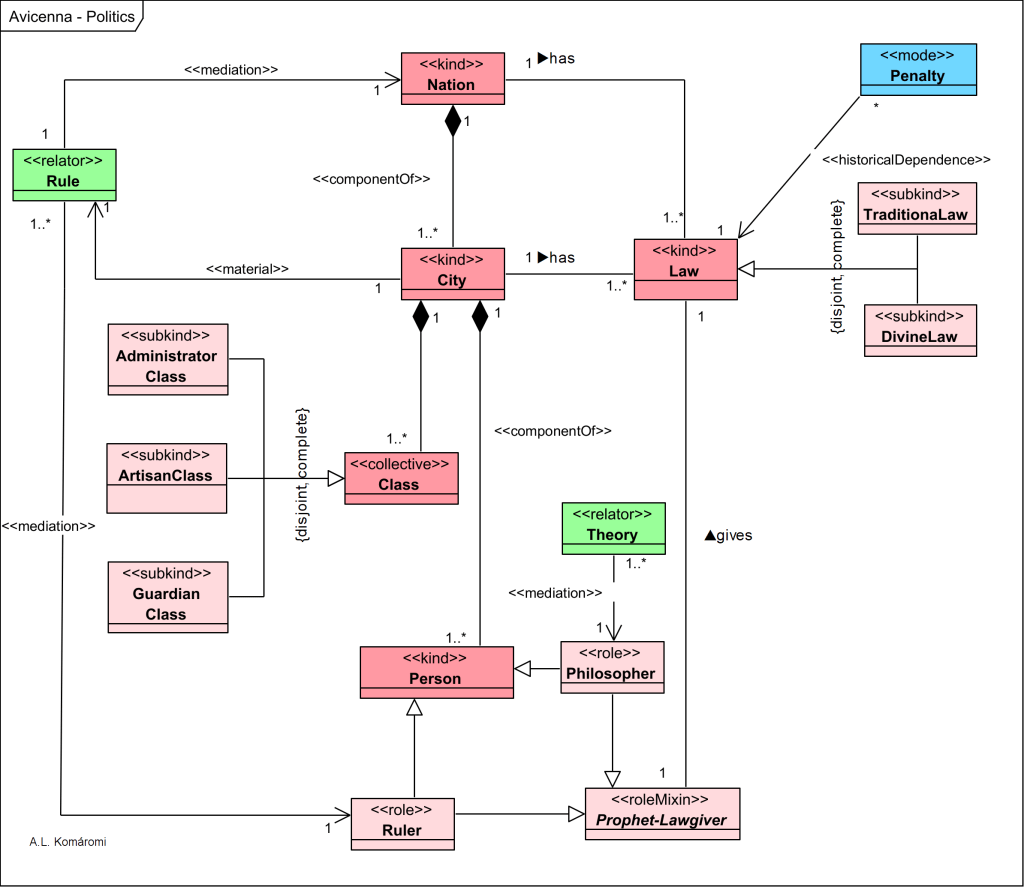
Avicenna on the Prophet as lawgiver
ClassDescriptionRelation
NationThe prophet, when creates divine law is “no longer concerned with mere cities and communities, his focus is now upon a nation (umma) – one of such a size that people may have to migrate or travel long distances in order to reach the spot designated as his abode. Even the time for which he wishes to preserve his laws and teaching has expanded. (Meta, 444:16–445:1). He now thinks it important for the people to remember these things for more than a century or two (Meta, 445:9–10).”
For the prophet, the nation is necessary for providing security for the pilgrimage (hajj).
has Law
City“Merely to feed and clothe ourselves, we must enter into exchange relationships with other individuals. To perpetuate such relationships and to give them structure, human beings form cities and communities.”is exclusive part of the Nation; has Law
Law“It is then necessary for these larger associations to be regulated and for there to exist a standard on which exchange is based, in other words, for there to be law and justice (Meta, 441:3–12). In all of this, says Avicenna, his goal should be to keep matters as simple as possible so that all citizens agree on the principles and do not enter into disputations about beliefs such as would lead them to neglect their civic duties – the fulfillment of those duties being, after all, the whole purpose of his lawgiving (Meta, 442:8–443:9).”
TraditionalLaw“The kind of law Avicenna mentions […] as needed to regulate relationships of exchange is traditional law (sunna). […] the prophet sets forth a traditional law (sunna) containing precepts about God and the after-life that are needed for a people to come together in communal association.”
However, this kind of law, established by example, was known in pagan communities also. The Greek philosophers used the term nomos for it.
is subkind of Law
DivineLawDivine law (sharı¯‘a) is revealed by God and helps people to prepare their souls for happiness in the after-life.is subkind of Law
Penalty“Because fear of punishment in the life to come does not suffice to restrain all people from wrongful deeds, Avicenna notes that the prophetlawgiver must set down punishments, penalties, and prohibitions to prevent them from disobeying ‘the divine law’ (al-sharı¯‘a; see Meta, 454:2–4)” [and traditional law].characterizes Law
Class“Avicenna begins his enumeration of the prophet lawgiver’s political ordering by noting that his first objective is to provide the city with three classes or orders administrators, artisans, and guardians (Meta, 447:4–5). Reminiscent as such an ordering is of Plato’s Republic, even though administrators here take the place of Socrates’ philosopher-kings, Avicenna does not elaborate on the idea.”Class is exclusive part of the City; is a collection of Persons
AdministratorClass, ArtisanClass, GuardianClassAdministrators, Artisans and Guardians are three classes of the City.subkind of Class
PersonA human person.
Prophet-Lawgiver“The best or most virtuous of human beings is the one who has so perfected his soul that he has become fully rational and acquired the practical moral habits permitting him to manage his own affairs in an excellent manner. And among those who reach this level of accomplishment, the prophet [lawgiver] is the best. Two additional qualities give him this edge of superiority, namely, his ability to hear the speech of God and to see God’s angels (Meta, 435:6–16). […]
Differently stated, the prophet completes the partial lives of the philosopher and the virtuous ruler. The philosopher has a fully developed intellect, but apparently lacks the practical moral habits whose mastery would allow him to manage his own affairs or those of others that is, to rule others – and while the virtuous ruler surely has the latter, he seems to lack the former. Yet this by no means implies that the previously asserted affinity between philosophy and revealed religion is now rejected: on the grounds stated, philosophers can understand the superiority of prophets just as easily or readily as those who embrace the revelation prophets bring.”
is the roles of Philosopher and Ruler; gives Law
RulerThe ruler has “practical moral habits whose mastery would allow him to manage his own affairs or those of others”.Role of Person; Rules City and/or Nation
RuleRule: the act of ruling.Relates ruler to City and Nation
Philosopher“The philosopher has a fully developed intellect, but apparently lacks the practical moral habits whose mastery would allow him to manage his own affairs or those of others that is, to rule others”Role of Person
TheoryA philosophical theory related to the philosopher.Relates to Philosopher

Sources

  • All citations from:  Charles E. Butterworth, The Political Teaching of Avicenna, Topoi-an International Review of Philosophy, 2000
  • M. Cüneyt Kaya, In the shadow of “prophetic legistlation”; the venture of practical pilosophy after Avicenna, Arabic Sciences and Philosophy, vol. 24 (2014) pp. 269–296 doi:10.1017/S0957423914000034 © 2014 Cambridge University Press

First published: 27/2/2020
Update: 6/3/2021 added Rule, Theory
[3.3.6] Ibn Sina on Scientific Method and Demonstration

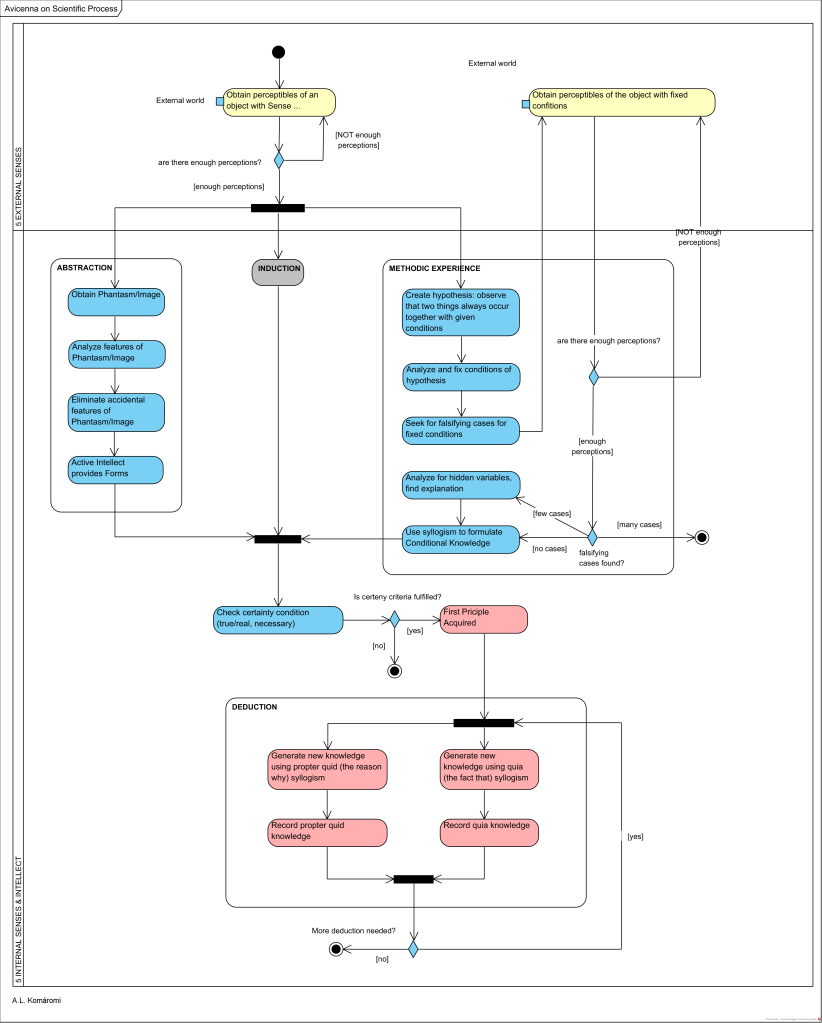
In the UML Activity Diagram below, I propose a reconstruction of the scientific “business” process based on Ibn Sina’s (Avicenna, 980-1037 AD) ideas about scientific inquiry elaborated in his works Kitāb al-Burhân, Najâh.
Here are some highlights of his ideas:

  • Sense perception with the involvement of the 5 external and internal senses (see [3.3.3]) is the starting point of the scientific process.
  • Abstraction, Induction and Methodic Experience are the activities to acquire First Principles. Syllogisms (see [3.3.5]) and actualization of the Intellect with Forms provided by First Intellect (see [3.3.3], [3.3.4]) both have their roles in these activities.
  • After First Principles are available, new knowledge can be reached with deduction, using syllogisms (see [3.3.5]).
Avicenna on scientific process
ACTIVITY/ActionDescription
Obtain perceptibles of an object with Sense Perception“the universal premises of demonstration and their principles are obtained only through sensory perception…” (McGinnis (2008), cites Avicenna)
ABSTRACTION“by acquiring the phantasmata (خيالات) of the singular terms through the intermediacy of [sensory perception] in order that the intellectual faculty freely acts on them in such a way that it leads to acquiring the universals as singular terms and combining them into a well-formed statement…
[T]he essences perceptible in existence are not in themselves intelligible, but perceptible; however, the intellect makes them so as to be intelligible, because it abstracts their true nature (حقيقتها) from the concomitants of matter…
Thus [the speculative intellect] receives these accidents, but then it extracts them, as if it is peeling away these accidents and setting them to one side, until it arrives at the account in which are common and in which there is no variation and so acquires knowledge of them and conceptualizes them.
The first thing that [the intellect] inquires into is the confused mixture in the phantasm; for it finds accidental and essential features, and among the accidents those which are necessary and those which are not. It then isolates one account after another of the numerous ones mixed together in the phantasm, following them along to the essence. (McGinnis (2008), cites Avicenna)
“this is not Avicenna’s whole story concerning abstraction and acquiring first principles; for as he says later, acquisition of the first principles also involves “a conjunction of the intellect with a light emanated upon the soul and nature from the
agent that is called the ‘Active Intellect’” (McGinnis (2008)).
INDUCTIONAvicenna accepts Aristotle’s view on Induction (see [1.3.8]) however, criticizes it: “Induction has two elements: one involves the sensible content of induction and the other the rational structure of induction, namely, the syllogism associated with induction. If induction is to provide one with the necessary and certain first principles of a science, then the necessity and certainty of the conclusion of an inductive syllogism must be due either to
induction’s sensory element or its rational element or some combination of both. On the one hand, the purported necessity and certainty of induction cannot be known solely through induction’s sensory element; for in good empirical fashion Avicenna
recognizes that necessity and certainty are not direct objects of sensation. On the other hand, if the necessity and certainty are due to induction’s rational component, then the syllogism associated with induction should not be question begging. Yet,
complains Avicenna, in the scientifically interesting cases one of the premises of an induction will be better known than its conclusion, and so the induction is neither informative nor capable of making clear a first principle of a science.” (McGinnis (2008)).
METHODIC EXPERIENCE“Ibn Sînâ’s theory of experimentation is by no means modern, it does move one closer to a modern scientific approach; for it emphasizes both the need to set out carefully the conditions under which experimentation or examination have taken place, as well as the tentativeness of scientific discoveries in the face of new observations…
experimentation involves in part seeking falsifying cases…the exceptions [falsifying cases] would be extremely rare, perhaps observed only once or twice. These rare exceptions might indicate that there is not a causal relation, but they might also indicate that the causal circumstances were more complex than initially supposed…
Experimentation, with its accompanying syllogism, then, occasions certainty…
although experimentation cannot provide “absolute” principles, the natural scientist can use experimentation to discover “conditional,” universal principles, which can function as first principles in a science.” (McGinnis (2003)).
Check certainty condition (true/ real, necessary) “Avicenna’s ‘certainty condition’ (يقين),… includes both being true or real (الحقّ) and necessary (الضروري)” (McGinnis (2008)).
First Priciple AcquiredIf certainty condition is fulfilled.
DEDUCTION“A demonstration according to Avicenna is ‘a syllogism constituting certainty’. In other words, it is a deduction beginning with premises that are certain or necessary that concludes that not only such and such is the case, but that such and such cannot not be the case. Thus, demonstrative knowledge involves possessing a syllogism that makes clear the necessity
or inevitableness obtaining between the subject and predicate terms of its conclusion. In addition, Avicenna divides demonstrative knowledge itself into two categories depending upon the type of demonstration employed. Thus there is the demonstration propter quid, or demonstration giving ‘the reason why’ ( برهان لِمَ ) and the demonstration quia, or demonstration giving ‘the fact that’ (برهان لأن ).” (McGinnis (2008)).

Sources

  • McGinnis,  Jon, “Avicenna’s Naturalized Epistemology and Scientific Method”, chapter from: The Unity of Science in the Arabic Tradition: Science, Logic, Epistemology and their Interactions, springer, 2008
  • McGinnis, Jon, “Scientific Methodologies in Medieval Islam”, Journal of the History of Philosophy. 41. 307-327. 10.1353/hph.2003.0033., 2003

First published: 05/09/2019