[3.3.2] Ibn Sina’s Cosmology

Ibn Sina (Avicenna, 980-1037 AD) writes about cosmology and metaphysics in Ilāhiyyāt of Kitāb al-Šifā’ (known in English as the Metaphysics of the Book of the Healing or the Book of the Cure). The basis of his theory is a necessary chain of causation starting at the First Principle (as cause), continuing with the chain of Intelligencies and Active Intellect (as effects and intermediaries), and ending with the Sublunary Bodies (as final effects) – as shown in the following OntoUML diagram:
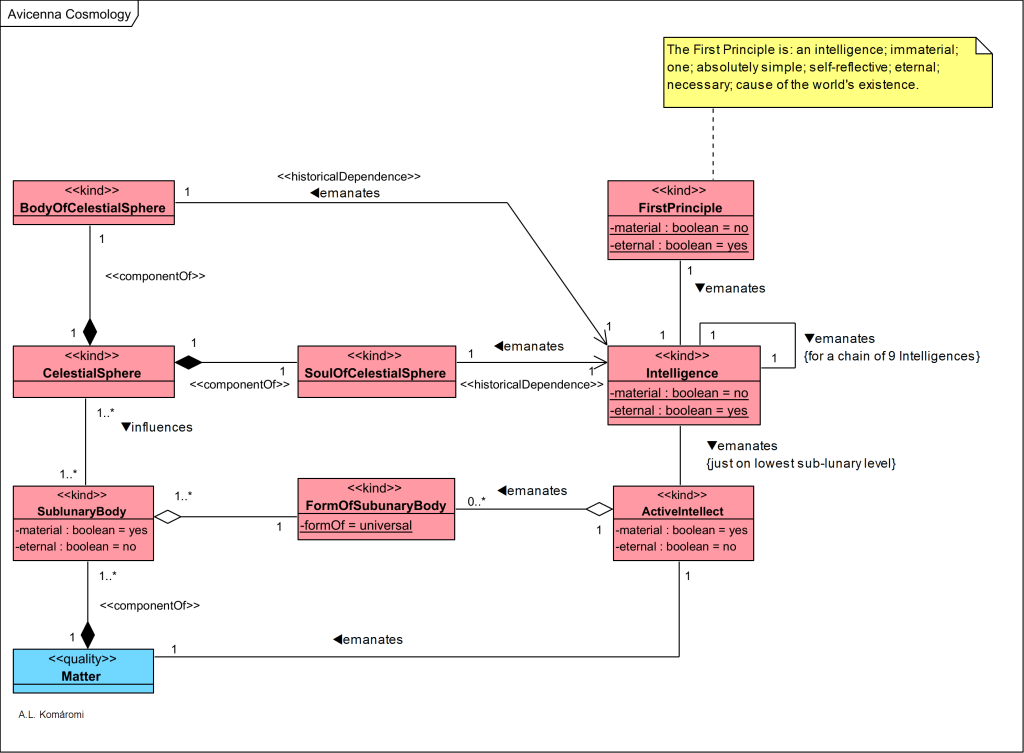
Avicenna cosmology
Class DescriptionRelations
FirstPrincipleThe main attributes of the First Principle are: intelligence; immaterial; one; absolutely simple; self-reflective; eternal; necessary; cause of the world’s existence.
“Avicenna considers the world to be ‘instaured” or absolutely created (mubdaʿ) and at the same time establishes that it is eternal and eternally in motion, as Aristotle’s physics and metaphysics teach. He therefore posits a Principle of the world’s existence (wuǧūd) […] the final cause is […] the same efficient cause that makes things exist (mūǧid). The First Principle is therefore a cause in every respect.

The First Principle is also referred as Necessary Existent.
associated with the (first) Intelligence of the chain
IntelligenceA chain of nine Intelligencies is necessarily emanated (fayḍ) from the First Principle, one from the other for the Heavens – the outermost sphere, one for the fixed stars, Saturn, Jupiter, Mars, Sun, Venus, Mercury, and the Moon. Each Intelligence:
“- thinks of the First Principle and aims at it, a further intelligence originates;
– from the act by which it thinks of itself and aims at itself, two entities originate: a soul, which is an intelligence bound to a body and which is, in some texts, equated to the practical intellect;
– and the celestial body to which this intelligence is bound.”
emanates: next level of Intelligence; SoulOfCelestialSpere; BodyOfCelestialSpere. Lowest level emanates ActiveIntellect
ActiveIntellectActive Intellect (or Agent Intellect) is the last, tenth member of the chain of intelligencies, which emanates universal (unified, undifferentiated) forms of Sublunary Bodies, and Matter, which combines into Sublunary Bodies. Since the forms are universal, the differences, particularities of the Sublunary Bodies are caused by the influence of the Celestial Spheres.

Due to the fact, that the members of the chain of intelligencies lose their power with the increasing distance from the First Principle, the Active Intellect is not able to emanate eternal entities, so the sublunary bodies are not eternal, yet in a structure similar to celestial bodies.
emanates FormsOf
SublunaryBody; Matter
SoulOfCelestial
Sphere
Soul of Celestial Sphere is emanated by the Intellect when thinks of itself.part of CelestialSphere
BodyOfCelestial
Sphere
Body of Celestia Sphere is emanated by the Intellect when thinks of itself.part of CelestialSphere
CelestialSphereCelestial Sphere contains Soul of Celestial Sphere and Body of Celestia Sphere.influences SublunaryBody
FormOf
SublunaryBody
Form of Sublunary Body is a universal (unified, undifferentiated) form emanated by Active intellect.
E.g. Form of sea, Soul of man
part of SublunaryBody
MatterMatter is emanated by Active Intellect, has the potentiality to be actualized by Form.contained by SublunaryBody
Sublunary BodySublunary Body is composed of Form and Matter. Its particularity is due to the influence of the Celestial Spheres.

His cosmological scheme Neoplatonist, and very similar with al-Farabi’s (see [3.2.1]), but with some notable differences:

  • the Forms of Sublunary Bodies contained and emanated by Active Intellect are undifferentiated universals, not Particulars, as at al-Farabi
  • Matter is emanated by the Active Intellect (not by the Celestial Sphers as at al-Farabi)
  • the existence of the First Cause is necessary by itself, the existence of the chain of Intellects is necessary by the First Cause and contingent by itself (aspects not analyzed by al-Farabi)

Sources

  • All citations from: Lizzini, Olga, “Ibn Sina’s Metaphysics”The Stanford Encyclopedia of Philosophy (Summer 2019 Edition), Edward N. Zalta (ed.)
  • Davidson, Herbert A., “Alfarabi, Avicenna, and Averroes, on Intellect”, Oxford University Press 1992

First published: 08/08/2019

[3.2.6] Al-Farabi on the Perfect City

Al-Farabi (Alpharabius, 872-950 AD)) was the first Islamic thinker with substantial contribution to political philosophy (‘philosophy of society’, falsfa madaniyya as he refers to it). In his main work about the subject On the Perfect State (Mabādiʾa ārāʾ ahl al-madīnat al-fāḍilah) he outlines his main ideas:

  • Perfect societies are human communities with the minimal size of a city, with the aim to help their members to reach their ultimate end: true felicity (see also [3.2.5]).
  • The social classes and the ruler of the perfect city work together like the organs of a living body.
  • Perfect (virtuous) cities have a religion, which sets the preconditions for the true felicity of their inhabitants: common actions, knowledge, and opinions.
  • The religion of the perfect city is created through revelation by its founder, the first ruler, who is a prophet.

This structure is presented in the following OntoUML diagram:

al-Farabi on the perfect city
ClassDescriptionRelations
Society“A society […] is an association of human beings collaborating “[i]n order to preserve [themselves] and to attain [their] highest perfections” (Perfect State V, 15, 1: 229).”is characterized by Collaboration
CollaborationA society is characterized by collaboration.
ImperfectSociety“Smaller associations, such as villages, quarters, streets, and houses are per se imperfect [societies]; larger ones, like nations and the “union of all the societies in the inhabitable world” (ibid.), by contrast, are perfect.”is subkind of Society
PerfectSociety“larger ones, like nations and the ‘union of all the societies in the inhabitable world’, by contrast, are perfect [societies]”.is subkind of Society; has PurposeOfPerfect
Society
PurposeOfPerfectSocietyThe purpose (telos) of the perfect society “consists, according to al-Farabi, in guiding their members towards their end: true felicity. As a consequence, a city […] in which people aim through association at co-operating for the things by which felicity in its real and true sense can be attained, is the excellent city [madina fadila], and the society in which there is a co-operation to acquire felicity is the excellent society [ijtima‘ fadil]. (Perfect State V, 15, 3: 231)”. See also [3.2.5].
PerfectCity“a city […] in which people aim through association at co-operating for the things by which felicity in its real and true sense can be attained, is the excellent [perfect] city [madina fadila], and the society in which there is a co-operation to acquire felicity is the excellent society [ijtima‘ fadil].”is subkind of PerfectSociety; has Relgion; its exclusive parts are Classes
ClassPeople are organized in classes, with different specific activities and knowledge/opinions. Classes are in a hierarchical.is a collective of Persons; forms a hierarchical self-reference
PersonA person is a human being.
Ruler“The excellent city resembles the perfect and healthy body, all of whose limbs co-operate …. Now the limbs and organs of the body are different and their natural endowments and faculties are unequal in excellence, there being among them one ruling organ, namely the heart, and organs which are close in rank to that ruling organ …. The same holds good in the case of the city. Its parts are different by nature, and their natural dispositions are unequal in excellence: there is in it a man who is the ruler, and there are others whose ranks are close to the ruler, each of them with a disposition and a habit through which he performs an action …. (Perfect State V, 15, 4: 231–3)”is subkind of Person; rules the PerfectCity
Lawgiver, Philosopher, ImamLawgiver, philosopher, imam are roles of the ruler.are roles of Ruler
FirstRulerThe first ruler is the leader who founded the perfect city, and who created its religion.is subkind of Ruler
ProphetTo be a prophet is the essential role of the first ruler. The prophet – trough divine revelation – is able to create religion.is role of FirstRuler; creates Religion
ReligionReligion is opinions and actions, determined and restricted with stipulations and prescribed for a community by their first ruler, who seeks to obtain through their practicing it a specific purpose with respect to them or by means of them. […] Al-Farabi has a fairly peculiar notion of religion. First, it embraces “opinions” and “actions” and, hence, those two elements […] play a significant role in connection with the attainment of individual felicity. Accordingly, human beings need to know certain things (in one of the two mentioned ways) and perform certain actions in order to become truly happy. Second, religion is described as the result of a first ruler’s activities. More precisely, this ruler is depicted as the one who first established the opinions and actions to be held and performed by the community she rules. Furthermore, in so doing she pursued a specific purpose. In other words, these opinions and actions are supposed to be defended and carried out, not for their own sake, but—provided “the first ruler is excellent”—for the sake of ultimate happiness. Religion, therefore, is not a goal in and of itself; it is an instrument, more specifically, it is an instrument of rulership.”contains as parts Action and Knowledge/Opinion
Action“There are some indications regarding the common activities […]. It appears that, once again in unison with Aristotle, these embrace all sorts of exercises suited to purify one’s soul while it is still unified with ‘its’ body, as al-Farabi’s references to the soul’s disposition as well as his recurrent comparisons with arts and crafts suggest. Thus, he intimates, in connection with the last quoted passage:
‘When each of [the people of the excellent city] acts in this way [i.e., according to the citizens’ common duties], these actions of his make him acquire a good and excellent disposition of the soul, and the more steadily he applies himself to them, the stronger and better becomes that disposition of this and increases in strength and excellence—just as steadily applying himself to performing the actions of writing well make a man acquire proficiency in the art of writing’ …. (Perfect State V, 16, 2: 261)”
is part of Religion; can relate to Class (in this case is specific to a Class, otherwise is common)
Knowledge/OpinionAl-Farabi thinks that the people in the virtuous city should have virtuous knowledge or at least virtuous opinions: “The things in common which all the people of the excellent city ought to know are: (1) In the first place to know the First Cause and all its qualities; (2) then the immaterial existents [including the above mentioned active intellect] …; (3) the celestial substances …; (4) [without number in Walzer’s translation] then the natural bodies which are beneath them, and how they come to be and pass away …; (5) then the generation of man; (6) then the first ruler …; (7) then the rulers who have to take his place …; (8) then the excellent city and its people and the felicity which their souls ultimately reach …” (Perfect State V, 17, 1: 277–9)is part of Religion; can relate to Class (in this case is specific to a Class, otherwise is common)

Sources

First published: 20/02/2020