
Al-Farabi’s (872-950 AD) views on the human happiness are spread through some of its works: The Political Regime (Kitāb al-siyāsa al-madaniyya), The Principles and Opinions of the People of the Virtuous City (Mabādi’ ārā’ ahl al-madīnah al-fāḍilah), and Attainment [of Happiness]. In these works:
- He upholds the Aristotelian theory that each human person has a goal of living (telos), which is the ultimate felicity. This state can be reached just in the afterlife when the soul is separated from the body.
- Ultimate felicity is the attainment of the actual phase of intellect (essentially the act of thinking – see [3.2.4]), not virtuous action (see [1.3.17]), virtue (see [2.2.7]), pleasure (see [2.1.3]), or love of God (see [2.5.5]), as for different other philosophers and schools.
- Ultimate felicity is possible for all humans in the afterlife, if the person meets some preconditions, like exercising virtuous actions and having the right knowledge and opinions.
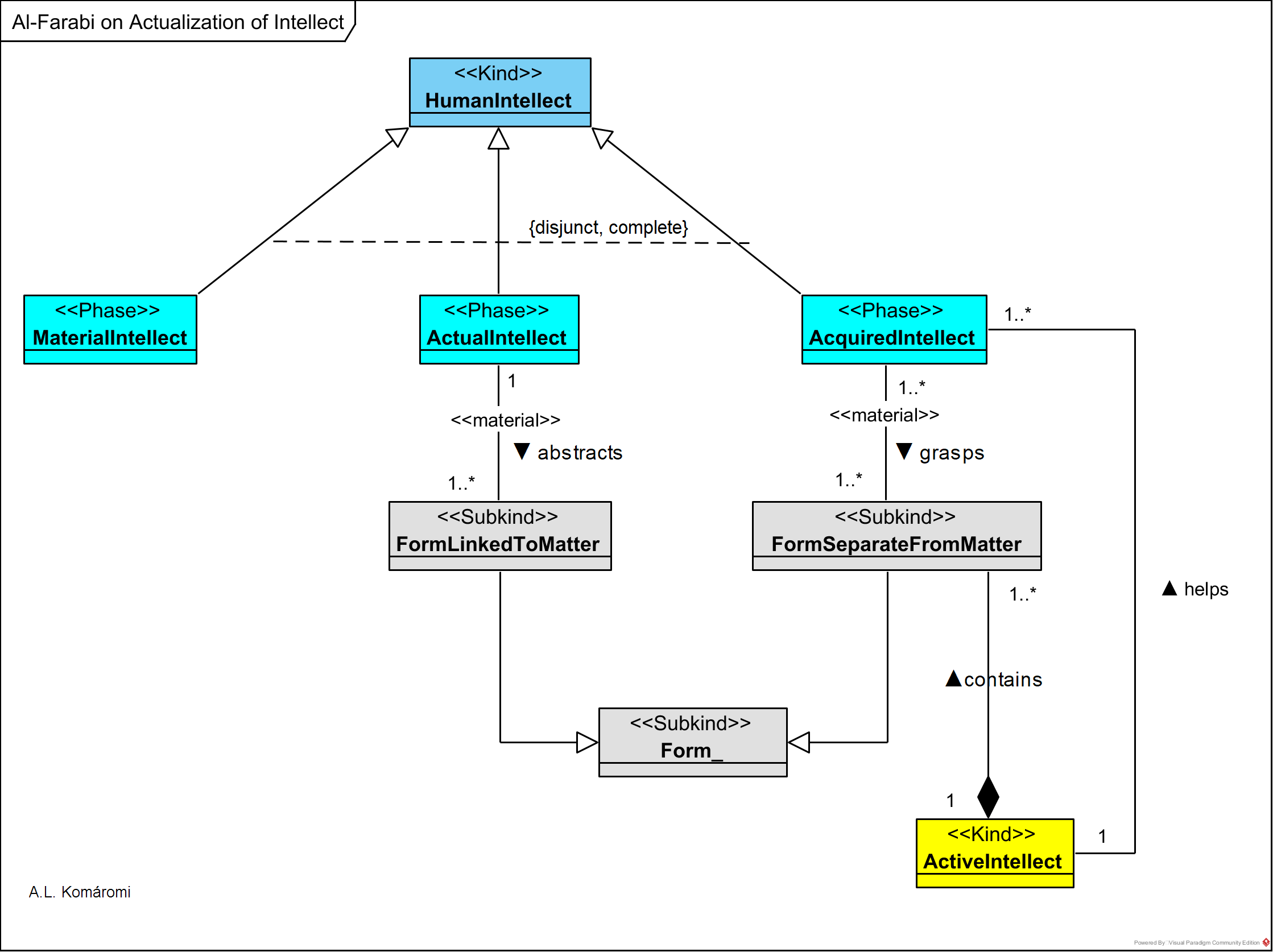
This structure is presented in the following OntoUML diagram:

| Class | Description | Relations |
| Person | “Prior to death, human beings [persons] are hybrids—corporeal entities, on the one hand, yet also immaterial, on the other, due to their intellects, that is, the rational faculty of their souls which survives death—and as such exposed to two sets of powers. Just like every other inhabitant of the sublunary world, human beings are subject to the natural laws determining corporeal substances. In contrast, however, to all the other species belonging to the sphere of generation and corruption, human beings moreover experience a certain influence by the so-called ‘active intellect’, an immaterial, incorruptible, supralunary entity whose existence is pure thinking. This active intellect does not affect the body of a human being, but rather her intellect and imagination, i.e., those psychic faculties involved in thinking. The most fundamental influence which the active intellect exerts on the human soul consists in, first, the provision and, second, the basic ‘formatting’ of the rational faculty: … [the active intellect] gives the human being a faculty and a principle by which to strive, or by which the human being is able to strive on his own for the rest of the perfections that remain for him. That principle is the primary sciences and the primary intelligibles attained in the rational part of the soul. (Political Regime B, 1, 68: 62)” (Germann) | has GoalOfLiving; has HumanIntellect; pursuits EarthlyFelicity |
| GoalOfLiving | “In line with Aristotle, al-Farabi leaves no doubt whatsoever that there is one kind of happiness which constitutes the telos [goal of living] of every human being.”(Germann) | is UltimateFelicity |
| Happiness | al-Farabi “distinguishes between ‘earthly’ and ‘ultimate felicity’ [happiness]“. (Germann) | |
| EarthlyFelicity | Earthly felicity is a subkind of Happiness, not relevant for the goal of living. | subkind of Happiness |
| UltimateFelicity | “from the majority of his writings it is clear that happiness in the strict sense of the word, that is, as the concomitant of the highest human perfection, is ultimate felicity.” (Germann) | subkind of Happiness; is attainment of ActualIntellect; has Precondition |
| Precondition | “As the last citation from the Perfect State conveys, when discussing the preconditions of felicity, al-Farabi distinguishes between (a) common and (b) specific duties of the citizens, as well as between (i) knowledge and (ii) activities.” (Germann) | |
| Knowledge/ Opinion | Al-Farabi thinks that the people in the virtuous city should have virtuous knowledge or at least virtuous opinions: “The things in common which all the people of the excellent city ought to know are: (1) In the first place to know the First Cause and all its qualities; (2) then the immaterial existents [including the above mentioned active intellect] …; (3) the celestial substances …; (4) [without number in Walzer’s translation] then the natural bodies which are beneath them, and how they come to be and pass away …; (5) then the generation of man; (6) then the first ruler …; (7) then the rulers who have to take his place …; (8) then the excellent city and its people and the felicity which their souls ultimately reach …” (Perfect State V, 17, 1: 277–9) | subkind of Precondition |
| KnowledgeOfObject | The knowledge of the objects necessary for ultimate felicity “presupposes a quite profound knowledge of cosmology, physics, anthropology, and philosophy of society.” (Germann) This knowledge is attainable just for a handful of people, who are intellectually gifted enough to do science. | subkind of Knowledge/ Opinion |
| KnowledgeOf Symbolic Representation | The knowledge of symbolic representations of objects necessary for ultimate felicity is attainable for every person, even modest intellectual capacity: “according to al-Farabi, the requirement of knowing these common objects does not exclude anyone from attaining happiness, because they ‘… can be known in two ways, either by being impressed on [the people’s] souls as they really are or by being impressed on them through affinity and symbolic representation.‘ (Perfect State V, 17, 2: 279)” (Germann) | subkind of Knowledge/ Opinion |
| Action | “There are some indications regarding the common activities […]. It appears that, once again in unison with Aristotle, these embrace all sorts of exercises suited to purify one’s soul while it is still unified with ‘its’ body, as al-Farabi’s references to the soul’s disposition as well as his recurrent comparisons with arts and crafts suggest. Thus, he intimates, in connection with the last quoted passage: ‘When each of [the people of the excellent city] acts in this way [i.e., according to the citizens’ common duties], these actions of his make him acquire a good and excellent disposition of the soul, and the more steadily he applies himself to them, the stronger and better becomes that disposition of this and increases in strength and excellence—just as steadily applying himself to performing the actions of writing well make a man acquire proficiency in the art of writing’ …. (Perfect State V, 16, 2: 261)” (Germann) | subkind of Precondition |
| ActualIntellect | “And precisely in the realization of this activity, i.e., thinking, and its perfection—ideally, the attainment of its most sublime level, i.e., science—consists humanity’s telos. Human beings, hence, are born with the natural obligation to perfect their rational faculty. While they are equipped by the active intellect with this faculty and the principles of thought, their task consists in actualizing this potential, i.e., their intellects, “by which a human being is a human being” (Political Regime A, 2, 8: 32). Becoming an intellect in actuality, just like the active intellect and the other separate intelligences, therefore, constitutes humanity’s perfection. Once a human being reaches this level of perfection, she acquires the state of ultimate happiness: ‘When the rational faculty attains to being an intellect in actuality [actual intellect], that intellect it now is in actuality also becomes similar to the separate things and it intellects its essence that is [now] intellect in actuality. …. Through this, it becomes such as to be in the rank of the active intellect. And when a human being obtains this rank, his happiness is perfected.‘ (Political Regime A, 2, 8: 33; square brackets thus in the translation) Across al-Farabi’s various writings, it remains unclear whether this stage of ultimate felicity can already be reached during one’s lifetime, when the soul is still linked with the human body, or only in the hereafter, once the soul has separated from the body due to this latter’s death. Happiness, consequently, consists in the as-perfect-as-possible assimilation of the human soul to the active intellect, whose unique activity is thinking.” (Germann) | phase of HumanIntellect |
| HumanIntellect | Human intellect (arabic: aql, greek: νοῦς) “is understood as a faculty of the soul by means of which certainty about necessary, true, and universal premises is attained. Premises of this kind are not arrived at by means of syllogisms, but are present in the subject in a prior way, either by nature or without one being aware of how these premises were acquired. Hence, this faculty is some part of the soul by which humans have access to the first principles of the theoretical sciences.” (López-Farjeat) |
Sources
- Germann, Nadja, “al-Farabi’s Philosophy of Society and Religion”, The Stanford Encyclopedia of Philosophy (Winter 2019 Edition), Edward N. Zalta (ed.)
- López-Farjeat, Luis Xavier, “Al-Farabi’s Psychology and Epistemology”, The Stanford Encyclopedia of Philosophy (Summer 2018 Edition), Edward N. Zalta (ed.)
First published: 27/07/2019
 Philosophy Models