
William Ockham (1285-1349 AD) in Summa of Logic and Quodlibet writes about the mental language and its relation to written and spoken language (see also [4.0.1]):
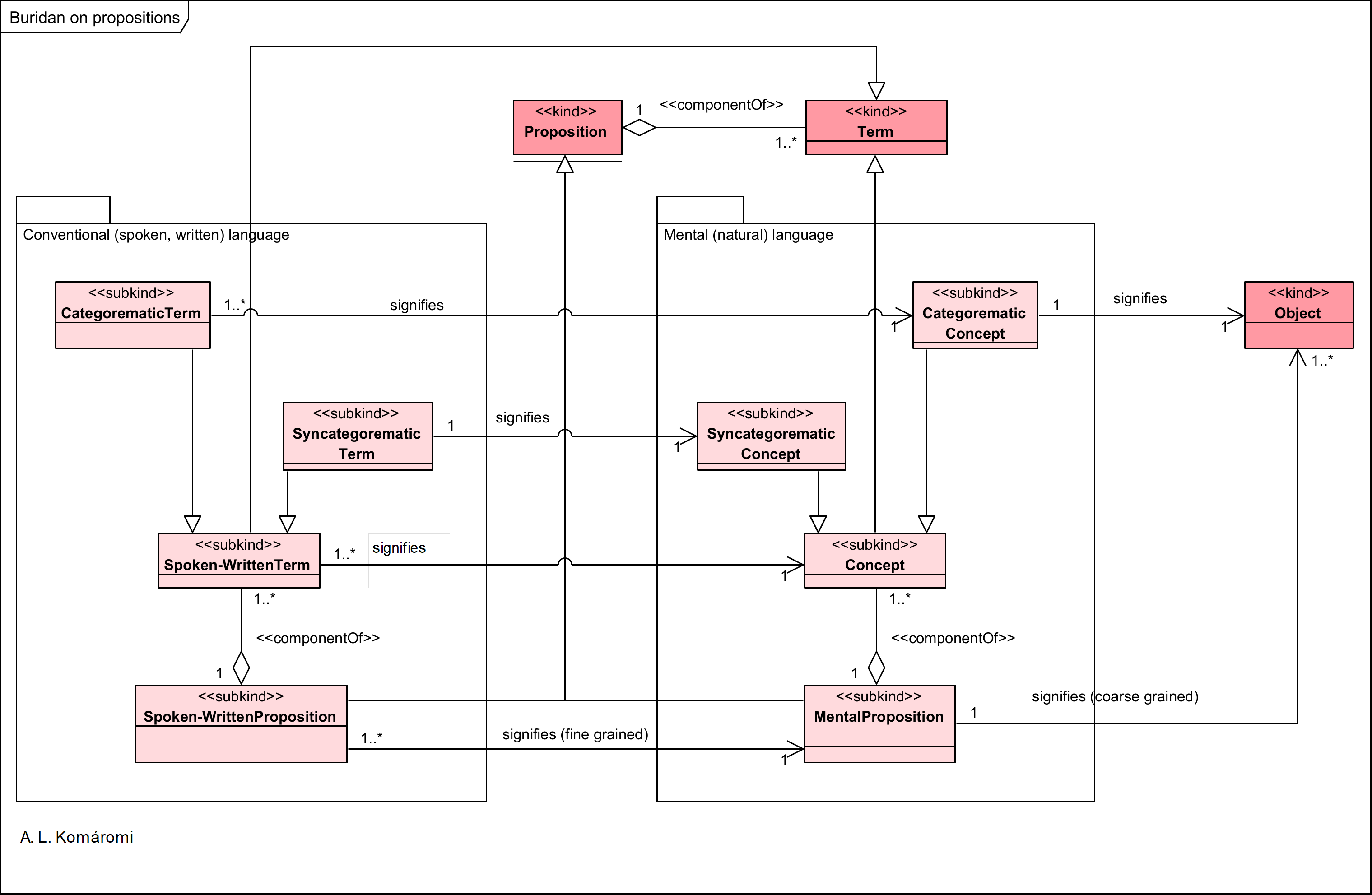
- Concepts (mental terms) are acts of understanding of objects.
- Concepts, through their likeness to objects, signify those naturally. Because of this, we say that mental language is natural.
- The mind combines concepts into mental propositions; both are mental expressions and part of the mental language.
- Concepts can be mental names, verbs, adverbs, conjunctions, propositions.
- Concepts are non-accidental, meaning that names don’t have case, number, comparison, gender, declension, and verbs don’t have mood, voice, person, number, tense, conjugation, inflection.
- Spoken terms (utterances) signify concepts conventionally.
- Spoken terms can be combined into spoken propositions; both are spoken expressions and part of the spoken language.
- Spoken expressions signify (or are subordinated to) mental expressions through language-specific conventions; this is why the spoken and written language is conventional language. This spoken expression – mental expression signification makes possible the translation between languages.
- Spoken expressions are synonyms if we have a many-to-one signification relation to mental expressions, and equivocals if we have a one-to-many signification relation to mental expressions.
- Written terms signify conventionally spoken terms. We can model the written language with similar classes as for the spoken language.
The following OntoUML diagram presents the main classes of Ockham’s theory of mental language:

| Class | Description | Relations |
|---|---|---|
| Object | An object, a thing or state of affairs in the external world. | |
| Term | Term generalizes the properties of concepts, utterances, and inscriptions. | generalizes Concept; SpokenTerm, WrittenTerm |
| CategorematicTerm | Categorematic terms have a “fixed and definite signification.” (Ockham) | subkind of Term |
| Concept | A concept [mental term] is an act of understanding of the Object signified: “There was a great disagreement in the Middle Ages about what it is that linguistic units signify, but there was universal agreement over the Aristotle tells us that although spoken and written terms differ from linguistic community to linguistic community, mental terms or concepts (as Boethius interpreted the passage) do not. They ‘are the same for all.’ This doesn’t mean that everyone has exactly the same supply of concepts, since that’s plainly not so; we think about and know about different things. […] it means is that, for example, my concept 'man‘ and your concept 'man‘ differ only ‘numerically,’ as they said. That is, they are exact duplicates of one another. They do not differ in the way the English spoken word ‘man’ differs from the Latin spoken word ‘homo’ or from the Greek spoken word ‘ἄνθροπος’, which are more than numerically different. (They don’t sound at all alike.) In short, what Aristotle is saying in this text is that, while we may speak and write in different languages, we all think in the same language. […] Concepts are private and mind-dependent” | subkind of Term; signifies naturally (subordinated to) the Object; component of MentalProposition; member of MentalLanguage |
| Non-accidental | Concepts are non-accidental: “While Ockham says that mental language reflects spoken and written language to the extent that it too has parts of speech, and even (apart from the two doubtful cases we have just discussed) the same parts of speech, nevertheless there are other grammatical features of spoken and written language that do not carry over into mental language [namely in concepts]. Here Ockham’s Quodlibet 5, q. 8, gives the fuller account. In that question he distinguishes two main kinds of grammatical ‘accidents’ — that is, grammatical properties — of spoken (and written) words: ‘common’ accidents and ‘proper’ ones.” Common grammatical accidents for names are: case, number, comparison, quality. Proper grammatical accidents for names are: gender, declension. Common grammatical accidents for verbs are: mood, voice, person, numer, tense. Proper grammatical accidents for verbs are: conjugation, inflection. | characterizes Concept |
| Signification | Signification relates CategorematicTerm with Object. | mediates CategorematicTerm with Object |
| Likeness | “Aristotle tells us […] that concepts or mental terms are likenesses of real things and that real things are just what they are, the same for everybody. A stone is just a stone, and that’s the end of the matter. It doesn’t change its structure or nature depending on who’s thinking about it. It is “objective” in the sense of being interpersonally invariant. We all therefore live in the same world, ontologically speaking. There is no room for any sort of “ontological relativity” (to use Quine’s phrase) in this Aristotelian doctrine. Now concepts, Aristotle has just told us, are likenesses of these interpersonally invariant things. That is, the relation between a concept and what it is a concept of is a relation of similarity or likeness. […] Here let’s just explore some of the consequences of the doctrine. Similarity, when it occurs, is an objective fact. There is nothing conventional about it at all. (Of course, it may be a matter of convention or cultural conditioning which similarities matter to us, or which ones we notice. But that is an altogether different question.) If Socrates and Plato, for example, are alike to the extent that they are both over six feet tall, then that fact does not depend on anyone’s convention; it is, so to speak, a fact of ‘nature.’” | subkind of Signification; mediates Concept with Object |
| MentalProposition | “Ockham many times says explicitly that mental propositions are composed, made up, of mental terms — that is, of concepts. He says it for example in Summa of Logic I.1, § 6: ‘A conceived term is an intention or passion of the soul naturally signifying or consignifying something [and] apt to be a part of a mental proposition…’ […] This is clear from the fact that for every spoken expression, true or false, there corresponds some mental proposition put together out of concepts. Therefore, just as the parts of the spoken proposition that are imposed to signify things on account of the necessity of signification or expression (for it is impossible to express all [things] by means of verbs and names alone that can be expressed by means of [them together with] the other parts of speech) are distinct parts, so [too] the parts of the mental proposition that correspond to utterances are distinct, to make distinct true and false propositions.” | subkind of MentalExpression; member of MentalLanguage |
| MentalExpression | Mental expressions are concepts and mental propositions. | |
| MentalLanguage | “Ockham says that there are parts of speech in mental language just as in spoken language — nouns, verbs, adjectives, prepositions, etc. […]” | |
| Natural | “What is the most basic feature that distinguishes mental language from spoken or written language? Answer: Mental language is supposed to be a natural language, whereas spoken language and written languages are conventional. To say that mental language is “natural” is to say that its features are not established by choice or convention, but by nature. They’re not up to us.” | characterizes MentalLanguage |
| MentalName; MentalVerb; MentalAdverb; MentalConjunction; MentalPreposition | “As for the first point, I say that just as among spoken and written terms some are names, [while] others [are] verbs, others pronouns, others participles, others adverbs, others conjunctions, [and] others prepositions, so [too] among mental concepts some concepts are [mental] names, others [are] [mental] verbs, others [mental] adverbs, others [mental] conjunctions, [and] others [mental] prepositions.” | Subkind of Concept |
| SpokenTerm | A spoken term signifes conventionally a Concept. | subkind of Term; signifies conventionally Concept; component of SpokenProposition; memberod SpokenLanguage |
| SpokenName; SpokenVerb; SpokenPronoun; SpokenConjunction; SpokenAdverb; SpokenPartciple; SpokenPreposition | “As for the first point, I say that just as among spoken […] terms some are [spoken] names, [while] others [are] [spoken] verbs, others [spoken] pronouns, others [spoken] participles, others [spoken] adverbs, others [spoken] conjunctions, [and] others [spoken] prepositions […]” | subkinds of SpokenTerms |
| Convention | A spoken expression signifies a mental expression by convention: “we will also see authors talking about the signification of words and inscriptions as conventional (= ad placitum, literally “at your pleasure”) signification. So too, we will see people refer to spoken and written language as a whole as artificial or conventional, in contrast to mental language, which is natural. […] The conventions can be changed, with the result that there are different languages over time. And for that matter the conventions can vary at any one time, so that there are several distinct languages all coexisting simultaneously (like English and French).” | mediates SpokenExpression with MentalExpression |
| Synonim | “The term ‘rock’ and the term ‘stone’, let us say, are synonyms. They are subordinated to the same concept, which is a natural likeness of all stones (rocks) in the relevant sense […] In short, where the subordination relation is many-one, we have synonymy. […] It is this fact that accounts for the possibility of translating from one language to another. Insofar as a translation is supposed to ‘express the same thought’ as the original, we can say that a statement in one language is a correct translation of a statement in another language iff the two statements are subordinated to the same mental proposition. This suggests that mental language can provide us with a general account of synonymy, not only of interlinguistic synonymy (as with translation) but of intralinguistic synonymy too. Two expressions — whether terms, whole propositions or whatever, whether from different languages or from the same language — are synonymous iff they are subordinated to the same mental expression. […] | role of SpokenExpression; relates materially to MentalExpression |
| Synonimity | Synonimity relates Synonim with mental expression. | relates Synonim with MentalExpression |
| Equivocal | “Ockham says in his Summa of Logic I.3, § 3: Now an utterance is ‘equivocal’ if it signifies several [things and] is not a sign subordinated to one concept, but is instead a sign subordinated to several concepts or intentions of the soul. Thus a spoken (and presumably also a written) expression is equivocal iff it is subordinated to more than one mental expression. Ockham goes on to say this holds not only for intralinguistic equivocation, but also for interlinguistic equivocation. It is a little hard to think of good examples of interlinguistic equivocation, but for spoken language consider the Latin ‘homo’ (= man) and the Greek prefix ‘ὁμο-’ (= the same). For written language, consider the sentence ‘Jam dies’. In English it affirms the mortality of that sweet substance one spreads on toast. (It’s an odd thing to say, of course, but that doesn’t matter here.) In Latin it says ‘Now it is day.’ In short, where the subordination relation is many-one, we have synonymy. Where it is one-many, we have equivocation.” […] Ockham’s text in Summa of Logic I.13, rules out equivocal terms in mental language, it says nothing at all about mental propositions.” | role of SpokenExpression; relates materially to MentalExpression |
| Equivocation | Equivocation relates synonim with mental expression. | relates Equivocal with MentalExpression |
| SpokenProposition | Spoken propositions are composed of spoken terms, namely spoken names, verbs, pronouns, conjunctions, adverbs, partciples and prepositions. | member of SpokenLanguage |
| SpokenExpression | Spoken expressions are spoken terms and spoken propositions. | signifies conventionally MentalExpression |
| SpokenLanguage | “Ockham says (§ 1) that there are parts of speech in mental language just as in spoken language — nouns, verbs, adjectives, prepositions, etc. He says the same thing […]: As for the first point, I say that just as among spoken and written terms some are names, [while] others [are] verbs, others pronouns, others participles, others adverbs, others conjunctions, [and] others prepositions, so [too] among mental concepts some concepts are names, others [are] verbs, others adverbs, others conjunctions, [and] others prepositions. | |
| WrittenTerm | A written term signifies conventionally a spoken term. We can model the written language with the same class structure as the spoken language. | signifies conventionally the SpokenTerm |
Sources:
- All citations from: Spade, Vincent, “Thoughts, Words and Things: An Introduction to Late Mediaeval Logic and Semantic Theory”, Version 1.2: December 27, 2007
First published: 13/9/2021
Updated: 11/11/2021
 Philosophy Models