[4.4.2] Abelard on Logic

Peter Abelard (“Doctor Scholasticus”, 1079?-1142 AD), in his work Logica Ingredientibus, introduced some novel ideas in the domain of logic:

  • the distinction between force and content of a proposition
  • the concept of entailment (inferentia), which is necessary for each argument.

Abelard’s main concepts of logic is presented in the following OntoUML diagram:
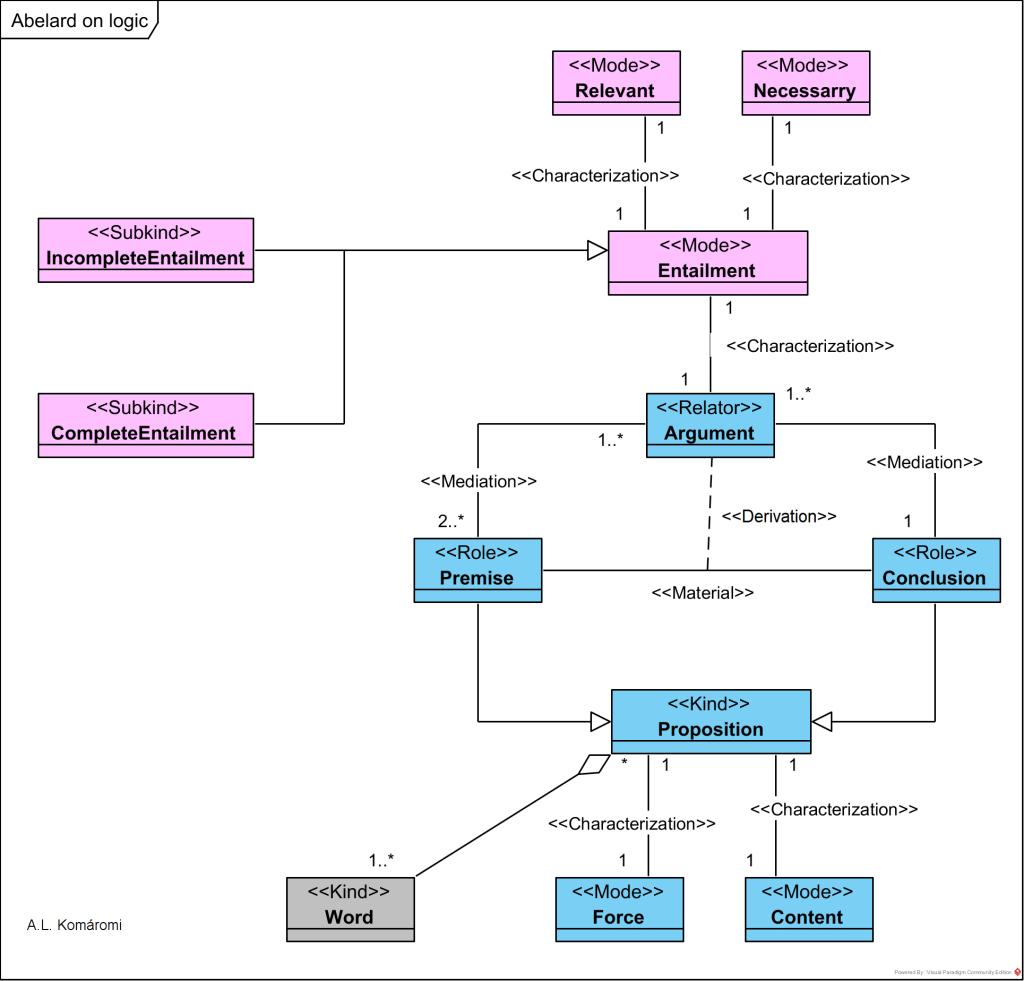
ClassDescriptionRelations
ArgumentArguments relates two (or more) Premises to a Conclusion. According to Abelard, it has to be characterized by entailment, meaning that the connection between the propositions involved to be both necessary and relevant.mediates between Premise and Conclusion
Entailment“The key to the theory of argument, for Abelard, is found in inferentia, best rendered as ‘entailment’ since Abelard requires the connection between the propositions involved to be both necessary and relevant. That is, the conclusion—more exactly, the sense of the final statement—is required by the sense of the preceding statement(s), so that it cannot be otherwise. Abelard often speaks of the sense of the final statement being ‘contained’ in the sense of the preceding statement(s), much as we speak of the conclusion being contained in the premisses.”characterizes Argument
Relevant, Necessary “Abelard requires the connection between the propositions involved to be both necessary and relevant.”characterizes Entailment
IncompleteEntailment“There is another way in which conclusions can be necessary and relevant to their premisses, yet not be formally valid (not be a complete entailment). The necessary connection among the propositions, and the link among their senses, might be a function of non-formal metaphysical truths holding in all possible worlds. For instance, human beings are a kind of animal, so the consequence ‘If Socrates is a human being, Socrates is an animal’ holds of necessity and the sense of the antecedent compels that of the consequent, but it is not formally valid under uniform substitution. Abelard takes such incomplete entailments to hold according to the theory of the topics (to be forms of so-called topical inference). The sample inference above is validated by the topic “from the species”, a set of metaphysical relations one of which is expressible in the rule “Whatever the species is predicated of, so too is the genus” which grounds the inferential force of the entailment. Against Boethius, Abelard maintained that topical rules were only needed for incomplete entailment, and in particular are not required to validate the classical moods of the categorical and hypothetical syllogism mentioned in the preceding paragraph.”
(see also [2.7.2])
is subkind of Entailment
CompleteEntailment“An entailment is complete (perfecta) when it holds in virtue of the logical form (complexio) of the propositions involved. By this, Abelard tells us, he means that the entailment holds under any uniform substitution in its terms, the criterion now associated with Bolzano. The traditional four figures and moods of the categorical syllogism derived from Aristotle, and the doctrine of the hypothetical syllogism derived from Boethius, are all instances of complete entailments, or as we should say, valid inference.”is subkind of Entailment
PropositionA proposition is a sentence with a truth-value (true or false).
WordProposition is made up of words.is non-exlusive part of Proposition
PremisePremise is a previous proposition from which another is entails or follows as a conclusion.is subkind of Proposition; in material relation with Conclusion
ConclusionConclusion is a proposition which follows from a premise as result of an entailment.is subkind of Proposition
Force“Abelard observes that the same propositional content can be expressed with different force in different contexts: the content that Socrates is in the house is expressed in an assertion in ‘Socrates is in the house’; in a question in ‘“Is Socrates in the house?’; in a wish in ‘If only Socrates were in the house!’ and so on. Hence Abelard can distinguish in particular the assertive force of a sentence from its propositional content, a distinction that allows him to point out that the component sentences in a conditional statement are not asserted, though they have the same content they do when asserted— ‘If Socrates is in the kitchen, then Socrates is in the house’ does not assert that Socrates is in the kitchen or that he is in the house, nor do the antecedent or the consequent, although the same form of words could be used outside the scope of the conditional to make such assertions.” characterizes Proposition
Content“Abelard can distinguish in particular the assertive force of a sentence from its propositional content.”characterizes Proposition

Related posts: [1.3.9], [2.2.4], [2.7.2], [3.3.5]

Sources

  • All citations from: King, Peter and Arlig, Andrew, “Peter Abelard”The Stanford Encyclopedia of Philosophy (Fall 2018 Edition), Edward N. Zalta (ed.)

First published: 30/06/2020

[4.4.1] Abelard on Universals

Peter Abelard (“Doctor Scholasticus”, 1079?-1142 AD), in his work Logica Ingredientibus, concluded that the uttered words and the related concepts are the only real universals. According to his nominalist (or irrealist) theory, the individual’s status is the common cause by which we can create a common concept and give a common name to all individuals belonging to the same kind.

Here are Abelard’s responses to Porphyry’s questions (see [2.5]):

Porphyry’s questionsUniversals according to Abelard
(a) whether genera and species [universals] are real or are situated in bare thoughts aloneare situated in thoughts (as concepts and words)
(b) whether as real they are bodies or incorporealsthey are not real things
(c) whether they are separated or in sensibles and have their reality in connection with themthey are not real things

Abelard’s model of universals is presented in the following OntoUML diagram:

Abelard on universals
ClassDescriptionRelations
WordWords here = ‘voces,’ which I said earlier might best be translated ‘utterances’. Only they are predicated of many. […] .”
E.g. ‘man’ – which names and is imposed on Plato, Soctates and Justin Bieber.
names, imposed on Individual; signifies establishes understanding of Concept
Concept“but for Abelard, universals were not just voces but also sermones—significant voces [..]
What are we made to think of when we hear the word ‘man’? In short, what is the link-up between our universal terms, our concepts, and the external world? How are we going to save Abelard’s nominalism from the epistemological skepticism it threatens to yield? This is the meat of Abelard’s theory. Well, here is where considerations about equivocation do apply. If a universal term is going to be univocal, it must establish in us a single understanding, a single concept. (‘Understanding’ in these contexts does not mean the faculty of understanding, but either the act of understanding or else the object of such an act.)
That concept has to be a general concept. But what is it a concept of? Not of a general or universal thing, since there aren’t any, as Abelard has argued at length. Neither does the universal term make us think of individual things, for the reasons we’ve already seen, reasons the objection states and Abelard apparently accepts.”
in material relation with Individual
Status“There must, therefore, Abelard says […], be some common cause or reason why the universal term [concept] is “imposed on” the several individuals it names (“imposition” is the assigning of names to things), and so names the several individuals it does, and which links the name to the general concept we have when we hear the term. This ‘common cause’ is going to be the linkage between our concepts and the world that saves the objectivity of our knowledge. So it’s going to be pretty important. It common cause (?) imposed on, names concept ‘man’ establishes an understanding is whatever it is that answers the question, ‘What is it that links the general concept generated by a universal term with the individual things the term is truly predicable of?
Well, how does it work? We need to look at both sides of the question: (a) at this mysterious “common cause,” and also at (b) the ‘common concept’ that it
grounds […].
Ad (a): We have seen that Abelard criticized William of Champeaux’s second theory for saying that, while Socrates and Plato had two distinct essences, nevertheless they agreed — ‘indifferently,’ to be sure, but ‘agreeing’ nonetheless — in man or in humanity. Abelard thought this was just a verbal smoke screen. He says instead that Socrates and Plato agree, or are alike in being a man, or in that they are men, or in being man […].
So what? What is the big difference here? Well, there is a big difference. A man is a thing — a res. And there is no thing in which Socrates and Plato agree, no thing they can share, as Abelard has already argued at length. Nevertheless, they must somehow agree, there must be some community between them, or else there would be no objective basis for our calling them both ‘men,’ and we would be left with subjectivity and skepticism — and Roscelin’s doctrine.
The common predication of the word ‘man’ of both of them must be tied to reality somehow. Well, Abelard bites the bullet. Since Socrates and Plato cannot ‘agree in’ or share any common thing, and since they must nevertheless have some community, it follows that they must agree in or share some non-thing, something that is not a thing — not a res. They do not agree in man, he says […], but they do agree in being a man (= hominem esse), otherwise translated as ‘to be a man.’ Being a man, therefore, is not a thing. This doesn’t mean that being a man is ‘nothing,’ that it isn’t really out there. It is really out there. It has to be, since there is an important epistemological job for it to do. But it is not a thing — not a res.
Instead, it is what Abelard calls a ‘status’ (fourth declension, so that the plural is ‘stat¨s’ — spelled the same, but with a long ‘¨’). This word ‘status’ as a technical expression is not unique to Abelard in the twelfth century. Other people used the word too. For example, Walter of Mortagne used it. But we shouldn’t assume immediately that the word always means the same thing for all these people. And in fact, in many cases it may not be clear just what a given author means by it. In any case, let’s look at how Abelard is using it here.”
is the common cause for the relation between Individual and Concept
IndividualIndividual

Related posts in theory of Universals: [1.2.2][1.3.1][1.3.2][2.5][2.7.3][4.3.1][4.3.2], [4.4.1][4.5.2], [4.9.8]

Sources

  • All citations from: Spade, Paul Vincent, “History of the Problem of Universals in the Middle Ages”, Indiana University 2009
  • King, Peter and Arlig, Andrew, “Peter Abelard”The Stanford Encyclopedia of Philosophy (Fall 2018 Edition), Edward N. Zalta (ed.)
  • Klima, Gyula, “The Medieval Problem of Universals“, The Stanford Encyclopedia of Philosophy (Winter 2017 Edition), Edward N. Zalta (ed.)
  • Harjeet Singh Gill, “The Abelardian Tradition of Semiotics”, Conference Adress, 1993

First published: 25/06/2020