[4.7.1] Philip the Chancellor on Transcendentals

Philip the Chancellor (1160?-1236 AD) in the work Summa de bono introduces a theory of transcendentals, according to which:

  • transcendentals are properties to be found in all and every thing: being, unity, good, truth
  • they are convertible to each other, are coextensional meaning that “
  • whatever has being also has unity, truth, and goodness”,
  • the division of the transcendentals exists only in the human mind.

The following OntoUML diagram presents Philip the Chancellor’s model of the transcendentals:

Philip the Chancellor on transcendentals
ClassDescriptionRelations
PropertyPropertycharacterizes Category
CategoryAristotelian categories, like Genus, Species (see [1.3.2])
ThingA thing is an individual creature (otherwise particular).inherits from Category
Transcendental“Certain properties fall into none of Aristotle’s categories; rather they are properties of all of the things to which the categories are applicable. For this reason, these properties are said to “transcend” the categories [transcendentals]. inherits form Property
Being“The concept of being is fundamental in that the concepts of the other transcendentals presuppose it.”subkind of Transcendental; characterizes (each and every) Thing
Unity, Good, Truth“Although there is some variation in what is counted as a transcendental, the list generally included being, unity, truth, and goodness. Thus, everything that falls into any of Aristotle’s categories is a being, has a certain sort of unity, and is true and good to a certain extent.
Not only do these properties transcend the categories and as a result, apply to everything classified by the categories, but they are held to be convertible with each other as well. This could mean one of two things. The transcendentals could be coextensional, so that whatever has being also has unity, truth, and goodness. This leaves open the possibility that the transcendentals are separate and distinct from one another. The second option of the convertibility thesis involves a stronger claim, namely, the idea that the transcendentals differ from one another only in concept, not in reality. Unity, truth, and goodness add nothing to a particular being over and above what is already there; everything that is a being is also one, true, and good in virtue of the very same characteristics. […] The various transcendentals do not differ in reality, only in concept. The concept of being is fundamental in that the concepts of the other transcendentals presuppose it. However, the concepts of all of the other transcendentals add a certain basic notion to the notion of being in order to differentiate them from being (see Aertsen 2012, MacDonald 1992). This basic notion is the notion of being that is undivided. Because this is a purely negative notion, it picks out no additional property in reality. The addition of indivision alone yields the concept of unity. To derive the concepts of the true and the good, one adds further the notion of the appropriate cause. The concept of truth involves the idea of the formal cause, that is, the cause in virtue of which matter is enformed, and a thing becomes what it is. Things are true, that is, genuine instances of the kind of thing they are to the extent that they instantiate the form of things of that kind. Thus, the concept of truth is the concept of being that is undivided from a formal cause. Goodness, on the other hand, has to do with being that is undivided from a final cause, that is, a cause that has to do with goals or ends, especially those goals that have been brought to fulfillment. Everything has a particular nature, that is, properties that make that thing a thing of that type. But things can exemplify those properties to a greater or lesser extent. Philip claims that everything has as its goal its own perfection, which means that things move toward exemplifying their specifying characteristics to the greatest extent possible. To the extent that a thing does so, that thing will be good. But that thing will also have being to the same extent. Thus, goodness and being in a given thing coincide in reality, and a thing’s goodness adds nothing over and above the thing’s being. But of course, goodness and being involve two different concepts. Thus, being and goodness have the same extension while differing intensionally. […]
Philip adopts the second notion of convertibility. The various transcendentals do not differ in reality, only in concept. The concept of being is fundamental in that the concepts of the other transcendentals presuppose it.
subkind of Transcendental; characterizes Being

Sources

  • All citations from: McCluskey, Colleen, “Philip the Chancellor”The Stanford Encyclopedia of Philosophy (Summer 2019 Edition), Edward N. Zalta (ed.)

First published: 23/7/2020
Updated: 29/3/2021
Updated: 30/1/2022
[4.5.2] Gilbert of Poitiers on Universals

Gilbert of Poitiers (Gilbert de la Porrée, 1085?–1154 AD) in different commentaries to Boethius’s De Trinitate, De Hebdomadibus, and Contra Eutychen et Nestorium proposes an anti-realist theory of universals, according to which:

  • universals (like genus and species) are sets (collectiones)
  • these sets are based on the resemblance of some essential properties (subsistentiae) of individuals.

Here are Gilbert’s responses to Porphyry’s questions (see [2.5]):

Porphyry’s questionsUniversals according to Gilbert
(a) whether genera and species [universals] are real or are situated in bare thoughts aloneare situated in thoughts (as sets)
(b) whether as real they are bodies or incorporealsthey are not real things
(c) whether they are separated or in sensibles and have their reality in connection with themthey are not real things

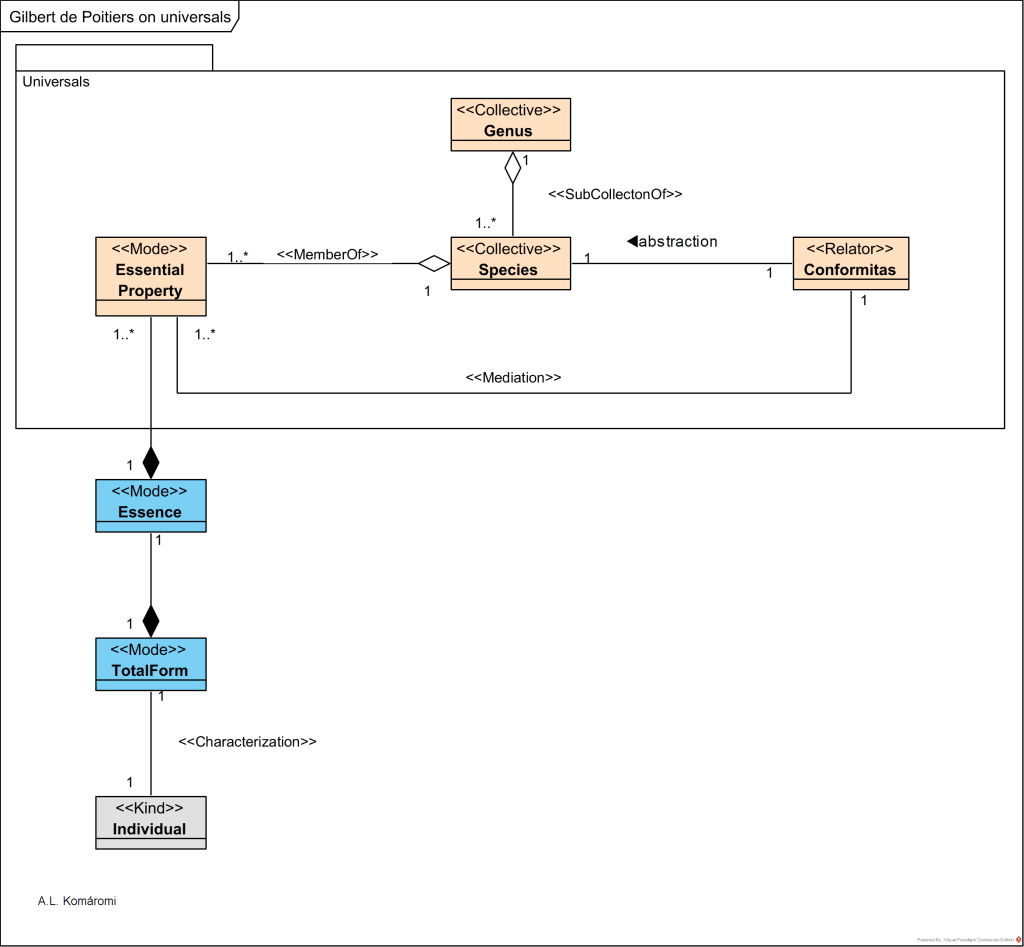
Gilbert’s model of universals is pictured in the following OntoUML diagram:

Gilbert of Poitiers on universals
ClassDescriptionRelations
GenusGenus is a collection of Species
SpeciesSpecies is a collection of EssientialProperites (substancia), based on their resemblance (Conformitas)is subcollection of Genus
Conformitas“For Gilbert, a universal is a collection of properties on the basis of resemblance. His theory is based upon the notion of conformitas. There are many subsistentiae of a given kind, the number of which is the same as that of the subsistents of which they are the being (this thesis is summarized clearly by the author of the Compendium Logicae Porretanum in the formula ‘there are as many humanities as there are men’), and their natural conformity causes their generic or specific union. Gilbert notes that universals are ‘collected from particulars by the intellect.’ The intellect is able to abstract on the basis of conformitas, which is naturally given and may be observed through the manifest resemblance that exists between things in the sensible world. The universal is the union of subsistentiae in virtue of their conformity—union, but not unity.”mediates between EssentialProperies; Species is abstracted (by the Intellect) form Conformitas
Essential Property“An id quo —that is, an essential property—is also called subsistentia, a particular essential property or substantial form determining the being of just one individual. Each individual, or subsistens, is constituted of several subsistentiae. The interest and originality of Gilbert’s position lie in the fact that each of these subsistentiae is particular.”
E.g. The animality of Felix, the cat.
component of Essence
Essence“All these subsistentiae taken together constitute the essence of an individual, which Gilbert calls tota substantia.component of TotalForm
TotalForm“Gilbert offers a very interesting theoretical tool for the consideration of an individual seen over a whole lifetime. He probably pursues the doctrinal aim of ensuring personal identity across time and of avoiding that an individual undergoing qualitative or quantitative change becomes a different individual. Gilbert introduces the concept of forma tota [total form] to refer to the set of all the properties that might be true of a given subject, including also those that will never be actualized. The sum of the essential properties and accidents thus constitutes the forma tota of the individual; the sum of the characteristics of Socrates is called Socrateitas and the sum of those of Plato, Platonitas. According to Gilbert, the tota forma of an individual—for example, Plato’s Platonitas— includes all its subsistences (its substantia tota) but also its quantitative and qualitative accidents—not only those it possesses actually (actu), but also those it possessed in the past and those it will or could possess in future according to the potentiality of its own nature. Expressed as bundle, the forma tota could be understood as the most comprehensive possible bundle. This total form belongs to just one concrete being. The individuality of a concrete being or, in Gilbert’s words, its numerical diversity, is caused by the particularity of its essential properties and rendered manifest by the fact that it possesses its own total form. An anonymous Porretan treatise is explicit when it speaks of the case of the individual Peter. The form which is composed of all the various properties, both essential and accidental, which are in Peter, and which make Peter different from all the other men, is called petritas. This form is particular, and explains how Peter is a being discrete from all other men”.characterizes Individual
Individual“An id quod est is an independent individual, such as Peter, my cat Felix, or this apple. Gilbert uses an alternative terminology: an id quod est, an individual, is also called a subsistens, a subsisting entity. […]
An individual is the sum, the collection of all its essential subsistentiae and particular accidental properties.”

Related posts in theory of Universals: [1.2.2][1.3.1][1.3.2][2.5][2.7.3][4.3.1][4.3.2], [4.4.1], [4.4.1][4.5.2], [4.9.8]

Sources

  • All citations from: Erismann, Christophe, “Explaining Exact Resemblance: Gilbert of Poitiers’s Conformitas Theory Reconsidered”, Oxford Studies in Medieval Philosophy, Volume 2, Edited by ROBERT PASNAU,2014
  • Adamson, Peter, “216. One of a Kind: Gilbert of Poitiers on Individuation“, History of Philosophy without any Gaps podcast

First published: 07/07/2020