
Giordano Bruno (1548–1600) was an original thinker preoccupied with cosmology.
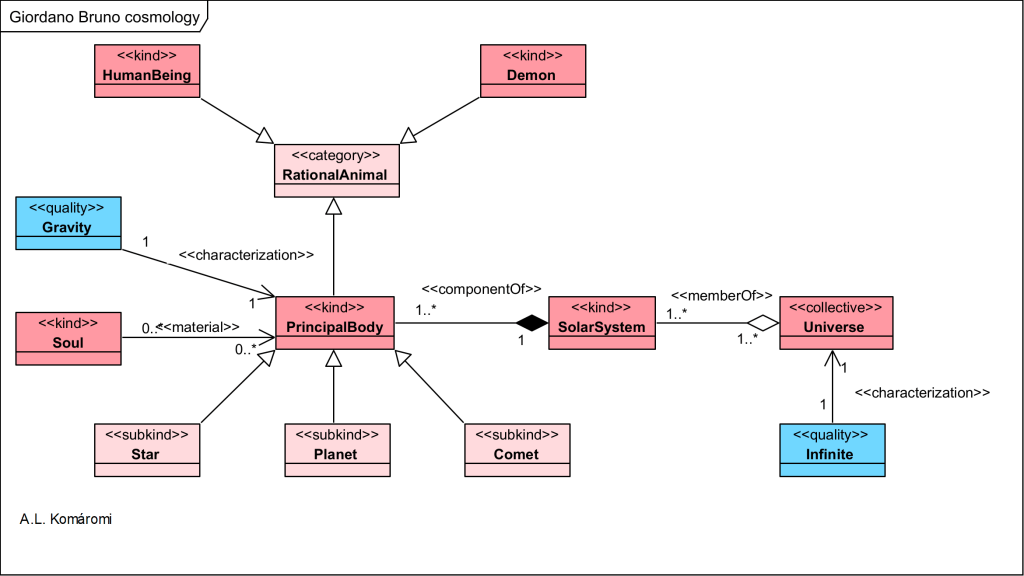
- “The principal bodies, human beings and demons were the three genera of rational animal inhabiting the universe”
- Planets, stars and comets are principal bodies.
- Principal bodies are components of the solar system.
- The solar system is member of the infinite universe.
- Principal bodies are moved by their souls.
- Principal bodies characterized by gravity,
The following OntoUML diagram shows the main classes in Giordano Bruno’s model:
| Class | Description | Relations |
|---|---|---|
| Rational Animal | “The principal bodies, human beings and demons were the three genera of rational animal inhabiting the universe. In one important respect, however, principal bodies were unique. Like accomplished musicians—here Bruno adapted an analogy used by Plotinus and many others to illustrate how nature operated non-discursively according to a final cause—they did not think rationally, proceeding from one thought to the next as they executed their roles. Their intellects dominated their animal bodies, enabling them to move intuitively in accordance with the ends proper to them. Unlike human beings, too, the celestial “animals” were eternal and hence did not reproduce, grow or decay. Though corruptible intrinsically, they were, as the Chaldeans and Plato had taught, sustained by divine providence (for providence, see Section 5). This is, at least, what Bruno tended to think even if he conceded, uncharacteristically, that he was uncertain on this point (Granada, 2000). In all other respects, the principal bodies were animals like any other. Stones and other parts of our earth, for example, might seem inanimate but, as parts of a principle body, they were, like the bones, nails and hair of an animal, alive, if only vestigially. Like animals, too, the principal bodies fed and excreted. They expelled stray particles from the surrounding aether and in compensation emitted others, an idea inspired by Lucretius’s concept of simulacra (On the Nature of Things, IV.54–268). This picture was incompatible with traditional doctrines of the elements. Aristotelian, Neoplatonic and scholastic cosmology distinguished neatly between the super- and sublunary regions” | |
| HumanBeing; Demon | “The principal bodies, human beings and demons were the three genera of rational animal inhabiting the universe.” | category of Rational Animal |
| Universe | “The universe was not, Bruno insisted, a finite globe composed of concentric spheres, “like an onion” (BOL I.2, 261), to use a common simile. Instead it was an infinite, homogeneous expanse populated by an infinite number of solar systems like our own.” | |
| Infinite | “Instead it was an infinite, homogeneous expanse populated by an infinite number of solar systems like our own | characterizes universe |
| SolarSystem | “Instead it was an infinite, homogeneous expanse populated by an infinite number of solar systems like our own.” | memberOf Universe |
| PrincipalBody | “The celestial or, as Bruno called them, “principal” bodies glided weightlessly within an infinite “receptacle” or “expanse” of aether (BOI II, 110) like specks of dust in the sunlit air (BOL I.1, 262; I.2, 91). What made them move? Their souls. They were animate and, as their orderly patterns of motion attested, intelligent too. Aristotle had suggested this among other possible explanations for celestial motion. Most patristic and scholastic authors, anxious to discourage polytheism, had rejected the idea. Ficino’s revival of Platonism, however, had given a new lease of life to the idea that the celestial bodies were animate. True to form, Bruno, though indebted to Ficino on this as on many other scores, quoted the Book of Job (28:20–21) as his authority. In each solar system or, in Bruno’s terminology, “synod” the suns and earth regulated their motions autonomously to their mutual advantage. From the earths, the suns absorbed vaporous exhalations. In exchange the sun produced the light and heat that the earths, as “animals”, needed in order to host living things. No part of them remained forever barren thanks to the several approximately circular revolutions that they performed. Nature, for Bruno no less than for Aristotle, did nothing in vain (BOL III, 108). […] The infinite number of celestial bodies corresponded to “those so many hundreds of thousands [of angels]”—an allusion to Daniel 7:10—“that assist in the ministry and contemplation of the first, universal, infinite and eternal efficient cause. […] In keeping with these ideas, Bruno populated the principal bodies with life-forms of every kind. Each region of each principal body comprised matter which, circumstances permitting, became a plant or animal, even a rational animal. This last category included human beings and also demons, in other words, rational beings with rarefied bodies made of pure aether or combinations of aether with air, water or earth. The latter, to judge by the demons frequenting the elemental regions of our globe, were generally, but by no means invariably, more intelligent than human beings. Within the mountains were dim-witted troglodytes jealously guarding the earth’s mineral veins (BOL I.2, 61, 282; III, 431). Long-living but of feeble intelligence, they had little commerce with human beings. Stone-throwing demons, another species of earthy demon, of the kind described by the Byzantine author Michael Psellos, had lairs in the vicinity of Nola and habitually pelted those who passed nearby at night, as Bruno knew from personal experience (BOL III, 431). Nymphs with predominantly aqueous bodies lived secluded in grottos (BOL I.2, 282; III, 181). The variety of demonic life was such that it “far surpassed that of sensible things” (BOL III, 427, 429). A comparable diversity was evident among human beings, who differed in skin colour and stature from region to region (BOL I.2, 282, 284). The variations reflected their diverse habitats. When extinguished by a cataclysm of some kind, they regenerated spontaneously (BOL I.2, 282), in the manner that Avicenna and, if only as a philosophical possibility, some Christian authors had described. The novelty in Bruno’s interpretation was the idea that spontaneous generation explained the variety of life in an infinite and infinitely varied universe rather than the survival of a privileged species on this earth.” | category of Rational Animal; componentOf SolarSystem; in material relation with Soul; characterizes Gravity |
| Soul | [The principal bodies] “What made them move? Their souls” | |
| Star | “Timely support came from contemporary accounts of the 1572 supernova and theories about comets proposed by Tycho Brahe and others (Tessicini 2007, 112–150). The birth of a new star proved that generation did, after all, occur in the superlunary region”. | subkindOf PrincipalBody |
| Planet | “How and when Bruno began to develop what he called his “new philosophy” is uncertain (Granada 1990). His earliest surviving philosophical work, On the Shadows of the Ideas, dated 1582, hints at a few of its propositions, including heliocentrism (BOL II.1, 7–8). The first detailed statement, however, came in The Ash Wednesday Supper, published at London in 1584, in which he set out his interpretation of Copernicus’s heliocentric hypothesis, as explained in On the Revolutions (1543). Dismissing contemporary claims that Copernicus’s hypothesis was merely a convenient computational device, Bruno announced that it disproved the traditional Aristotelian-Ptolemaic picture of the cosmos. In the first place, it disproved Aristotle’s doctrine that each sublunary element had a fixed “natural place” at the centre of the cosmos—the earth’s globe at the very centre, water in the sphere immediately surrounding it, followed by the air and fire spheres—and that particles of the elements, if displaced from these natural spheres, had an intrinsic impulse to regain them. On the contrary, since the earth, Bruno explained, [the Earth] was a planet circling the sun, the elemental spheres of which it was constituted were continuously in motion. The elements did not have absolute “natural places”; and an elemental part, whether displaced from a whole or chancing to be near a whole, sought to attach itself to it because a whole was the place where it would be best preserved. Once united with a whole, elemental parts were no longer heavy or light and revolved with it naturally, that is, without resistance. This doctrine of gravity drew on Ficino’s Neoplatonic ideas of elemental motion, Copernicus’s doctrine of gravity, Lucretius’s comments on the weightlessness of parts in their wholes and scholastic notions of self-conservation (Knox 2002).” | subkindOf PrincipalBody |
| Comet | “As for comets, they were indeed, as Aristotle and others held, composed of the same elements as other sublunary things but they were not, as they had concluded, sublunary phenomena peculiar to the air and fire spheres. Their trajectories proved that were superlunary objects or, more exactly, planets which, owing to the incline at which they revolved around the sun, only intermittently reflected the sun’s light towards the earth. The supposedly sublunary elements occurred in the superlunary region! In short, not only reason but also observation disproved the notion of a cosmos divided into two finite regions of contrasting properties (BOL I.1, 219–221). This was a vivid example of Bruno’s constant refrain that the senses, regulated by reason, could be used to advantage (BOI II, 10, 136–137; BOL I.2, 196, 218; II.2, 78; Firpo 2000, 57, doc. 11).” | subkindOf PrincipalBody |
| Gravity | “The [aristotelian] elements did not have absolute “natural places”; and an elemental part, whether displaced from a whole or chancing to be near a whole, sought to attach itself to it because a whole was the place where it would be best preserved. Once united with a whole, elemental parts were no longer heavy or light and revolved with it naturally, that is, without resistance. This doctrine of gravity drew on Ficino’s Neoplatonic ideas of elemental motion, Copernicus’s doctrine of gravity, Lucretius’s comments on the weightlessness of parts in their wholes and scholastic notions of self-conservation (Knox 2002).” |
Sources
- Knox, Dilwyn, “Giordano Bruno“, The Stanford Encyclopedia of Philosophy (Summer 2019 Edition), Edward N. Zalta (ed.)
First published: 8/2/2023
 Philosophy Models