[3.3.1] Ibn Sina’s Metaphysics

Ibn Sina (Avicenna 980-1037 AD) presents his metaphysical framework in the treatise Ilāhiyyāt of Kitāb al-Šifā’ (known in English as the Metaphysics of the Book of the Healing or the Book of the Cure), in which:

  • Existence is separated being (a thing), the latter is named quiddity (or essence). We can comprehend the quiddity of a thing without knowing anything about its existence. 
  • Things can be material singulars – sensibles, externals to the human, and concepts in the human mind. The corresponding mental and external existence is on the par for Ibn Sina.
  • thing is a composition of existence and quiddity.
  • The necessary existent is it’s own existence, and as such is necessary; all the other things are contingent.

as presented in the OntoUML diagram below:

Ibn Sina’s (Avicenna) methaphysics
ClassDescriptionRelations
Necessary
Existent
“the Necessary Existent has no essence or no quiddity that differs from existence (anniyya) and is therefore beyond essence. The first attribute of the Principle is ‘that It is and that It is existent’ (inn wa-mawǧūd): existence is not what It ‘has’: It simply is […] absolutely necessary and simply coincides with, or more exactly, is Its own existence… The Necessary Existent has no cause. It has relations in so far as it is existent. […] the ‘thing’ in question is only necessary existence, it has no quiddity (or no quiddity beyond its existence) and is not, properly speaking, a “thing” (Bertolacci 2012a): in this case, in fact, what is revealed is the existence of the Necessary Principle, which is pure existence on condition of not and can therefore be conceived beyond essence and thingness.” [3]
Necessary Existent is also referred asFirst Principle.
is its own Existence
ExistenceExistence (al-mawǧūd) can be: mental, external, and the existence of the Necessarry Existent. Existence and being (a thing) are distinct.
“Avicenna posits a distinction between the being of the thing and its existence. Clearly, then, the fundamental and primary character of being does not imply simplicity: to exist means to be a given entity in the world or—as Avicenna also uses it—a ‘thing’. The existence of something must thus be distinguished from its being what it is.” [3]
Mental
Existence
“everything that is conceived of or simply mentally represented exists and hence has at least a mental existence (which means either intellectual or imaginary or estimative). Indeed, the existent as such is immaterial and only non-existence in the absolute sense does (obviously) not exist, since it cannot be either conceived or discussed” (Lizzini, 2019)descendant of Existence; characterizes Concept
External
Existence
External existence (fī l-ʿayān) is existence in concrete material singulars.descendant of Existence; characterizes MaterialSingular
QuiddityQuiddity (māhiyya), essence or thingness is independent of existence, and necessarily accompanies the thing, be it particular or universal.

“the quiddity or essence of a thing is not in its turn a thing” with its own mental existence so that, once added to (real) existence, it could become a real thing… What Avicenna states by distinguishing quiddity and existence is that quiddity does not coincide with its existence: neither with its mental existence, which is related but does not correspond to universality, nor with its concrete existence (fī l-ʿayān), which implies individuality… The indifference of quiddity to any kind of existence and determination truly establishes the correspondence between reality and knowledge: it is exactly because quiddity is in itself neither real nor mental that it can be present both in reality and in the mind, accompanied by the determinations of either individuality or universality: in concrete reality there is x in its particular existence, while in the mind there is x with its possible multiple predication. In this respect, the consideration of quiddity in itself—which corresponds to the thing in itself as expressed by its definition—transcends both levels of existence (external and mental) and in one passage is equated to the “divine existence” (wuǧūd ilāhī) of something that depends on God’s providence.” [3] E.g. horseness” (which is common in the concept of the horse, and in Tucker, the horse).
is shared part of the Thing, Concept and MaterialSingular
Thing“In every thing the distinction between what the thing is and the fact that it is is inevitable. Existence can consequently be said to be external to essence, so that an existing thing, whose essence or quiddity is possible, can be said to be composed of essence and existence. […]
In order to ask what a thing is, one cannot avoid referring to being, which is exactly what allows us to conceive all things, whether they are sensible, imaginary or intelligible, as existent. [3]
Has Existence
ConceptConcept is the understood quiddity of things.Exclusive part of Mind
UniversalUniversal is the concept in the mind related to a material singular: “the one concept is related by the mind to many, and in this way it is universal”. [3]
“And the soul itself also conceptualizes another universal which unites this form with another one in this soul or in another soul; but all of them, insofar as they are in the soul, have a single definition.” [5]
E.g: horse”
MentalExistence and Quiddity are parts of it
FictionalBeing“the natures or quiddities of even such fictional beings as phoenixes and unicorns do indeed exist, although they have only a mental, and not a concrete, mode of existence” [4]Is subkind of Concept
MaterialSingularMaterial singulars are are concrete, external things.
E.g. horses like: Lilly, Tucker, Spirit
Is descendant of Thing
HumanA human personSubkind of MaterialSingular
MindA human mindexclusive part of Human; subkind of MaterialSingular
ModalityModality “explains the relation that what exists has to its own existence: an existent [thing] can be either necessary in itself (ḍarūrī; wāǧib: it is then also necessarily one) or possible (mumkin, contingency) in itself” [3] – this is the case of every existent with the exception of the Necessary Existent.
NecessityNecessitycharacterizes NecessaryExistent; descendant of Modality
ContingencyContingency or Possibility characterizes the Thing: it is possible for the quiddity of the thing to gain existence and also not.characterizes Thing; descendant of Modality

Sources

  • All citations from: Lizzini, Olga, “Ibn Sina’s Metaphysics”The Stanford Encyclopedia of Philosophy (Summer 2019 Edition), Edward N. Zalta (ed.)
  • Raja Bahlul, “Avicenna and the Problem of Universals”, Philosophy & Theology 21  

First published: 01/08/2019
Updated: 01/01/2021 added Human, Mind, Concept, FictionalBeing
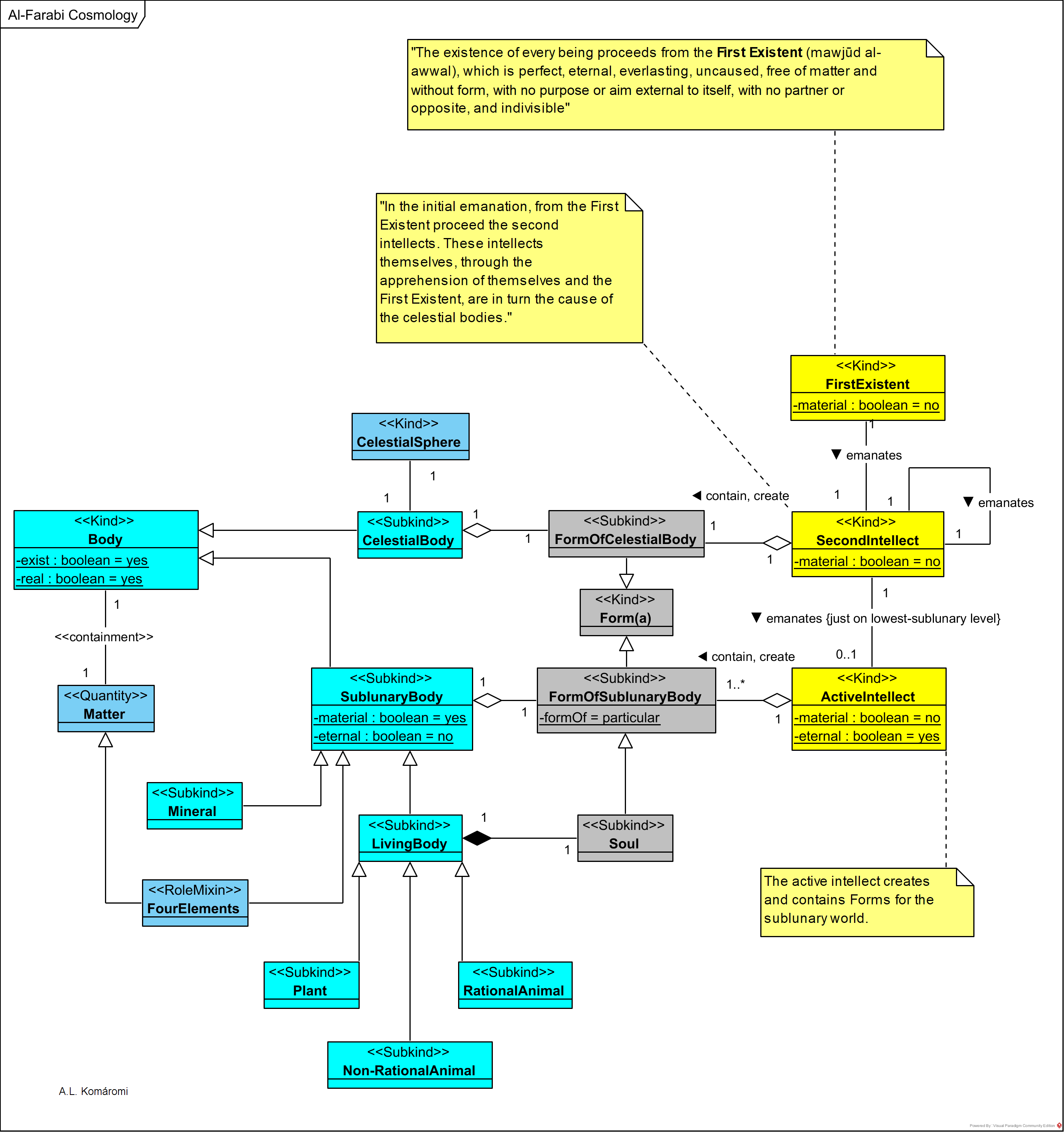
[3.2.1] Al-Farabi’s Cosmology

In The Political Regime and The Virtuous City, al-Fārābī (872-950 AD) provides a metaphysical and ontological model of the universe, combining:

  • Neoplatonic emanationism (see [2.4.2])
  • Aristotelian views on the celestial spheres
  • and hylomorphism (see [1.3.5], [1.3.7])

as can be observed in the following OntoUML diagram:

Al-Farabi’s cosmology
ClassDescriptionRelations
FirstExistentAl- Fārābī identifies the First Existent with God, who is the source of revelation for Rational Animals (Man) through the Active Intellect.
“According to the emanation (fayḍ) process described by al-Fārābī, the existence of every being proceeds from the First Existent (mawjūd al-awwal), which is perfect, eternal, everlasting, uncaused, free of matter and without form, with no purpose or aim external to itself, with no partner or opposite, and indivisible. The First Existent is distinguished from all other beings due to its oneness, which is its essence. This description seems very close to the Neoplatonic conception of the One, but it is not exactly the same. Al-Fārābī instead argues that, given that this First Existent is not in matter and has no matter, it should be an actual intellect (‘aql bi’l fi‘l). The First Existent is also intelligible (ma‘qūl) through its substance, and its identity consists in simultaneously being the act, the subject, and the object of its own intellection.”
emanates highest SecondIntellect
SecondIntellectEach Second Intellect creates and contains a Form for a CelestialBody (e.g. the form of Saturn), and emanates a next level of Intellect.

“Every existent comes to be, according to al-Fārābī, by the First Existent. This takes place through a sort of expansion or emanation through which the First Existent necessarily gives existence to every being in the universe. Yet this does not imply any addition to its own perfection. In the initial emanation, from the First Existent proceed the second intellects. These intellects themselves, through the apprehension of themselves and the First Existent, are in turn the cause of the celestial bodies.”
contains FormOfCelestialBody; emanates next level of SecondIntellect
ActiveIntellect The active intellect creates and contains particular Forms for the particular Bodies in the sublunary world. E.g. creates the form of the Mont Blanc.

“There is a tenth intellect, namely, the active intellect (‘aql al-fa ‘‘āl), whose activity is very relevant mainly for two reasons: (1) this intellect governs together with the celestial spheres the sublunary world, and is even involved in the processes of generation and corruption (al-Fārābī LI: 29–30; OI: 75); (2) furthermore… this intellect also provides the first principles of understanding through which human beings can attain happiness (al-Fārābī VC: 204–205)”
contains FormsOfSublunaryBody; is emanated by the lowest SecondIntellectIntellect (Moon)
FormOf
Celestial
Body
The Form of Celestial Body is created by the corresponding Second Intellect.contained by a SecondIntelect; part of a CelestialBody
CelestialBody “..fixed stars, Saturn, Jupiter, Mars, the sun, Venus, Mercury, and the Moon.” is subkind of Body; Composed of FormOfCelestialBody and Matter
Celestial
Sphere
“In The Virtuous City he explicitly enumerates nine spheres starting with the first heaven, and then the fixed stars, Saturn, Jupiter, Mars, the sun, Venus, Mercury, and the Moon.”associated with 1 CelestialBody
FormOf
Sublunary
Body
A multidude of Forms of particular sublunary bodies are created by the ActiveIntellect. E.g. form of the Mont Blanc. contained by a ActiveIntelect; part of a SublunaryBody
Soul
The soul is the Form of particular a Living Body.
“Al-Fārābī describes the soul as Aristotle did in On the Soul 2.1, 412a19, that is, as the form or actualization (ἐντελέχεια / antalāshiyā or at-tamām) of a natural organic body that potentially has life. Living beings have different faculties: the nutritive, sensitive, appetitive, and rational faculties.”
E.g. the soul of Aristotle, created and contained by the Active Intellect.
FormForms can be of Celestial and Sublunary Bodies.
“there are also different kinds of forms, some of them of lower perfection, as the form of minerals or plants, and others more perfect, as the form of rational animals. This perfection is given by the faculties that each body has according to its natural disposition: while plants have basic faculties such as nutrition or reproduction, rational animals have a higher faculty, the intellect, which enables human beings to attain intelligibles in act.Forms can be of Celestial and Sublunary Bodies.”
Body“Al-Fārābī explains that the universe contains six kinds of body. In decreasing order of perfection, there are: (1) celestial bodies, (2) rational animals, (3) non-rational animals, (4) plants, (5) minerals, and (6) the four elements (al-Fārābī KS: 31; PR: 29).”contains Matter
SublunaryBodySublunary Bodies can be:
– Living Bodies: rational animals, non-rational animals, plants,
– minerals, and the four elements
E.g. Mont Blanc
contains FormOfSublunaryBody
LivingBodyLiving Bodies: rational animals, non-rational animals, plants
E.g. Aristotle as a human being, with Soul created by the Active Intellect and body created from matter.
contains Soul
RationalAnimalrational animals have a higher faculty, the intellect, which enables human beings to attain intelligibles in act.”is LivingBody
Non-Rational
Animal
Non-Rational Animal is Living Body.is LivingBody
Plant Plant is Living Body.is LivingBody
MineralMinaral is Sublunary Body.is SublunaryBody
FourElementsThe FourElements are Sublunary Body and Matter at the same time.
“The four elements proceed from prime matter and, when these elements combine and mix in different ways and undergo the influence of the heavenly bodies, they generate numerous kinds of bodies: minerals, plants, non-rational animals, and rational animals (al-Fārābī VC: 112–115).”
is Sublunary Body and Matter
Matter“Concerning the origin and composition of matter, al-Fārābī explains that the circular motion of the celestial spheres generates prime matter (al-madda al-ūlā), which is common to all bodies in the sublunary world… Given that matter is the substratum of form, the different forms appear when the combination of the elements takes place, giving rise to different kinds of bodies.”

Hylomorphism (see [1.3.5], [1.3.7]) can be observed in the following relations:

  • Matter – CelestialBody – FormOfCelestialBody
  • Matter – SublunaryBody – FormOfSublunaryBody
  • Matter – LivingBody – Soul

Sources

  • All citations from: López-Farjeat, Luis Xavier, “Al-Farabi’s Psychology and Epistemology”The Stanford Encyclopedia of Philosophy (Summer 2018 Edition), Edward N. Zalta (ed.)
  • Herbert A. Davidson, “Alfarabi, Avicenna, and Averroes, on Intellect”, Oxford University Press 1992
  • Amelia Carolina Sparavigna, “The Ten Spheres of Al-Farabi: A Medieval Cosmology, Article in International Journal of Sciences January 2014

First published: 11/07/2019