[6.3.0] Marsilio Ficino Ontology

Marsilio Ficino (1433–99) in Theologia platonica (Platonic Theology), outlines his ontological scheme (see also ):

  • “That said, Ficino did, in numerous places, suggest a five-part (instead of a four-part) ontological scheme, which began with God, followed by Angelic Mind, Rational Soul (in which human beings take part), “Quality” (a kind of ontological glue that stands between matter and soul), and finally matter, the level in which we human beings are embodied and from which we must try to liberate ourselves by living a philosophical life.”
  • The rational soul is a component of the human being.
  • The rational soul is immortal.

The following OntoUML diagram shows the main classes in Ficino’s model:

Ficino Metaphysics
ClassDescription Relations
God“That said, Ficino did, in numerous places, suggest a five-part (instead of a four-part) ontological scheme, which began with God, followed by Angelic Mind, Rational Soul (in which human beings take part), “Quality” (a kind of ontological glue that stands between matter and soul), and finally matter, the level in which we human beings are embodied and from which we must try to liberate ourselves by living a philosophical life.”
AngelicMind“…followed by Angelic Mind…”
RationalSoul
“… Rational Soul (in which human beings take part), …”componentOf HumanBeing
Quality“Quality” (a kind of ontological glue that stands between matter and soul), and finally matter, the level in which we human beings are embodied and from which we must try to liberate ourselves by living a philosophical life.”mediates RationalSoul
Matter“… that stands between matter and soul …”
HumanBeing“… Rational Soul (in which human beings take part), …
Immortal“Similarly, he shared much with Plotinus when it came to psychology, the study of the soul. The immortality of the human soul represented Ficino’s main preoccupation, fearing as he did the potential loss of belief among intellectual elites. He entitled the first chapter of his Platonic Theology accordingly: “Were the soul not immortal, no creature would be more miserable than man.”
 (Allen and Hankins 2001–06, 1.1, vol. 1, p. 14–15)
characteries RationalSoul

Sources

  • Celenza, Christopher S., “Marsilio Ficino”, The Stanford Encyclopedia of Philosophy (Winter 2021 Edition), Edward N. Zalta (ed.).

First published: 29/9/2022
[5.1.0] John Italos on Universals

John Italos (c. 1025-1082) elaborated on a three-tiered model of universals:

Universals are:

  • Universal In The Particulars;
  • Universal Before Many Particulars;
  • Universal After The Particulars

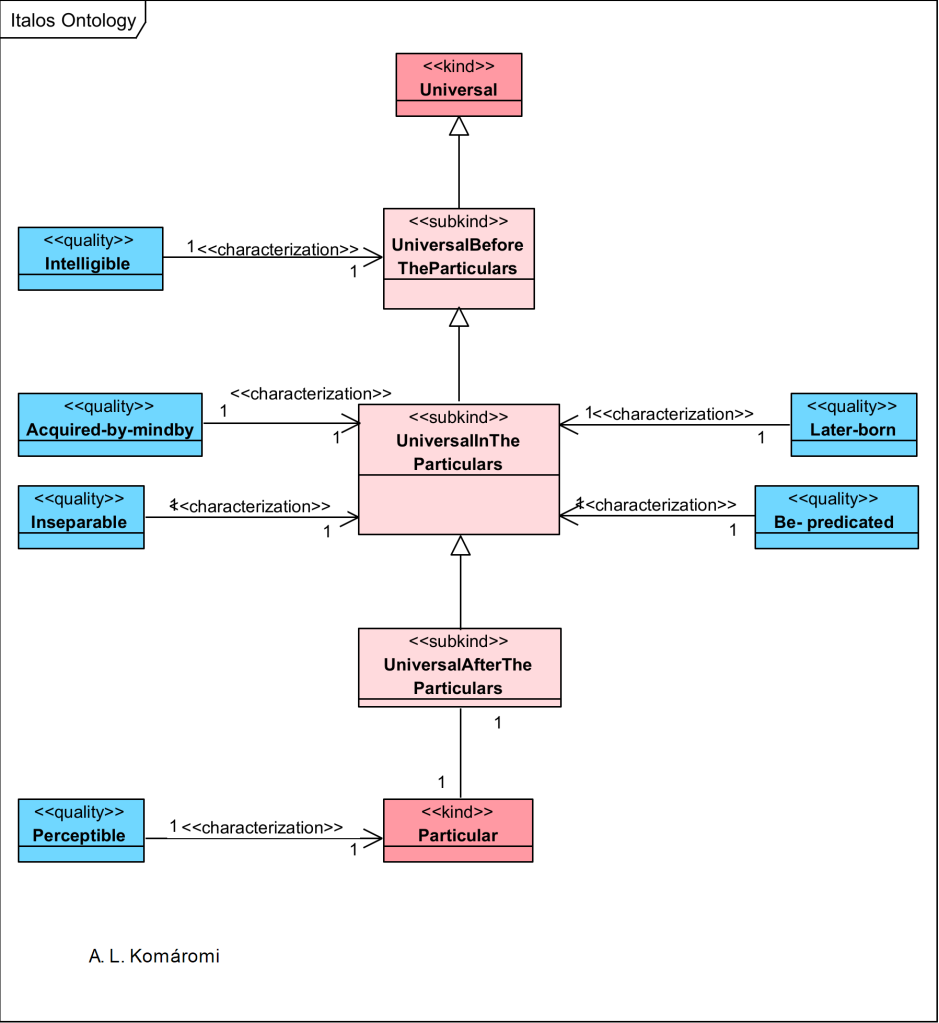
The following OntoUML diagram shows the main classes in this model:

Italos on universals

CLASSDESCRIPTIONRELATIONS
Universal“Italos talks about the same three types of universals in the same order, but a certain detail of his account proves to be important. Italos, too, regards the universals before the many particulars the causes (aitia/prtourga ) and paradigms (paradeigm ata) of perceptible individuals, which hence cannot be predicated of them, are separable from them (christa ), and in God’s mind (para/en t the), perfectly accommodating in this way the requirements of Christian Dogma (p p . 7.15-19 ; 29-32); but, then, he presents the distinction between the universals in the particulars and the universals after the particulars in a different manner.”
UniversalBeforeTheParticulars“the universals before the many particulars (pro t n poll n ), which are generally identified with the Platonic Ideas”subkind of Universal; characterizes UniversalBeforeManyParticulars
UniversalInTheParticulars“the universals in the particulars (en tois pollo is), which represent Aristotle’s notion of immanent forms”subkind of the UniversalBeforeMany particulars; characterizes UniversalInTheParticulars
UniversalAfterTheParticulars“the universals after the particulars (epi tois pollo is), which concepts or thoughts.”subkind of UniversalInTheParticulars
Intelligible“On the other hand, the universal after the particulars are intelligible in a certain way, most probably because they are acquired by our mind by abstraction and they also are perceptible in a certain way, most probably because they are acquired by abstraction of the common characteristics of perceptible individuals.”
Later-born; Be-predicated; Inseparable; Acquired-by-mind“Italos claims (p . 8.1-14) that both the universals in the particulars and the universals after the particulars differ from the universals before the particulars, because they both are later-born than the perceptible individuals (husterogen), can be predicted of them (kat goroumena), are inseparable from them (achrista ), and are acquired by our mind by abstraction (k at ’ aph airesin ).”
ParticularA particular thingcharacterizes Particular
PerceptiblePerceptible

Related posts in theory of Universals: [1.2.2][1.3.1][1.3.2][2.5][2.7.3][4.3.1][4.3.2][4.4.1][4.5.2][4.9.8][4.11][4.15.6], [4.18.8]

Sources

First published: 1/9/2022