[3.4] Ibn Gabirol on Cosmology and Universal Hylomorphism

Jewish philosopher and poet Solomon ben Judah Ibn Gabirol (or Ibn Jabirul in Arabic; Avicebron in Latin, 1021/2-1057/8 AD) in his work Fons Vitae envisioned a cosmology, which is:

  • emanationist in a neoplatonist sense, like that of Plotinus, al-Farabi, Avicenna (see [2.4.2], [3.2.1], [3.3.2])
  • emphasizes the importance of the Devine Will
  • and distinctively introduces universal hylomorphism (for hylomorphism see [1.3.5] and [1.3.7]), meaning that the (universal) intellect and soul – not just the bodies – are compound of matter and form.

Here is a OntoUML representation of Ibn Gabirol’s cosmology:

Ibn Gabirol cosmology and universal hylomorphism
ClassDescription Relations
God“Ibn Gabirol’s God is described as a Creator God who is an absolute simple unity—so simple as to exceed the grasp of the human mind and tongue.” relates to Matter and DivineWill
Matter “God’s formative act begins with creating matter and form (possibly a creation ex nihilo, but described fluidly enough as to leave open other interpretations)”
Form “God’s formative act begins with creating…form…  form, on the contrary, arising somewhat secondarily from the Divine Will.”relates to DivineWill
DivineWillWill is identified also with Wisdom and Word.
“Turning further to Will’s mediating cosmic role, while the Latin text translates “intermediary between the extremes,” the Arabic text uses a dual grammatical form, translating more specifically as “intermediary between the two extremes…, Ibn Gabirol might mean that Will intermediates between (1) matter and (2) form, the two cosmic “building blocks” out of which all reality is comprised.”
mediates between Matter and Form
UniversalIntellect “In Ibn Gabirol’s cosmology, Intellect is highlighted as the first created being, as the Divine Glory (Kavod),and as the first occurrence of “form in matter” composition… Pure universal matter is thus coupled—in a process overseen by Divine Will—with a pure universal form to yield the first fully existing substance, Universal Intellect.”
PureMatter“Ibn Gabirol describes pure matter as stemming directly from the Divine Essence itself… existent in and of itself, of a single essence, sustaining diversity, and giving to everything its essence and name”is contained by UniversalIntellect; is Matter
PureFormThe closest Form to the Devine Will, contained in the Universal Intellect. is component of UniversalIntellect; is Form
UniversalSoul Ibn Gabirol also envisions not one but three Universal Soulsrelates to UniversalIntellect and itself (there are 3 souls in a chain of emanation)
MatterSMatter of the Universal Soul is contained by UniversalSoul; is Matter
FormSForm of the Universal Soulis component of UniversalSoul; is Form
CeletialBodyCelestial Bodies are: Fixed Stars, Saturn, Jupiter, Mars, Sun, Venus, Mercury, Moonrelates to UniversalSoul and itself (there are 8 bodies in a chain of emanation)
MatterCMatter of the Celestial Bodyis contained by CelestialBody; is Matter
FormCForm of the Celestial Body is component of CelestialBody; is Form
TerrestrialBodyAll bodies on the Earth relates to CeletialBody
LowerMatterForm of the Celestial Body is contained by TerrestrialBody; is Matter
LowerForm Form of the Celestial Body is component of TerrestrialBody; is Form

The following triplets present hylomorphic structure:

  • PureMatter – UniversalIntellect – PureForm
  • MatterS – UniversalSoul – FormS
  • MatterC – CeletialBody – FormC
  • LowerMatter – TerrestrialBody – LowerForm

Sources

First published: 12/09/2019

[3.3.5] Ontological Structure of Ibn Sina’s Logic

Ibn Sina (Avicenna, 980-1037 AD) was the most crucial logician in the Arabic tradition. He synthesized, re-framed and extended the problems and solutions inherited from Aristotle and the Peripatetic tradition, e.g.:

  • enriched Aristotelian term logic [3.3.9] with the systematical and detailed consideration of modality and reading (see Categorical Propositions),
  • introduced propositional logic different from the Stoic one [3.5.4] (see Hypothetical Propositions).

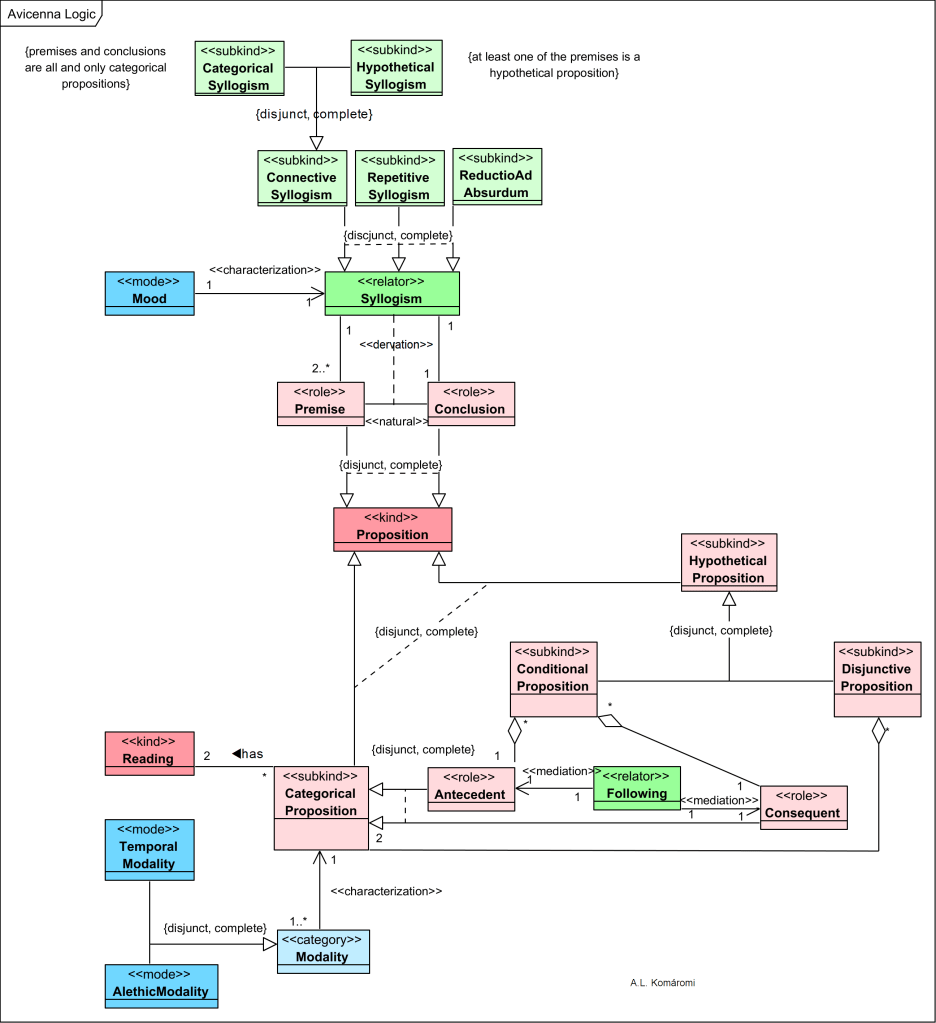
Here is a very high level OntoUML representation of Avicenna’s logic:

Avicenna on logic
ClassDescriptionRelations
PropositionProposition (qaḍiyya) according to Avicenna can be (1) categoricals, and (2) hypotheticals. 
Categorical
Proposition
Categorical (ḥamliyyāt) propositions are subject (mawḍūʿ)-predicate (maḥmūl) propositions expressing a relation (nisba) or judgment (ḥukm) between terms.”
E.g.: “Avicenna is man.”
“All man are mortal.”
is Proposition
Hypothetical
Proposition
Hypotheticals (šarṭiyyāt) comprise two main sub-types, depending on whether the component sentences are in connection (ittiṣāl) or in conflict (ʿinād)… The resulting propositional types are conditionals (muttaṣilāt) and disjunctions (munfaṣilāt)…”is Proposition
Conditional
Proposition
The Conditional proposition is formulating a relation of following (ittibāʿ) between and two propositions, an antecedent (muqaddam) and a consequent (tālin).
E.g.If [the sun rises], then [it is day].”
is Hypothetical Proposition
Disjunctive
Proposition
The Disjunctive Proposition expresses a conflict in terms of a disjunction of propositions (or parts, ağzāʾ).
E.g.Either [this number is even] or [<this number> is odd].”
is Hypothetical Proposition
AntecedentAntecedent is a possible role of a Categorical Proposition in a Conditional Proposition, where designates a condition.
E.g.[the sun rises]”
is shared part of Conditional proposition; is Categorical Proposition
ConsequentConsequent is a possible role of a Categorical Proposition in a Conditional Proposition, where designates a consequence of the Antecedent.
E.g.[it is day].”
is shared part of Conditional proposition; is Categorical Proposition
FollowingThe relation of following between antecedent and consequent in conditional propositions.Relates Antecedent with Consequent
ModalityModality: every categorical proposition is modalized, either implicitly or explicitly. The modality may be either temporal […], alethic […], or a combination of both.”Characterizes Categorical Proposition
Temporal
Modality
Temporal Modality can be e.g.: sometime, always, never etc.inherits from Modality
Alethic
Modality
Alethic Modality can be e.g.: necessarily, possibly, impossibly etc. inherits from Modality
Readingevery categorical proposition is subject to an additional reading, depending on whether the proposition is taken to express a relation between the predicate and what is picked out by the subject:”
(a) referential/substantial (ḏātī): “as long as what is picked out by the subject exists (mā dāma mawğūd aḏ-ḏāt) or
(b) descriptional (waṣfī): “as long as it is qualified—or ‘described’ (mā dāma mawṣūf)—by the subject. This move amounts to adding a temporal parameter that identifies”
is related to Categorical Proposition
SyllogismSillogism is an inference with two ore more premises, and having as conclusion a proposition. the terms of which are just those two terms not shared by the premises.
E.g. P1: “All man are mortal.” P2: “Avicenna is man,” C: “Avicenna is mortal.”
relates 2 or more premises and 1 conclusion;
Connective
Syllogism
Connective syllogisms are divided into two main types: (1) categorical (ḥamlī) and (2) hypothetical (šarṭī) syllogisms.” is Syllogism
Repetitive
Syllogism
“The repetitive (istiṯnāʾī) syllogistic covers inference patterns such as modus ponens and modus tollens (in their conditional and disjunctive variants)…
Repetitive syllogisms consist of (i) a hypothetical premise (conditional or disjunctive) containing the conclusion or its negation as one of its parts, and (ii) another premise which asserts or denies (and thereby “repeats”) part of the hypothetical premise.”
is Syllogism
ReductioAd
Absurdum
“A reductio [ad absurdum] is a compound syllogism (qiyās murakkab)—i.e., a concatenation of syllogisms—consisting of a connective hypothetical syllogism and of a repetitive syllogism. Both categorical and hypothetical propositions may be proved by reductio.”is Syllogism
Categorical
Syllogism
Categorical syllogisms are those whose premises and conclusions are all and only categorical propositions.”is Connective Syllogism
Hypothetical
Syllogism
“The hypothetical syllogistic investigates arguments in which at least one of the premises is a hypothetical proposition (of type (i), namely one whose parts are themselves categoricals. Purely hypothetical syllogisms are those in which the combination of the premises involve only hypotheticals (conditional-conditional; conditional-disjunction; disjunction-disjunction). Mixed hypothetical syllogisms are those in which the combination of the premises involves a hypothetical (conditional or disjunction) and a categorical.”is Connective Syllogism
MoodMoods are formalized templates of valid (productive) syllogismsCharacterizes syllogism

Sources

  • All citations from:  Strobino, Riccardo, “Ibn Sina’s Logic”The Stanford Encyclopedia of Philosophy (Fall 2018 Edition), Edward N. Zalta (ed.)

First published: 29/08/2019
Updated: 6/3/2021 added Following