[4.18.5] Ockham’s Razor Applied to Metaphysics

William Ockham (1285-1349 AD) in the works Summa of Logic and the Quodlibets uses his “razor” (see [4.18.4]) on Aristotle’s ten categories (substance; quantity; quality; relatives; somewhere; sometime; being in a position; having; acting; and being acted upon, see [1.3.2]), reducing them to a number of only three:

  • His ontology consists of individual substances, individual accidents in the category of quality and a minimal number of relations necessary to explain some theological concepts.
  • His primary claim is that all our scientific absolute and connotative terms signify nothing but singular substances or qualities.

For example, in Summa of Logic, he presents his razor eliminating the relational entity “similarity” in the following way: “for the truth of ‘Socrates is similar to Plato’, it is required that Socrates have some quality and that Plato have a quality of the same species. Thus, from the very fact that Socrates is white and Plato is white, Socrates is similar to Plato and conversely. Likewise, if both are black, or hot, [then] they are similar without anything else added.

The following OntoUML diagram presents the main classes of Ockham’s ontology:
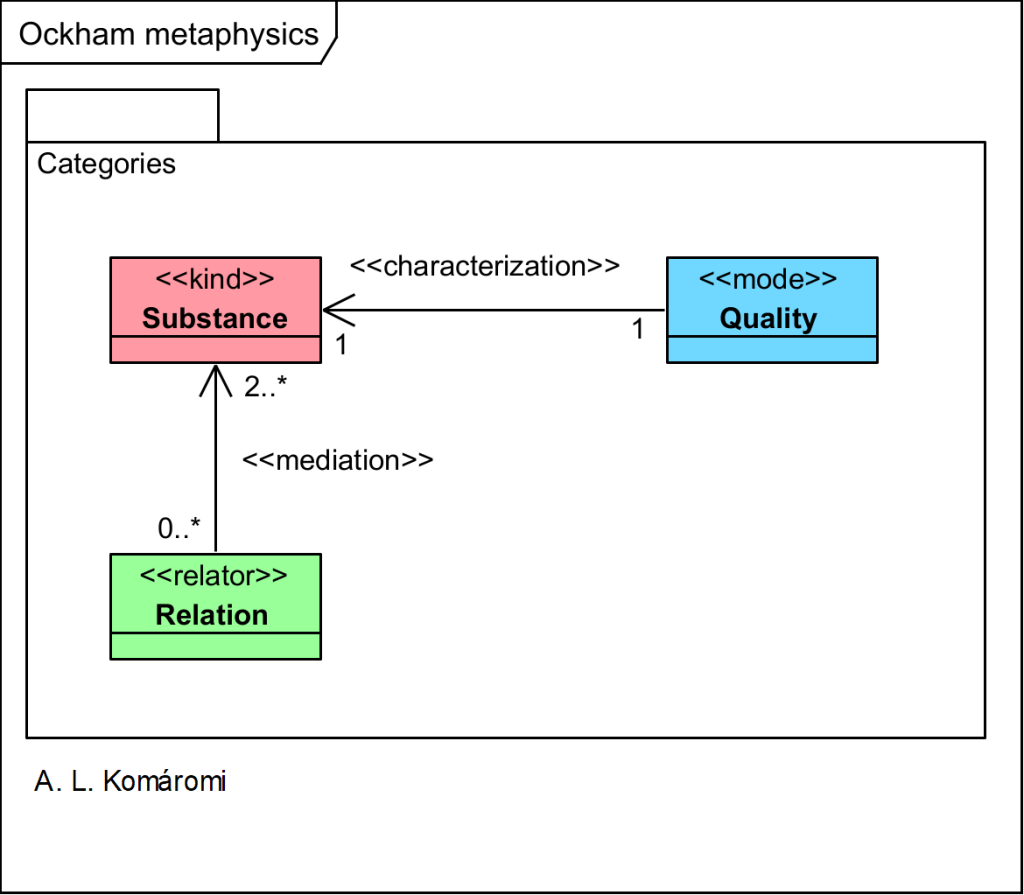
Ockham’s categories
ClassDescriptionRelations
Substance“Ockham is prepared to say things really act or are acted on, are really related to one another, and so on, but he does not think the truth of these statements requires us to postulate real entities in the categories of action, passion, or relation. Things really act, but there are no actions; things are really related without relations (except for the few exceptional cases required by theology).
Ockham ‘eliminates’ all the Aristotelian categories in this way – except for substance and quality.”
Quality“He [Ockham] allows individual qualities, for example; there are as many whitenesses as there are white things (although there is no universal whiteness).
[…]
One wonders why he stopped there. Why is it not just as legitimate to say things are really ‘qualified’ but there are no qualities – things are really white or red, hot or cold, although there is no whiteness or redness, no heat or cold as a distinct accidental entity in the category of quality? If other categories can be eliminated without denying any of the ways things really are, why not quality too?
In that case, we would end up with a single ontological category:
substance. Substances would be qualified, quantified, related in different ways, would variously act and be acted upon, and so on, but there would be only substances. None of the richness of the world would be lost, only the illusion that we need distinct entities for all the different claims we want to make about things. […]
Ockham does not explicitly address this question, but it is tempting to suppose the answer lies in the doctrine of the Eucharist interpreted according to the theory of transubstantiation. That theory holds that at the moment of consecration the bread and wine of the sacrament cease to exist and are replaced by the body and blood of Christ. But the accidents of the bread and wine remain (without inhering in the newly present body and blood of Christ, or in any other substance). This theory of course entails that the qualities of the bread and wine are real entities distinct from their substances.”
characterizes substance
RelationOckham allows that the supply of truths we want to maintain can come from several quarters: ‘For nothing ought to be posited without a reason given, unless it is self-evident or known by experience or proved by the authority of Sacred Scripture.” Theology, therefore, can provide evidence to answer ontological questions where unaided human reason would have inclined the other way.’
In discussing the category of relation, for instance, Ockham argues that there is no good pure reasoning, self-evident principle, or experience to indicate that there exist real relations distinct from their relata. But there do. The doctrine of the Trinity, as Ockham understood it, requires us to posit such relations in God. Likewise, the Incarnation requires a real relation of union between Jesus’s human nature and the Divine Word. And the Eucharist, understood according to the theory of transubstantiation, requires that the “inherence” of accidents in a substance be construed as a real relation distinct from its relata.”
relates substances (in very special cases postulated by the Scripture)

Sources:

  • All citations from: Spade, Paul Vincent, “Ockham’s Nominalist Metaphysics”, The Cambridge Companion to Ockham, ed. Paul Vincent Spade, Cambridge University Press, 2006
  • Spade, Paul Vincent and Claude Panaccio, “William of Ockham”The Stanford Encyclopedia of Philosophy (Spring 2019 Edition), Edward N. Zalta (ed.)

First published: 25/11/2021
[4.18.3] William Ockham on Connotation

William Ockham (1285-1349 AD), in Summa of Logic (SL), writes about the concepts of connotation:

  • Terms can be categorematic and syncategorematic. The former signifies (represents) something in themselves (e.g., man, Aristotle, a number, an object), the latter represents something connected with other concepts (e.g., non in nonhuman).
  • Categorematic terms can be absolute or connotative terms.
  • The absolute terms have only one (primary) signification, while the connotative terms have a primary and at least a secondary signification, the connotata.
  • Examples for absolute terms: ‘man,’ ‘horse,’ ‘animal,’ ‘tulip.’
  • Examples for the connotative term: ‘red’ has as primary signification ‘red’, but brings to the mind as connotata ‘redness’ also.

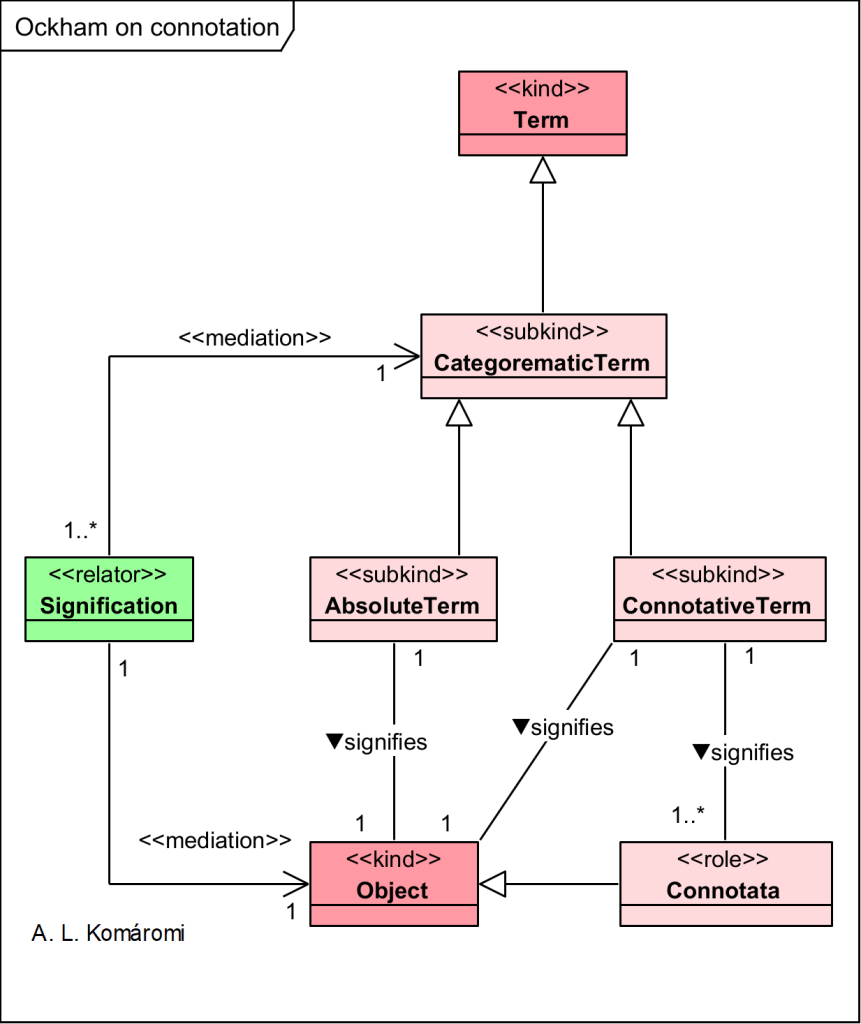
The following OntoUML diagram presents the main classes of Ockham’s logic:

Ockham on connotation
ClassDescriptionRelations
Term“The immediate parts of syllogisms are sentences (propositiones), and these are resolved into what Ockham in the first chapter of SL calls ‘terms’. Terms, broadly speaking, come in two sorts: categorematic and syncategorematic.” (Normore)
CategromatiTerm“A categorematic term is one that has signification. […] Categorematic terms have a ‘fixed and definite signification.’
Ockham explains that, in the narrow sense, a term signifies whatever it is ‘verified’ of. A term is verified of a thing if it can be truly predicated of a proper name or demonstrative pronoun picking out that thing in a singular affirmative categorical sentence with the present tense and unmodified copula ‘is’ (est). Thus ‘human’ signifies, in the narrow sense, Socrates if and only if ‘Socrates is human’ is true. […]
Ockham presents another, ‘wider’ sense of signification in which a term signifies a thing if it can be truly predicated of a proper name or demonstrative pronoun picking out that thing in an affirmative singular sentence with the copula ‘can be’ (potest). In this wide sense the term ‘green’ can be said to signify even the White House if that building can be green. It is often suggested that, in introducing this wider sense of signification, Ockham commits himself to an ontology of possibilia.
The signification relation connects language to the world, and Ockham suggests that the signification of mental categorematic terms is natural. We encounter objects in the world, and these encounters produce (absolute and, if there are any, simple connotative) mental terms. Thus we acquire these terms but do not learn them in any sense requiring that we have already represented the world.
But the signification relation does not enter directly into the truth conditions for sentences. For that we need another relation – that of supposition.” (Normore)
subkind of Term
SignificationSignification relates CategorematicTerm with Object.mediates CategorematicTerm with Object
AbsoluteTerm“Among categorematic terms, some have only a primary signification, whereas others, in addition, have a secondary signification, or connotation. The former Ockham calls absolute terms. They correspond, in modern philosophical terminology, to natural kind terms, such as ‘man,’ ‘horse,’ ‘animal,’ ‘tulip,’ ‘flower,’ and so forth. What characterizes them is that each one signifies all its significates in exactly the same way and can indifferently stand for any of them in propositions. Consider ‘horse,’ for example. According to Ockham, it signifies nothing but horses; and every horse it signifies equally: it can stand for any of them in propositions such as ‘Every horse is a mammal,’ ‘Some horses are white,’ or ‘Bucephalus is a horse.’” (Panoccio)subkind of Term; signifies Object
ConnotativeTerm“A connotative term, by contrast, has at least two series of significates. Like absolute terms, it has primary significates such as red things in the case of ‘red’ and horsemen in the case of ‘horseman’; but in addition it also refers the mind, in virtue of its very meaning, to some other singular beings in the world, for which it normally will not stand in propositions (e.g., rednesses in the case of ‘red’ and horses in the case of ‘horseman’). Those are said to be its secondary significates or connotata. In mental as well as in spoken languages, the class of connotative terms is very extensive for Ockham – much more than that of absolute ones. It includes all concrete qualitative terms such as ‘red,’ all relational terms (‘father,’ for instance, primarily signifies all fathers and connotes their children), many psychological, semantical, and moral terms such as ‘intellect,’ ‘will,’ ‘true,’ ‘good,’ and so forth, all quantitative and dimensional terms such as ‘figure,’ ‘length,’ ‘solid,’ and so on, and generally, Ockham says, “all the expressions in the categories other than substance and quality.” (Panoccio)subkind of Term; signifies Object and Connotata
ObjectAn object, a thing or state of affairs in the external world.
Connotata“Like absolute terms, it has primary significates such as red things in the case of ‘red’ and horsemen in the case of ‘horseman’; but in addition it also refers the mind, in virtue of its very meaning, to some other singular beings in the world, for which it normally will not stand in propositions (e.g., rednesses in the case of ‘red’ and horses in the case of ‘horseman’). Those are said to be its secondary significates or connotata. (Panoccio)role of object

Sources:

  • Panoccio, Claude, “Semantics and Mental Language”, The Cambridge Companion to Ockham, ed. Paul Vincent Spade, Cambridge University Press, 2006
  • Calvin, G. Normore, “Some Aspects of Ockham’s Logic”, The Cambridge Companion to Ockham, ed. Paul Vincent Spade, Cambridge University Press, 2006
  • Spade, Vincent, “Thoughts, Words and Things: An Introduction to Late Mediaeval Logic and Semantic Theory”, Version 1.2: December 27, 2007
  • Spade, Paul Vincent and Claude Panaccio, “William of Ockham”The Stanford Encyclopedia of Philosophy (Spring 2019 Edition), Edward N. Zalta (ed.)

First published: 11/11/2021