[4.17.3] John Buridan on the Theory of Supposition (Reference)

John Buridan (Jean Buridan 1301-1358) in Summulae de Dialectica writes about supposition occurring in conventional (spoken and written) languages and mental language:

  • Propositions (sentences) are made up of terms.
  • Terms in a proposition refer to other terms – the suppositum (or supposita); this relation is called supposition. The supposition of a term always occurs in a propositional context and can be entirely different from its signification (see [4.0.1]).
  • Written and spoken terms signify Concepts conventionally; Concepts signify Objects naturally.
  • Buridan (in contrast to Ockham, see [4.0.2]) differentiated the mechanism of supposition for the different layers of language: for conventional (spoken and written) language supposition has various subkinds, like improper, proper, material, simple, personal. On the other hand, for the mental language we have only personal supposition, because “concepts signify just what is conceived by them— that is, just what they are thoughts of—and since in general it is only in personal supposition that terms supposit for what they signify” (Spade)

The following OntoUML diagram depicts Buridan’s theory of supposition (reference):
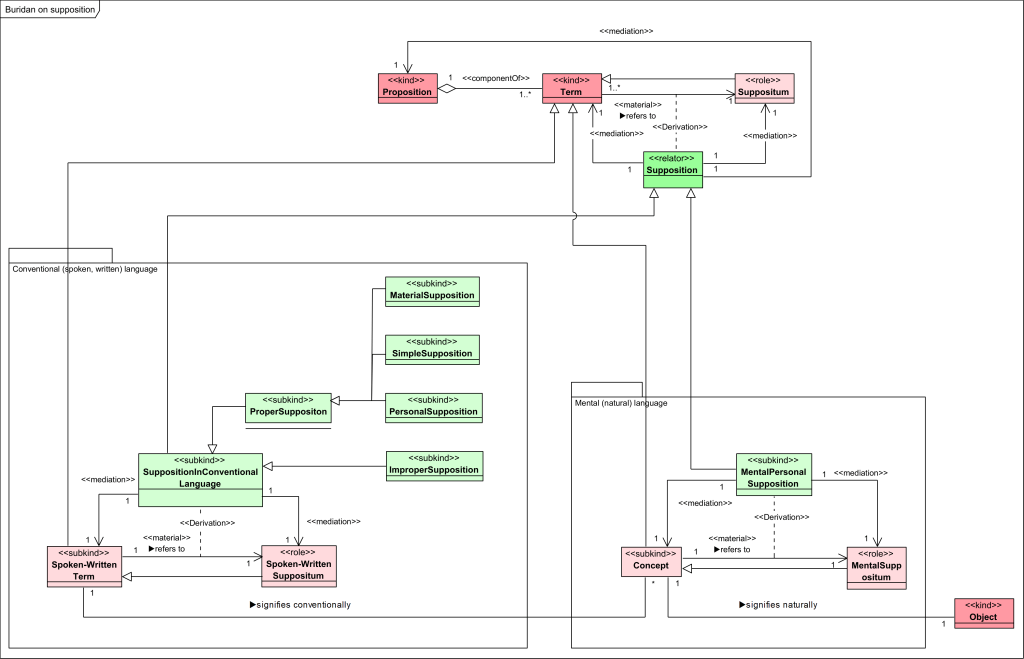
Buridan on supposition (reference)
ClassDescriptionRelations
Propositionproposition or sentence is made up of terms.
TermA mental, spoken, or written term.shared part of proposition; refers to Suppositum
SuppositumSuppositum is “whatever a term supposits for.”role of Term
Supposition“What sort of relation is supposition? Well, the first thing we can say about it is that supposition is a semantic relation. To a first (but pretty good) approximation, supposition in this first part of the theory is what nowadays we call ‘reference.’ It is the relation between the terms used in a proposition and the things those terms are used to talk about in that proposition. […] supposition occurs only in a propositional context. And this is the first main difference between supposition and signification, which can occur outside a propositional context according to almost any author.
The second main difference is this: We do not always in practice use terms in propositions to talk about what those terms signify. We use them in a variety of other ways too. Hence supposition also differs from signification insofar as a term may signify one thing, but supposit on a given occasion for something entirely different.” (Spade)
relates Term, Proposition and Suppositum
Spoken-WrittenTermSpoken or written terms are utterances or inscriptions.subkind of Term refers to Spoken_WrittenSuppositum; signifies conventionally Concept
Spoken-WrittenSuppositumA spoken or written term in the context of a proposition refers to (supposits) a spoken or written suppositum.role of Spoken_WrittenTerm
SuppositionInConventional LanguageSupposition in conventional language is supposition occuring in spoken or written (conventional) languages.subkind of Supposition; relates Spoken_WrittenTerm with Spoken_WrittenSuppositum
ImproperSupposition“Improper supposition […] is the kind of supposition or reference a term has when it is used figuratively and not literally. Now a detailed semantics of metaphor was just as much beyond the reach of mediaeval authors as it is beyond our reach today. So we should not be surprised to find that the theory of improper supposition is not worked out very fully.” (Spade)subkind of SuppositionIsnConventionalLanguage
ProperSuppositonproper supposition occurs when a term supposits for what it properly signifies” (Spade)subkind of SuppositionInConventionalLanguage
MaterialSupposition; SimpleSupposition; PersonalSuppositionMaterialSupposition; SimpleSupposition; PersonalSupposition are subkinds of supposition. For conventional (written and spoken) languages Buridan accepts Ockham’s view on supposition. For more details please check [4.0.2]. subkinds of ProperSuppositon
ConceptA concept is a term in mental language an act of understanding. 
“Buridan makes it quite clear that in his view a concept cannot vary its semantic features, which means that there is no ambiguity in mental language. The same concept always represents the same things in the same way, so there is not even a variation of supposition in mental language in the way there is in spoken or written languages” (Klima)
subkind of Term; refers to MentalSuppositum; signifies naturally Object
MentalSuppositumA concept in the context of a (mental) proposition refers to (supposits) a mental suppositum.role of Concept
MentalPersonalSuppositionBuridan makes it quite clear that in his view a concept cannot vary its semantic features, which means that there is no ambiguity in mental language. The same concept always represents the same things in the same way, so there is not even a variation of supposition in mental language in the way there is in spoken or written languages:
We should know, therefore, that (as it seems to me), material material supposition occurs only where signifi cative utterances are concerned. For no mental term in a mental proposition supposits materially, but rather always personally, for we do not use mental terms by convention [ad placitum] as we do with utterances and written marks. This is because the same mental expression never has diverse signifi cations, or acceptations; for the affections of the soul [ passiones animae] are the same for all, just like the things of which they are the likenesses, as is said in bk. 1 of On Interpretation. […]
A concept that represents some object does not signify it by virtue of anything else: to have such a concept active in one’s mind is just to conceive of the object in the way the concept represents it. This understanding of the representative function of a concept, however, immediately renders Ockham’s account problematic. For to have a concept active in one’s mind on this understanding is to conceive of the object represented by the concept, whereas the same concept may represent different objects. Sometimes it may represent its ordinary objects, as the concept of human beings does in the mental counterpart of ‘Man is an animal’. At other times, it may represent itself or a similar concept, as it does in the mental counterpart of ‘Man is a species’. Consequently, it would appear that one might not be sure just what one conceives of, for one may not be sure whether the same concept is to be taken to stand for itself or for its ordinary objects, just as one may not be sure about the supposition of the subject termof the corresponding spoken proposition. But this seems absurd, namely, that having a concept active in one’s mind, one is not sure what one conceives by that concept, given that having the concept active in one’s mind is nothing but conceiving of its object in the way the concept represents it. In his detailed analysis of the problem, Paul Spade put the point in the following way. “Since concepts signify just what is conceived by them— that is, just what they are thoughts of—and since in general it is only in personal supposition that terms supposit for what they signify, it follows that if mental terms may have simple or material supposition, we do not always know what we are asserting in a mental sentence.” (Klima)
subkind of Supposition; relates Concept with MentalSuppositum
ObjectAn object, a thing or state of affairs in the external (or internal) world.

Sources:

First published: 20/9/2021 (szülinap edition)
[4.17.2] John Buridan on Language

John Buridan (Jean Buridan 1301-1358) in Sophismata, Quaestiones in Porphyrii Isagogen and Summulae de Dialectica writes about the mechanism of interpretation and concept formation in languages:

  • Meaningful utterances and inscriptions generate understanding in the mind; thus, they belong to a conventional language. Buridan thinks that each inscription and utterance is singular, i.e., if a person pronounces twice the phrase "Socrates is a man," that is two utterances, and as such two tokens.
  • Meaningful utterances and inscriptions are singular tokensSimilar tokens are recognized by the human mind and grouped in token types. E.g., the utterance "Socrates is a man" and the inscription "Socrates is a human" are similar, and as such they belong to the same token type.
  • The mind subordinates the token types and the belonging tokens to the mental concept through the interpretation process, characterized by a context, which includes conditions like where, when, by whom, to whom, intention, etc. A mental concept is an act of understanding in a singular mind.
  • The mental concept can not vary its semantic features in a given mind. “The same concept always represents the same things in the same way, so there is not even a variation of supposition in mental language in the way there is in spoken or written languages”.
  • Conventional interpretations are of proper sense, while otherwise of improper sense. Improper sense interpretation can be ironic, figurative, metaphoric, etc.
  • Buridan’s model of language is thoroughly nominalist (see [4.4.1]).
  • Buridan thinks, that the concepts form a natural and mental language, which is prior to spoken and written conventional languages, like English, Latin, French, Greek, Hungarian etc. (see [4.0.1])
  • (Buridan never used the terms token and token type, however, those entities are present in his model.)

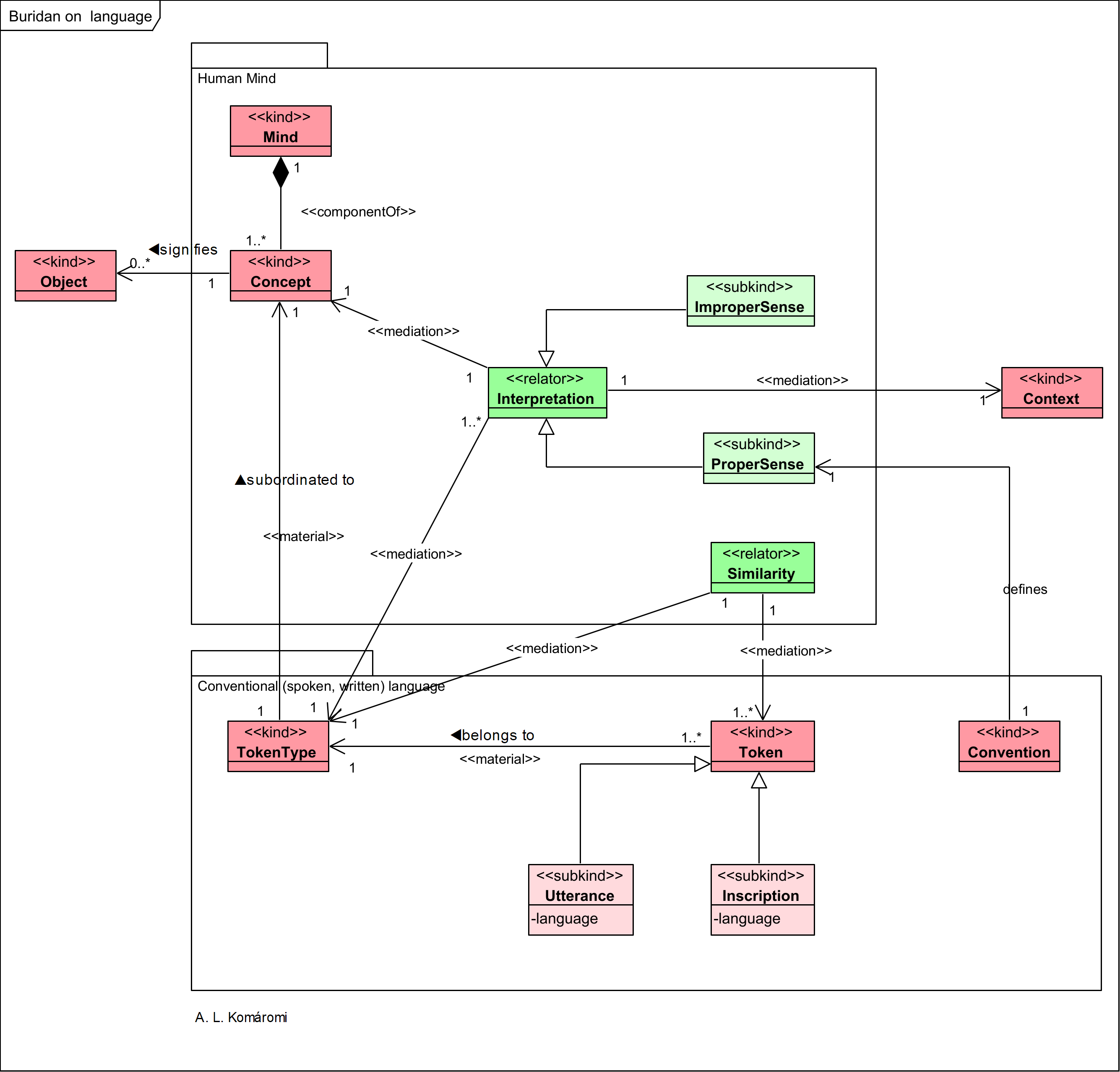
The following OntoUML diagram shows the mechanism of understanding for natural language according to Buridan:

Buridan on language
ClassDescriptionRelations
MindA human mind.
Conceptconcepts, the acts of understanding which render utterances and inscriptions meaningful, are just as singular as as are the utterances and inscriptions themselves. In addition, the acts of imposition whereby we subordinate utterances and inscriptions to concepts are singular, voluntary acts. This renders the relation of subordination conventional and changeable from one occasion of use to the next. So, the correlation of these singular items, inscriptions, utterances, and concepts is to be established in a piecemeal way, by carefully evaluating which utterance or inscription is subordinated to which concept in whose mind, on which occasion of its use, in what context. […]
Buridan makes it quite clear that in his view a concept cannot vary its semantic features, which means that there is no ambiguity in mental language. The same concept always represents the same things in the same way, so there is not even a variation of supposition in mental language in the way there is in spoken or written languages”
component of Mind; signifies Object
ObjectAn object, a thing or state of affairs in the external world.
TokenType“Individual linguistic signs, symbol tokens, come in types [token types] based on their recognizable similarities. Indeed, even if some tokens are not inherently similar, such as the íupper- and lowercase letters of the alphabet (A, a, B, b, etc.) or different fonts or typefaces (a, a, a, etc.), we are trained early on to recognize them as similar. Obviously, the same applies to utterances at an even earlier stage, in a less formally educational setting, leaving much to our natural abilities to recognize phonemic similarities. Therefore, what primarily allows any sort of uniformity of interpretation is the fact that even if in principle any token of any type can be interpreted ad placitum at any time, tokens are interpreted in types. Once we specify the relevant variable conditions of interpretation, such as when, where, by whom, to whom, according to what intention, and so on a token is to be interpreted, then any token of the same type under the same conditions is to be interpreted in the same way. That is to say, a rule that applies to a token in virtue of its interpretation as belonging to a given type under such and such conditions of its use applies to all tokens of the same type under the same conditions. To be sure, Buridan never talks about tokens or types. This is modern terminology, which I bring in to summarize the gist of Buridan’s ideas.”subordinated to Concept
Token“Buridan does talk about the fact that any linguistic sign (whether spoken [utterance], written [incription], or even mental) is a singular occurrence (which we call a token). He also talks about the fact that some of these are recognizably similar (thereby constituting what we would call a type), and about the fact that once we fix the variable conditions of interpretation, then talking about one token is equivalent to talking about all.” belongs to TokenType
Similarity “Individual linguistic signs, symbol tokens, come in types [token types] based on their recognizable similarities. Indeed, even if some tokens are not inherently similar, such as the íupper- and lowercase letters of the alphabet (A, a, B, b, etc.) or different fonts or typefaces (a, a, a, etc.), we are trained early on to recognize them as similar.” relates TokenType with Token
Utterance; Inscription “[…] any spoken language is but a system of singular utterances [vox], while any written language is but a system of singular inscriptions. Moreover, it is obvious that any such utterance or inscription belongs to a language only insofar as it produces some understanding in the minds of competent users of the language, that is to say, insofar as it is meaningful at all. […]
Buridan does talk about the fact that any linguistic sign (whether spoken [utterance], written [incription], or even mental) is a singular occurrence (which we call a token) ”
subtype of Token
Interpretation“That is to say, a rule that applies to a token in virtue of its interpretation as belonging to a given type under such and such conditions of its use applies to all tokens of the same type under the same conditions. […]
To be sure, the correct interpretation need not be the interpretation expressing the proper or primary sense, because occasionally the correct, intended interpretation is provided by some improper, secondary sense of the phrase in question. In fact, this is precisely why it is the intention expressed by the phrase on the given occasion of its use that determines its correct semantic evaluation. The reason for this is that the written or spoken phrase has any sense whatsoever only in virtue of the fact that it is subordinated to the concept or intention it is supposed to express according to the intended interpretation, for it signifies just what is conceived by the corresponding concept. So, the correct interpretation of an utterance or inscription is fixed by the mental concept to which the utterance or inscription is actually subordinated on a particular occasion of its use. Consequently, the reason why tokens of the same type have the same semantic features allowing us the primacy of mental language to evaluate them in the same way in the same type of context is that under these circumstances they are subordinated to the same concept. […]
So, although we can use any utterance and inscription in the way we wish, once it is conventionally instituted to signify somehow, that established signifcation is to be regarded as its proper, primary sense, and any other only as a secondary, improper sense. Nevertheless, there is no hard and fast rule that says that we should take the expressions of our spoken or written languages always in their primary sense, and that we should evaluate our propositions for their truth or falsity accordingly. On the contrary, sometimes we are obliged to take written or spoken expressions in their secondary, improper sense, if that is what is intended. […]
the occurrences of two token-terms of the same type (provided they are interpreted in the same way) are subordinated to numerically one and the same concept in the same mind, and so, given that whatever semantic features they have they have from the semantic features of the concept,
no wonder they will have exactly the same semantic features. But then, if the semantic features of concepts are not variable, this certainly suffi ciently fixes the interpretation of token-terms according to a given subordination, for according to that subordination they will all be subordinated”
mediates Concept, Context and TokenType
ContextContext is the “variable conditions of interpretation, such as when, where, by whom, to whom, according to what intention, and so on a token is to be interpreted […]
So, in the specification of acts of imposition we might use variables indistinctly referring to any number of individual users, various times, places, or any other relevant contextual factors […]”
characterizes Interpretation
ProperSense; ImproperSense “So, although we can use any utterance and inscription in the way we wish, once it is conventionally instituted to signify somehow, that established signifcation is to be regarded as its proper, primary sense, and any other only as a secondary, improper sense.”
Improper sense interpretation can be ironic, figurative, metaphoric, etc.
subkinds of Interpretation
Convention“So, although we can use any utterance and inscription in the way we wish, once it is conventionally instituted to signify somehow, that established signification is to be regarded as its proper, primary sense, and any other only as a secondary, improper sense.”
Convention might vary in time.
defines ProperSense

Sources:

  • All citations from: Klima, Gyula, “John Buridan”, Oxford University Press, 2009
  • Zupko, Jack, “John Buridan“, The Stanford Encyclopedia of Philosophy (Fall 2018 Edition), Edward N. Zalta (ed.)

First published: 14/8/2021
Updated: 20/8/2021