[4.16.2] Meister Eckhart on Analogy and Univocity

Meister Eckhart (Eckhart von Hochheim 1260 – 1328 AD) in different works written in Latin and German language (Opus Tripartitum, Rechtsfertigungschrift/Defense Document, Essential Sermons, Commentary on Genesis and Commentary on St John) writes about two types of relations with an important role in the process of creation:

  • The analogy relates the uncreated thing to the created (see also [4.16.1]), while the univocal causality has a role when a thing creates itself.
  • Analogy describes the relation between God (uncreated) and all his creatures (created things).
  • We have Univocal causality when the active principle of a thing causes its passive principiate; and this way the thing creates itself. We have this kind of relationship between the persons of Trinity, sight, and object of sight, intellect and object of intellect, just man and justice, free man and freedom etc.

The following OntoUML diagram shows Eckhart’s model of analogy:

Eckhart’s model of analogy
ClassDescriptionRelations
ThingAn existent, a thing.
UncreatedAn uncreated thing, i.e. God.subkind of Thing; creates Created
CreatedA created thing.subkind of Thing
Analogy“Between the uncreated and the created the predominant relationship is one of  analogy, a relationship involving as well the disjunction of the two terms.”  (Mojsisch, Summerell)relates Uncreated with Created
Temporal“The univocal relation is atemporal while the analogue relation is temporal.”
(Hackett, Hart Weed)
characterizes Analogy

The following OntoUML diagram shows Eckhart’s model of univocal causality:
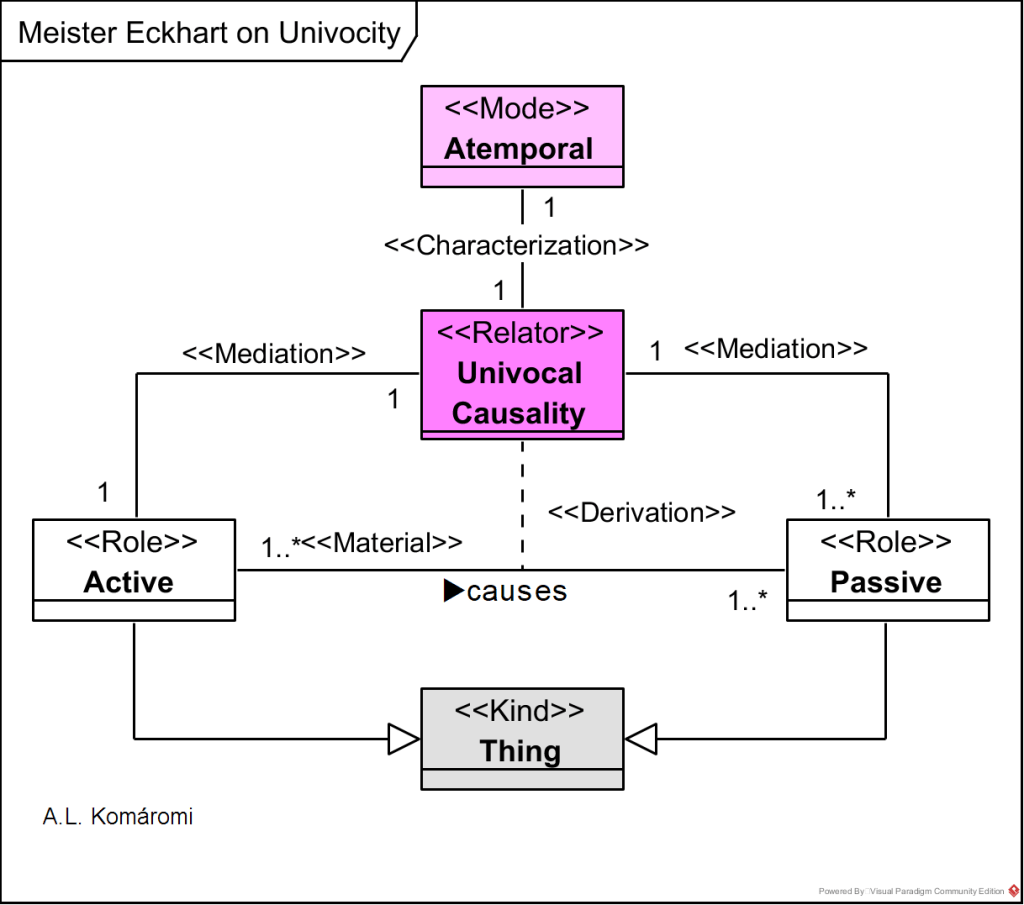
Eckhart’s model of univocal causality
ClassDescriptionRelations
ThingAn existent, a thing.
Active“This means that the active (principle) is at the same time active and passive, being affected in the course of its activity (as principle). In turn, the passive (principiate) is at the same time passive  and active, being active in the course of its passivity (as principiate). Accordingly, a central proposition of Eckhart reads as follows: ‘[Principium et principiatum]… opponuntur relative: in quantum opponuntur, distinguuntur, sed in quantum relative, mutuo se ponunt …‘ (Echardus, In Ioh. n. 197; LW III, 166, 10–12: ‘[The principle and the principiate] … are opposed to one another relatively: Insofar as they are opposed, they are distinguished, but insofar as they are relative, they reciprocally posit themselves …’).  (Mojsisch, Summerell) role of Thing; causes Passive
Passive“This means that the active (principle) is at the same time active and passive, being affected in the course of its activity (as principle). In turn, the passive (principiate) is at the same time passive  and active, being active in the course of its passivity (as principiate). Accordingly, a central proposition of Eckhart reads as follows: ‘[Principium et principiatum]… opponuntur relative: in quantum opponuntur, distinguuntur, sed in quantum relative, mutuo se ponunt …‘ (Echardus, In Ioh. n. 197; LW III, 166, 10–12: ‘[The principle and the principiate] … are opposed to one another relatively: Insofar as they are opposed, they are distinguished, but insofar as they are relative, they reciprocally posit themselves …’).  (Mojsisch, Summerell) role of Thing;
Univocal causality“Eckhart, however, breaks through that metaphysics of being with its analogical base by thinking through the relation of causality informing absolute being. We can assume at least hypothetically that a cause causes not only something dependent on it, but also something equal to it, namely that the cause causes in such a manner that it causes itself.
But if it causes itself, it causes something which is itself also cause and at the same time cause of its cause. Such a mode of causality is called ‘univocal causality’. Our hypothesis of what could be thought in these terms turns into a certainty when we explore the structures of intellectual causality, for example, the relation between the act of thinking and what is thought, or between an ethical principle and an ethical principiate. Their relation is precisely what Eckhart takes advantage of in developing his theory of univocal causality. In these cases, it holds that the principle causes its principiate, and the principiate causes its principle. Even more: The principiate is in its principle nothing other than its principle. […]”  (Mojsisch, Summerell)

“The breakthrough that Eckhart attains through his theory of univocal causality is exemplified by the relation between thinking and thought. For Eckhart, thinking presupposes no origin because a presupposed origin could only be thought by thinking and hence would be a thought of thinking, that is, itself thinking. Thinking is, then, for itself a presuppositionless origin, that is, it is its own principle: principium (Echardus, In Ioh. n. 38; LW III, 32, 11: “… ipsum principium semper est intellectus purus …”: “The principle itself is always pure intellect …”). Any thinking without act, however, is no thinking at all. Consequently, its own originative activity accrues to thinking, that is, insofar as it is a principle, the dynamics of its principiating: principiare. In this activity, however, thinking directs itself towards a thought that it has originated, that is, towards the product that is its principiate: “principiatum. But since this thought is a thought of thinking, it is itself nothing other than thinking. The act of this thinking that has been thought is, then, retrograde. This thought, as thinking, is in turn principle, principiating and principiate, whereby this last is the original thinking. In this way, thinking thinks itself as thought and is therewith active thinking, while thought, insofar as it thinks its thinking, is itself thinking, and its thinking now thought. Consequently, both thinking and thought are at the same time active and passive.
[…]
The result of this analysis: Over against the external relationality of analogue relata, univocal correlationality involves an immanent relationality. Eckhart emphasizes the mutual relatedness of the moments univocal-casually interpenetrating one another . . . The agent imparts to the passive everything which it is able to impart, and the passive receives what has been imparted as its inheritance, not as something merely lent.” (Hackett, Hart Weed)
relates Active with Passive
Atemporal“The univocal relation is atemporal while the analogue relation is temporal.” (Hackett, Hart Weed) characterizes Univocal causality

Sources:

  • Mojsisch, Burkhard and Orrin F. Summerell, “Meister Eckhart“, The Stanford Encyclopedia of Philosophy (Summer 2011 Edition), Edward N. Zalta (ed.)
  • Hackett, Jeremiah and Hart Weed, Jennifer: “From Aquinas to Eckhart on Creation, Creature, and Analogy”, A companion to Meister Eckhart, Brill 2013, edited by Jeremiah M. Hackett.

First published: 16/7/2021

[4.16.1] Meister Eckhart on Transcendentals in God and Creatures

Meister Eckhart (Eckhart von Hochheim 1260 – 1328 AD) in different works written in Latin and German language (Opus Tripartitum, Rechtsfertigungschrift/Defense Document, Essential Sermons) presents an original take on the theory of transcendentals, according to which:

  • The transcendentals, which are being, one, truth, good, primarily refer to God, not to creatures, things, as Philip the Chancellor (see [4.7]) and Thomas Aquinas sustain: “according to Thomas, the transcendentals belong to the level of ens or esse commune, while for Eckhart they belong primarily to God.”
  • The transcendentals explain the inner divine life of the Trinity.
  • God is primarily characterized by being and goodness, while being and truth and being and goodness are convertible.
  • God creates the creatures. The transcendentals in creatures are analogically ordered the real transcendentals (in God). As such, the creature’s existence, oneness, goodness, truth depends, “eats” from the existence, oneness, goodness, truth of God.

The following OntoUML diagram shows Eckhart’s model of transcendentals:

Meister Eckhart on transcendence in God and creatures
ClassDescriptionRelations
(Trinitarian)God“Eckhart uses the theory of the transcendentals to provide a philosophical explanation of the inner divine life of the Trinity [trinitarian God]. Through it, he achieves a new dimension in speculative thinking about the Trinity that leads to the equating of the persons of the Trinity with the transcendentals. […]
The integration of henological and ontological discourses builds the following ontological scheme: God is Being (esse) per se as well as One (unum) per se. […]
only God is Being, One, True, and Good in the full sense of these words.” (Tsopurashvili)
creates Creature
Transcendental“The main questions of the first four treatises of the Opus tripartitum are Being, Unity, Truth, Goodness, and the concepts that are opposed to these. One significant characteristic of Eckhart’s theory of transcendentals is that they apply primarily not to common being (ens commune) but to the inner life of God. In his Expositio sancti evangelii secundum Iohannem, Eckhart claims that:
Those properties which are God’s own are Being or being, Unity, Truth, Goodness. For God has these four transcendental as properties in as much as is ‘the first,’ which is ‘rich in itself.’ God has these because the rich in itself has that which is proper to itself. For the aforementioned four (terms) are for everyone ‘guests’ within the First, and ‘immigrants,’ household members to God.
In this, Eckhart uses the theory of the transcendentals to provide a philosophical explanation of the inner divine life of the Trinity. Through it, he achieves a new dimension in speculative thinking about the Trinity that leads to the equating of the persons of the Trinity with the transcendentals.” (Tsopurashvili)
BeingIn Eckhart’s view “nothing arises from the indifferent and the indefinite. He argues that these characteristics (the transcendentals) are suitable for being (esse), because being applies to the inner and essence. So, being is equated with the divine essence.” (Tsopurashvili) subkind of Transcendental; characterizes (Trinitarian)God
One“The integration of henological and ontological discourses builds the following ontological scheme: God is Being (esse) per se as well as One (unum, [ens]) per se. The One per se means unity, the unity of essence, or even the essential unity. The One as essential unity is without relationality in itself, but as such it is the grounding ground of all entities even through its relationality. God as relationless and the One is the unique One in which one does not find difference (i.e. the difference according to the persons): God as the unique One is neither Father, nor Son, nor Holy Spirit. God as something means that God is completely free from the definite modes of divine Being. So, he is the simple One. The simple One is undefined and simple by comparison with the modes of Trinity. It is determined essentially through its simple and One-Being. Therefore, the simple One, as the positive in regard to the mode of triplicity of being, is negative at the same time as it itself presents the defining moment of being. […]
The One (unum) or the unity (unitas) are the explications of the uniqueness of God.” (Tsopurashvili)
subkind of Transcendental; characterizes (Trinitarian)God
Truth; Good When Meister Eckhart equates the transcendentals with God, he harkens back to the scholastic doctrine about the convertibility of the transcendentals. He formulates this idea with the following words: ‘Unum enim, ens, verum, bonum convertuntur.’ The reason for their convertibility is that all of them can name God in the full sense. He accentuates also the convertibility of Truth with Being as well as the convertibility of Being with Truth: ‘Verum et ens convertuntur.’
Based on this convertibility Eckhart understands truth not only as the truth of a sentence, but also as the truth of Being, that is, truth receives an ontological status through its convertibility with ens and connotes the truth of Being.
It also concerns bonum [Good], which receives ontological status through the convertibility with ens and connotes the goodness of Being. So truth has epistemological as well as ontological meaning: what is true, also is. Goodness expresses the ethical as well as the ontological sense: what is good, also is.” (Tsopurashvili)
subkind of Transcendental; characterizes Being
Creature“God acts and produces things [Creatures] through his divine nature. But God’s nature is intellect, and for him existence is in the understanding. Therefore, he produces all things in existence through intellect.” (Eckhart)
AnalogyAnalogous things are not distinguished according to things, nor through the differences of things, but ‘according to the modes [of being] of one and the same simple thing. For example, one and the same health that is in an animal is that (and no other) which is in the diet and the urine [of the animal] in such a way that there is no more of health as health in the diet and urine as there is in a stone. Urine is said to be ‘healthy’ only because it signifies health, the same in number, which is in the animal, just as a circular piece of wood which has nothing of wine in it [signifies] wine.” (Hackett, Hart Weed) relates Transcendental with Transcendental InCreature
TranscendentalIn CreatureTranscendentals in creatures are analogue and ordered to the transcendentals (in God), and “eat” from those: “Being or existence and every perfection, especially general ones such as existence, oneness, truth, goodness, light, justice, and so forth, are used to describe God in an analogical way. It follows from this that goodness and justice and the like [in creatures] have their goodness totally from something outside to which they are analogically ordered, namely, God. […]
The proof can be briefly summarized and formulated thus. Analogates have nothing of the form according to which they are analogically ordered rooted in positive fashion in themselves. But every created being is analogically ordered to God in existence, truth and goodness. Therefore every created being radically and positively possesses existence, life, a wisdom from and in God, not in themselves as a created being. And thus, it always “eats” as something produced and created, but it always hungers because it is always from another and not from itself.” (Hackett, Hart Weed)
ordered, “eats from” Transcendental
BeingInCreature; OneIn CreatureBeing in creature (esse hoc et hoc) and one in creature (ens hoc et hoc) is analogically ordered to Being and One (in God) and “eat” from those.
“Eckhart’s doctrine of analogy, then, is his way of showing that the creature is not autonomous, that is, in total self-possession of being. It has possession as an imparted possession, on loan as it were. The created is even in its own being a pointing away from itself to Being in itself, to the Absolute Being.” (Hackett, Hart Weed)
subkind of TranscendentalIn Creature; chatacterizes Creature
TruthInCreature; GoodInCreatureTruth in creature (verum hoc et hoc) and good in creature (bonum hoc et hoc) Analogically ordered to Truth and Good (in God) and “eat” from those. subkind of TranscendentalIn Creature; characterizes BeingInCreature

Sources:

  • Tsopurashvili, Tamar: “The Theory of the Transcendentals in Meister Eckhart”, A companion to Meister Eckhart, Brill 2013, edited by Jeremiah M. Hackett.
  • Hackett, Jeremiah and Hart Weed, Jennifer: “From Aquinas to Eckhart on Creation, Creature, and Analogy”, A companion to Meister Eckhart, Brill 2013, edited by Jeremiah M. Hackett.
  • Eckhart: “The Commentaries on the Book of Genesis”, Colledge and McGinn, Meister Eckhart: The Essential Sermons

First published: 11/7/2021