[4.12.3] Robert Kilwardby on Syllogistic Form and Matter

Robert Kilwardby (ca. 1215–1279 AD), in his commentary to Aristotle’s “Prior Analytics commentary,” enriches the Arostotelian logic (see [1.3.9]) with a few new perspectives:

  • He applies the theory of four causes (see [1.3.4]) on syllogism and concludes that syllogisms, like any other objects, have material, formal, efficient, and final causes.
  • Syllogisms have matter (the premises and terms) and form (the mood and figure), thus presenting a hylomorphic structure (see [1.3.5])

The following  OntoUML diagram presents the main elements of Kilwarby’s hylomorphic syllogism:
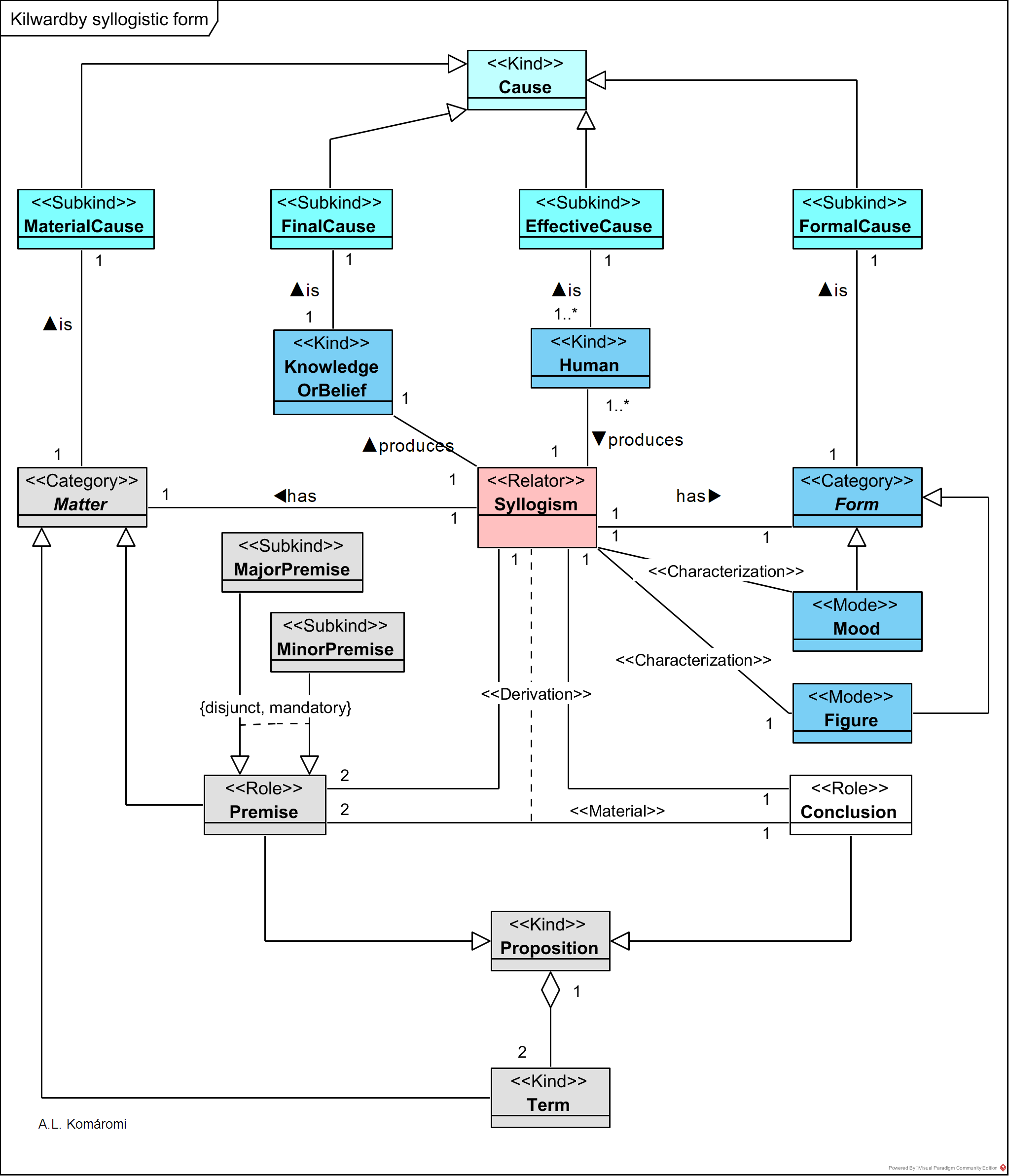
Kilwardby on syllogistic matter and form
ClassDescriptionRelations
Syllogism“A syllogism is composed of form as well as matter.23 In elaborating
on this idea, Kilwardby applies the Aristotelian doctrine of causes to the syllogism.” (Thom, 2013)
A syllogism is an “inference with two premises, each of which is a categorical sentence, having exactly one term in common, and having as conclusion a categorical sentence the terms of which are just those two terms not shared by the premises”. (Smith, 2018)
Not all the triplets of two premises and one conclusion of the required structure are syllogisms, only just those who lead to a valid inference, listed in the moods.
E.g. P1: All man are mortal. P2: Socrates is man, C: Socrates is mortal.
has Form; has Matter; relates 2 Premises with 1 Conclusion; produces KnowledgeOrBelief
PropositionPropositions (assertion, apophanseis) are sentences with a specific structure: “every such sentence must have the same structure: it must contain a subject and a predicate and must either affirm or deny the predicate of the subject.” (Smith, 2018)
Term“Subjects and predicates of assertions are terms (horos) which can be either individual, e.g. Socrates, or universal, e.g. human. Subjects may be individual or universal, but predicates can only be universals.”(Smith, 2018)shared part of Proposition
PremiseA possible role of an Proposition, relative to a Syllogism is Premise (protasis).
E.g. P1: All man are mortal. P2: Socrates is man.
in material relation with Conclusion; role of Proposition
MajorPremise“The major premise occupies a determining role, since it is ‘contracted’ by the minor premise to produce the conclusion. Because of this relation between major and minor premise, Kilwardby reasons, the minor should not be counted along with the major; and so, he says, the Aristotelian definition of the syllogism rightly names oratio (in the singular) as its genus, not orationes.” (Thom, 2013)
E.g. P1: All man are mortal.
subkind of Premise
MinorPremise“The major premise occupies a determining role, since it is ‘contracted’ by the minor premise to produce the conclusion. (Thom, 2013)
E.g. P2: Socrates is man.
subkind of Premise
ConclusionA possible role of an Proposition, relative to an Syllogism is Conclusion (sumperasma).
E.g. C: Socrates is mortal.
role of Proposition
Figure“The middle term must be either subject or predicate of each premise, and this can occur in three ways: the middle term can be the subject of one premise and the predicate of the other, the predicate of both premises, or the subject of both premises. Aristotle refers to these term arrangements as figures (schêmata)”. (Smith, 2018)
There are 3 Figures.
characterizes Syllogism
MoodMood characterizes a syllogism, and is prooved with a Proof. There are 14 Moods, 4 for the First figure, 4 for the Second figure, and 6 fot the Third figure.characterizes Syllogism
MatterThe matter of the syllogism “consists of two propositions (the
major and minor premises) and three terms. It is worth noting that on Kilwardby’s account, the syllogism is materially constituted by two propositions, not three. The conclusion is not part of the syllogism; therefore, the syllogism is not a type of consequence. The syllogism’s two premises, however, possessa unity thanks to the fact that they aim at a single conclusion.” (Thom, 2013)
E.g. matter in this example:
Major premise: All man are mortal.
Minor PremiseSocrates is man
Terms: man, mortal, Socrates
is MaterialCause; generalizes Premise and Term
Form“A syllogism’s form is the figure and mood as shown respectively by the relative position of the terms in the premises and by the premises’ quality and quantity; this is indicated by Aristotle when he says that in the syllogism certain things are posited (positis).”is FormalCause; generalizes Mood and Figure
Knowledge
OrBelief
“The demonstrative and dialectical syllogism also have a final cause, namely, the production respectively of knowledge or belief.” (Thom, 2013)is FinalCause
HumanHumanproduces Syllogism; is EfficientCause
Cause“Aristotle places the following crucial condition on proper knowledge: we think we have knowledge of a thing only when we have grasped its cause (aitia).” (Falcon, 2019)
MaterialCause“The material cause: ‘that out of which’, e.g., the bronze of a statue. […]
The bronze enters in the explanation of the production of the statue as the material cause. Note that the bronze is not only the material out of which the statue is made; it is also the subject of change, that is, the thing that undergoes the change and results in a statue. The bronze is melted and poured in order to acquire a new shape, the shape of the statue.” (Falcon, 2019)
subkind of Cause
FinalCause“The final cause: ‘the end, that for the sake of which a thing is done’, e.g., health is the end of walking, losing weight, purging, drugs, and surgical tools.” (Falcon, 2019)subkind of Cause
EfficientCause“the actual syllogisms that people produce have efficient causes.” (Thom, 2013))
“The efficient cause: ‘the primary source of the change or rest’, e.g., the artisan, the art of bronze-casting the statue, the man who gives advice, the father of the child.” (Falcon, 2019)
subkind of Cause
FormalCauseFormal cause, or the expression of what it is”, e.g., the shape of a statue. […]
The bronze is melted and poured in order to acquire a new shape, the shape of the statue. This shape enters in the explanation of the production of the statue as the formal cause.” (Falcon, 2019)
subkind of Cause

Sources

  • Thom, Paul, “Robert Kilwardby on the Syllogistic Form”, A Companion to the Philosophy of Robert Kilwardby, Christopher Henrik Lagerlund and Paul Thom (ed), Brill, 2013
  • Falcon, Andrea, “Aristotle on Causality“, The Stanford Encyclopedia of Philosophy (Spring 2019 Edition), Edward N. Zalta (ed.)
  • Smith, Robin, “Aristotle’s Logic“, The Stanford Encyclopedia of Philosophy (Winter 2018 Edition), Edward N. Zalta (ed.)
  • Silva, José Filipe, “Robert Kilwardby“, The Stanford Encyclopedia of Philosophy (Winter 2016 Edition), Edward N. Zalta (ed.)

First published: 11/2/2021

[4.12.1] Robert Kilwardby’s Theory of Soul and Plurality of Substantial Forms

Robert Kilwardby (ca. 1215–1279 AD), in a series of works (De ortu scientiarumNotulae super librum PorphyriiEpistola Roberti Kilwardby Archiepiscopi Cantuarensis ad Petrum de Confleto Archiepiscopum CorinthiQuaestiones in Librum Secundum SententiarumQuaestiones in Librum Tertium Sententiarum) explains the structure of the human being and the soul:

  • Humans (living human bodies) are composites of body and soul, like at Aristote, however, the hylomorphic structure (see [1.3.7]) is not followed, since not the entire soul is the form of the body.
  • Body and soul are substances, and as such, the spiritual substance like the soul also contains metaphysical matter.
  • Contrary to Aquinas, who sustains that the human soul is simple (see [4.9.6]), characterized by one form, he thinks that the human soul is a composite of three forms: the vegetative, sensitive and intellective. “All composite things have unity, even though they do not have simplicity.”
  • The vegetative and sensitive forms are naturally generated in the embryo and coexist with the human body.
  • God creates the intellective form, which can exist without the body. The intellective soul has the potency to know everything and to get sensory impressions necessary for knowledge; so it has the tendency to join a body.
  • “Once infused by God, the intellective form connects the previous forms inherent in the body of the embryo (vegetative and sensitive) and constitutes with them a human rational soul”.

The following OntoUML diagram presents Kilwardby’s explanation of the structure of the human being:

Kilwardby’s on the soul and plurality of forms

ClassDescriptionRelations
Human“A human being [a living human body] is a composite of two substances, the body and the soul. The soul is the act and form of the whole (totius) human body, and it is present wholly in every part of the body (in qualibet parte corporis tota). To be present wholly in every part does not require simplicity, as absence of composition, but spirituality (that is, immateriality).”
HumanSoul“According to Kilwardby, the human soul is a composite of three forms: vegetative, sensitive, and intellective. Like most of his contemporaries, Kilwardby claims a double origin for the parts of the human soul: the vegetative and sensitive result from natural generation, that is, they are educed from the active potentiality of matter, whereas the intellective soul is created directly by God.”
Human soul is a substance, and as such the spiritual substance like the soul contains also metaphysical matter.
is Subkind of Substance; exclusive part of Human
VegetativeForm; SensitiveForm“Like most of his contemporaries, Kilwardby claims a double origin for the parts of the human soul: the vegetative and sensitive [form] result from natural generation, that is, they are educed from the active potentiality of matter […]
This difference in genesis explains the different nature of the intellective soul with respect to the other souls: whereas the vegetative and the sensitive souls are defined as forms or acts of the body […]”
is Subkind of Form; exclusive part of HumanSoul; is act of HumanBody
IntellectiveFormintellective [form] soul is created directly by God. […] The intellective soul is a spiritual substance, a hoc aliquid, created as to exist quasi personaliter. The relation of the intellective form to the body is that of the sailor to the ship (sicut nauta navi), but this union is accidental only from the point of view of its operations—such as in understanding, where the intellective soul does not need bodily organs—but not from the point of view of the essence of the intellective soul. […]
It is created as the perfection of the human body and as a hoc aliquid, that is, an individual in the genus of substance. The intellective soul is a spiritual substance, a hoc aliquid, created as to exist quasi personaliter. The soul is not a person because, even though it is a complete substance of the rational kind and exists in act, it is part of another thing—a human being . A human being is constituted by the rational soul and the body. The soul constitutes a person only when united with the body in an actual existing human being. […]
An essential feature of the intellective soul is its natural desire and inclination (appetitus et inclinatio naturalis) to be united to a body capable of sensation (as it “hates” being separated from it). The intellective soul can exist without the body, but it is not created to exist without it, as it has, on the contrary, a natural inclination to be united with it. It is this ‘unibility’ that differentiates it from the angelic intellective soul (in the same way as the human body is differentiated from the bodies of other animals). In Kilwardby’s own words, “the [human] soul is born to move and to perfect the body, and in this way it differs from an angel” (see also QLIIS 6; in this he follows Bonaventure). The intellective soul is the specific (completive) difference in both, but it differs in species: whereas the human intellective soul is created to be united with a body, the angelic intellective soul is non-united with a body. This unibility (unibilitas) or aptitude to be united with the body is not an accidental feature but something essential to the human intellective soul.
The utmost justification for this unibility is the intellective soul’s natural capacity to know everything—an application of the Aristotelian principle that human beings desire to know everything. The rational soul is born (nata est) to know things in a twofold manner. The intellect turns its attention both to the images of sensible things received through the senses and abstracted from the phantasms, but it can also turn itself to the eternal, superior reasons. Thus, because the intellective soul is the perfection of the sensitive body, it can only fulfill its perfection, that is, the knowledge of all things, by means of its union with the body. […]
the intellective soul is the act of the sensitive body in the sense of being its perfection: it is the completion of the process of development; it is the actuality of no part of the body and does not require bodily organs for its operations. The relation of the intellective form to the body is that of the sailor to the ship (sicut nauta navi), but this union is accidental only from the point of view of its operations—such as in understanding, where the intellective soul does not need bodily organs—but not from the point of view of the essence of the intellective soul.”
is Subkind of Form; shared part of HumanSoul
HumanBodyHuman bodyis Subkind of Substance; exclusive part of Human
SensitiveBody“The sensitive body is not perfect and needs to be completed by the intellective form, and the intellective form is created to be the perfection of the sensitive body.”is phase of HumanBody
SubstanceSubstances are enduring existents.
FormForm in Aristotelian sense (see [1.3.5])

Sources

  • All citations from: Silva, José Filipe, “Robert Kilwardby“, The Stanford Encyclopedia of Philosophy (Winter 2016 Edition), Edward N. Zalta (ed.)

First published: 28/1/2021