[4.2] St Anselm on Rectitude and Freedom of Will

St Anselm of Canterbury (1033–1109 AD) in the works “On Truth” (De veritate), “On Freedom of Choice” (De libertate arbitrii), and “On the Fall of the Devil” (De casu diaboli) worked out a metamodel of rectitude (truth) according to which not only statements, but wills, actions, the senses, essences can be right or wrong.
Based on this metamodel he elaborated a theory of freedom of will, where

  • He defines freedom as “the power to preserve rectitude of will for its own sake”.
  • God and the angels are free, and they always preserve the rectitude of their will. So their freedom is stronger than that of humans and fallen angels.
  • Humans are free, but they can not preserve their rectitude of will without the help of divine grace.
  • Fallen angels are free, but they lost their rectitude of will by not using it according to its purpose.

Anselm’s metamodel of rectitude and theory of freedom of will is pictured in the following OntoUML diagram:
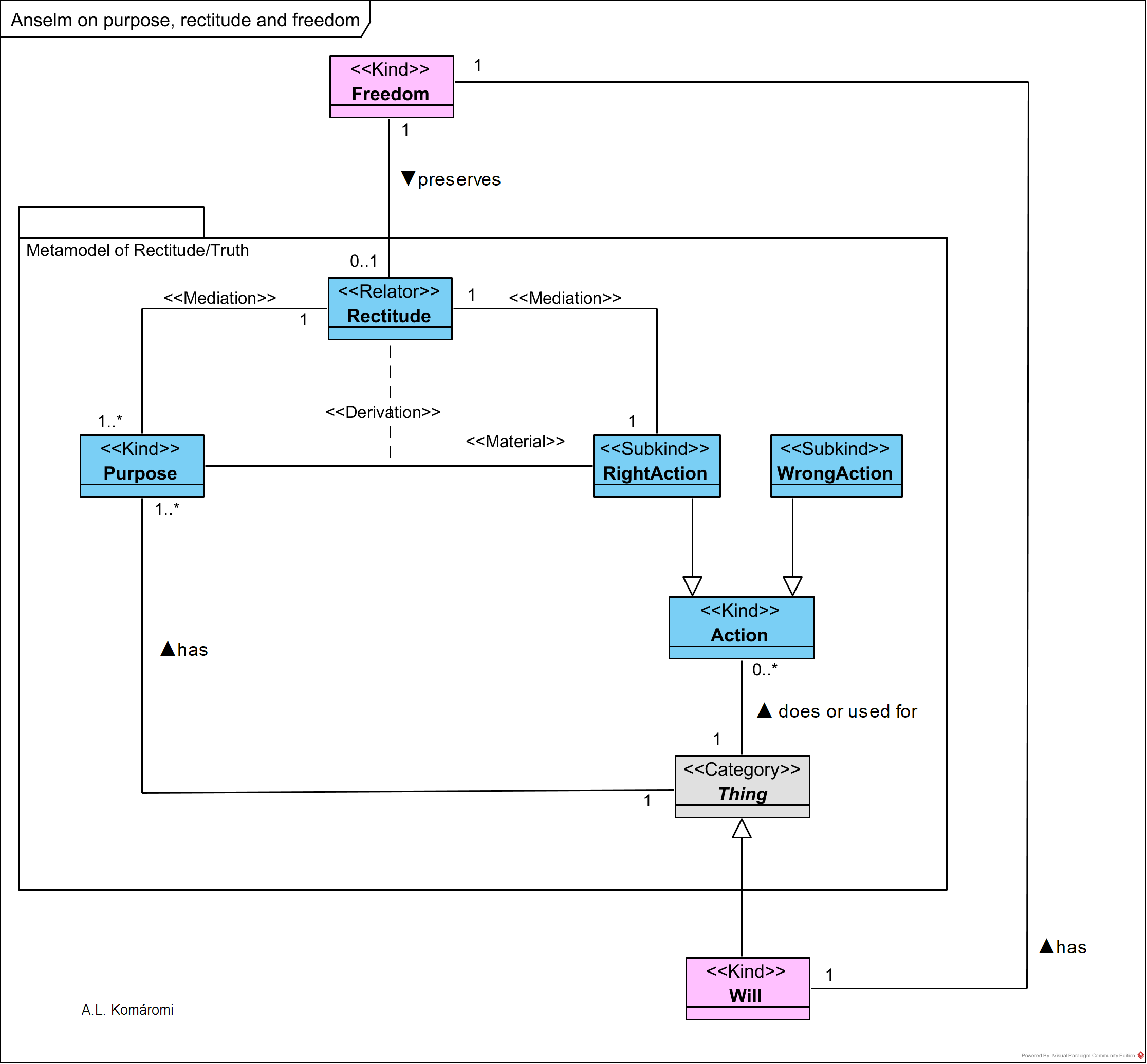
St Anselm on purpose, rectitude and freedom of will
ClassDetailsRelations
ThingThinghas Purpose; does/is used for Action
PurposePurpose understood in teleological way (see [1.3.4]): the finality, reason or explanation for something.
ActionThings are able to do, or to be used for different “actions“.
RightActionRight action is performed when the Thing acts/is used according to its purpose. is subkind of Action; in material relation with Purpose
WrongActionRight action is performed when the thing acts/is used not according to its purpose.is subkind of Action
RectitudeRectitude (or Truth) for Anselm “is understood teleologically; a thing is correct whenever it is or does whatever it ought, or was designed, to be or do.”relates Purpose with RightAction
WillWillsubkind of Thing; has Freedom
FreedomAnselm defines “freedom as ‘the power to preserve rectitude of will for its own sake,’ the arguments of On Truth imply that freedom is also the capacity for justice and the capacity for moral praiseworthiness. Now it is both necessary and sufficient for justice, and thus for praiseworthiness, that an agent wills what is right, knowing it to be right, because it is right. That an agent wills what is right because it is right entails that he is neither compelled nor bribed to perform the act. Freedom, then, must be neither more nor less than the power to perform acts of that sort. […]
God and the good angels cannot sin, but they are still free, because they can (and do) preserve rectitude of will for its own sake. In fact, they are freer than those who can sin: ‘someone who has what is fitting and expedient in such a way that he cannot lose it is freer than someone who has it in such a way that he can lose it and be seduced into what is unfitting and inexpedient’. It obviously follows, as Anselm points out, that freedom of choice neither is nor entails the power to sin; God and the good angels have freedom of choice, but they are incapable of sinning.”
preserves Rectitude

The following table contains some examples of how Anselm’s rectitude meta-model is working:

ThingPurposeRectitudeRightActionWrongActionExplanation
statementsignifies that what-is istruthsignifies that what-is isstatements are made for the purpose of ‘signifying that what-is is’. A statement therefore is correct (has rectitude) when, and only when, it signifies that what-is is. So Anselm holds a correspondence theory of truth, but it is a somewhat unusual correspondence theory. Statements are true when they correspond to reality, but only because corresponding to reality is what statements are for. That is, statements (like anything else) are true when they do what they were designed to do; and what they were designed to do, as it happens, is to correspond to reality.”
willto will:
● justice
● moral evaluation
Rectitude of willwilling what one ought to will“Rectitude of will means willing what one ought to will or (in other words) willing that for the sake of which one was given a will. So, […] the truth or rectitude of a will is the will’s doing what wills were made to do. In De veritate Anselm connects rectitude of will to both justice and moral evaluation.”
The will of God and the angels is allways in the state of rectitude.
willto will:
● justice
● moral evaluation
will for happiness “In On the Fall of the Devil (De casu diaboli) Anselm extends his account of freedom and sin by discussing the first sin of the angels. In order for the angels to have the power to preserve rectitude of will for its own sake, they had to have both a will for justice and a will for happiness. If God had given them only a will for happiness, they would have been necessitated to will whatever they thought would make them happy. Their willing of happiness would have had its ultimate origin in God and not in the angels themselves. So they would not have had the power for self-initiated action, which means that they would not have had free choice. The same thing would have been true, mutatis mutandis, if God had given them only the will for justice.
Since God gave them both wills, however, they had the power for self-initiated action. Whether they chose to subject their wills for happiness to the demands of justice or to ignore the demands of justice in the interest of happiness, that choice had its ultimate origin in the angels; it was not received from God. The rebel angels chose to abandon justice in an attempt to gain happiness for themselves, whereas the good angels chose to persevere in justice even if it meant less happiness. God punished the rebel angels by taking away their happiness; he rewarded the good angels by granting them all the happiness they could possibly want. For this reason, the good angels are no longer able to sin. Since there is no further happiness left for them to will, their will for happiness can no longer entice them to overstep the bounds of justice. Thus Anselm finally explains what it is that perfects free choice so that it becomes unable to sin. […]
Like the fallen angels, the first human beings willed happiness in preference to justice. By doing so they abandoned the will for justice and became unable to will justice for its own sake. Apart from divine grace, then, fallen human beings cannot help but sin. Anselm claims that we are still free, because we continue to be such that if we had rectitude of will, we could preserve it for its own sake; but we cannot exercise our freedom, since we no longer have the rectitude of will to preserve. (Whether fallen human beings also retain the power for self-initiated action apart from divine grace is a tricky question, and one I do not propose to answer here.)
So the restoration of human beings to the justice they were intended to enjoy requires divine grace.”

Sources

First published: 21/05/2020

[4.1.2] Eriugena’s Cosmology

Irish monk and philosopher John Scottus Eriugena (800? – 877? AD) in its masterpiece Periphyseon (On the Division of Nature) elaborates an original Christian and Neoplatonic (see also [2.4.2][3.2.1][3.3.2][3.4][3.7.3]) cosmology, where

  • “Nature” includes God and the creations, the totality of things that are and are not.
  • God expresses Himself in creation, and creation culminates in the return to the divine.
  • Being and non-being is defined as a set of dialectic modalities, so a thing “may be said to be under one mode and not to be under another.”

A draft of Eriugena’s cosmological model is presented in the following OntoUML diagram:

Eriugena on nature
ClassDescriptionRelations
ModeOfBeingEriugena defines “five ways of interpreting” (quinque modi interpretationis) the mode of being, the way in which things may be said to be or not to be.
“One of the striking features of this complex—and certainly, in this form, original—account is that being and non-being are treated as correlative categories: something may be said to be under one mode and not to be under another. Attribution of being is subject to the dialectic of affirmation and negation.”
charaterizes Thing
1stModeOfBeing“According to the first mode, things accessible to the senses and the intellect are said to be, whereas anything which, ‘through the excellence of its nature’ (per excellentiam suae naturae), transcends our faculties are said not to be.” descendant of ModeOfBeing
2ndModeOfBeing“The second mode of being and non-being is seen in the ‘orders and differences of created natures’, whereby, if one level of nature is said to be, those orders above or below it, are said not to be:
For an affirmation concerning the lower (order) is a negation concerning the higher, and so too a negation concerning the lower (order) is an affirmation concerning the higher. (Periphyseon, I.444a) According to this mode, the affirmation of man is the negation of angel and vice versa (affirmatio enim hominis negatio est angeli, negatio vero hominis affirmatio est angeli, I.444b). This mode illustrates Eriugena’s original way of dissolving the traditional Neoplatonic hierarchy of being into a dialectic of affirmation and negation: to assert one level is to deny the others. In other words, a particular level may be affirmed to be real by those on a lower or on the same level, but the one above it is thought not to be real in the same way. If humans are thought to exist in a certain way, then angels do not exist in that way.”
descendant of ModeOfBeing
3rdModeOfBeing“The third mode (I.444c–445b) contrasts the being of actual things with the ‘non-being’ of potential or possible things still contained, in Eriugena’s memorable phrase, ‘in the most secret folds of nature’ (in secretissimis naturae sinibus). This mode contrasts things which have come into effect with those things which are still contained in their causes. According to this mode, actual things, which are the effects of the causes, have being, whereas those things which are still virtual in the Primary Causes (e.g., the souls of those as yet unborn) are said not to be.”descendant of ModeOfBeing
4thModeOfBeing“The fourth mode (I.445b–c) offers a roughly Platonic criterion for being: those things contemplated by the intellect alone (ea solummodo quae solo comprehenduntur intellectu) may be considered to be, whereas things caught up in generation and corruption, viz. matter, place and time, do not truly exist. The assumption is that things graspable by intellect alone belong to a realm above the material, corporeal world and hence are timeless.”descendant of ModeOfBeing
5thModeOfBeing“The fifth mode offered by Eriugena is essentially theological and applies solely to humans: those sanctified by grace are said to be, whereas sinners who have renounced the divine image are said not to be.”descendant of ModeOfBeing; characterizes Human
ThingEriugena claims, that “nature” (natura), is “the general term for all things that are and all things that are not”, including both God and creation.
Species“Echoing similar divisions in Augustine (De civitate Dei Bk. V. 9, PL 41: 151) and Marius Victorinus (Ad Candidum), nature’s four ‘divisions’ or ‘species’ are: that which creates and is not created (i.e., God); that which creates and is created (i.e., Primary Causes or Ideas); that which is created and does not create (i.e., Temporal Effects, created things); that which is neither created nor creates (i.e., non-being, nothingness).”characterizes Thing
GodPeriphyseon Book One examines the first division, God understood as a transcendent One above, and yet cause of, all creation. God transcends everything; He is, following Pseudo-Dionysius, the “negation of all things” (negatio omnium, III.686d). According to Eriugena—who in this respect is following a tradition which includes Augustine and Boethius as well as Dionysius and other Greek authors—the Aristotelian categories are considered to describe only the created world and do not properly apply to God (I.463d). God cannot “literally” (proprie) be said to be substance or essence (ousia, essentia), nor can He be described in terms of quantity, quality, relation, place or time. He is “superessentialis” (I.459d), a term which, for Eriugena, belongs more to negative theology than to affirmative. His “being” is “beyond being”. Eriugena particularly admires a Dionysian saying from the Celestial Hierarchy (CH iv 1; PG 3: 177d1–2): to gar einai panton estin he hyper to einai theotes (“for the being of all things is the Divinity above being”, III.686d) which he translates as esse omnium est superesse divinitatis, (“the being of all things is the super-being of divinity”, III.686d, I.443b; see also I.516c; III.644b, V.903c). This is perhaps Eriugena’s favorite phrase from Dionysius. (Indeed, Maximus Confessor had also commented on it in I Ambigua xiii, PG 91: 1225d, a passage well known to Eriugena who translated the Ambigua.) Sometimes, instead of invoking the Dionysian formula superesse divinitatis, Eriugena speaks of the “divine superessentiality” (divina superessentialitas, III.634b), or—quoting Divine Names I 1–2 (PG 3: 588b–cb)—of the “superessential and hidden divinity” (superessentialis et occulta divinitas, I.510b).
God is a “nothingness” (nihilum) whose real essence is unknown to all created beings, including the angels (447c). Indeed, Eriugena argues in a radical manner, following Maximus Confessor, that God’s nature is infinite and uncircumscribable, such that He is unknown even to Himself, since He is the “infinity of infinities” and beyond all comprehension and circumscription. In the Periphyseon, Eriugena repeats the position of the De Praedestinatione that God does not know evil, and, in a genuine sense, God may be said not to know anything; his ignorance is the highest wisdom.”
According to the First Mode of Being “God, because of his transcendence is said not to be. He is ‘nothingness through excellence’ (nihil per excellentiam).”
creates PrimaryCause; returns to God; subkind of Thing
Creates NotCreatedCreates and not createdcharacterizes God; descendant of Species
neitherCreated norCreatesNeither created nor createscharacterizes God; descendant of Species
PrimaryCauseThe main focus of the Second Book of the Periphyseon is an analysis of what Eriugena terms “the Primary Causes” (causae primordiales) which are the patterns of all things located in the mind of God and function as the timeless and unchanging causes of all created things. This doctrine represents an eclectic combination of various earlier doctrines, including the Platonic theory of Forms or ideai, Dionysius’ discussion of the divine names, and Augustine’s revival of the Stoic notion of eternal reasons (rationes aeternae).
God’s mind, understood as the logos or verbum, contains in one undivided Form all the reasons for every individual thing. These reasons (rationeslogoi) are productive of the things of which they are the reasons. Their number is infinite and none has priority over the other, e.g., Being is not prior to Goodness, or vice-versa. Each is a divine theophany, a way in which the divine nature is manifested. The very nature of these Causes is to flow out from themselves, bringing about their Effects. This “outflowing” (πρόοδοςproodosprocessioexitus) creates the whole universe from the highest genus to the lowest species and “individuals” (atoma). In his understanding of this causal procession, Eriugena accepts Neoplatonic principles: like produces like; incorporeal causes produce incorporeal effects; an eternal cause produces an eternal effect. Since the causes are immaterial, intellectual and eternal, so their created effects are essentially incorporeal, immaterial, intellectual, and eternal. Eriugena, however, thinks of cause and effect as mutually dependent, relative terms (Periphyseon, V. 910d–912b): a cause is not a cause unless it produces an effect, an effect is always the effect of a cause.
creates CreatedEffect;
subkind of Thing
Creates isCreatedCreates an is Createdcharacterizes PrimaryCause; descendant of Species
CreatedEffectBy nature, they are eternal and incorruptible, but Eriugena also thinks of individual created things as located spatially and temporally. He seems to think there are two kinds of time: an unchanging time (a reason or ratio in the divine mind,Periphyseon, V.906a) and a corrupting time. Place and time are definitions in that they situate or locate the things they define, and since definitions are in the mind, then place and time are in the mind (Periphyseon, I.485b). Following Gregory of Nyssa, Eriugena holds that the sensible, corporeal, spatio-temporal appearances of things are produced by the qualities or “circumstances” of place, time, position, and so on, which surround the incorporeal, eternal essence. The whole spatio-temporal world and our corporeal bodies are a consequence of the Fall, an emanation of the mind. Eriugena is somewhat ambiguous about this. His considered position appears to be that God, foreseeing that man would fall, created a body and a corporeal world for him. But this corporeal body is not essential to human nature and in the return of all things to God, the body will be absorbed back into the spiritual body (spirituale corpus) and the spiritual body back to the mind (mens, intellectus, νοῦς). The corporeal world will return to its incorporeal essence, and place understood as the extension will return back into its cause or reason as a definition in the mind (Periphyseon, V.889d).returns to PrimaryCause; subkind of Thing
isCreated doesNotCreateIs created and does not createcharacterizes CreatedEffect; descendant of Species
Human“I declare that man consists of one and the same rational soul conjoined to the body in a mysterious manner, and that it is by a certain wonderful and intelligible division that man himself is divided into two parts, in one of which he is created in the image and likeness of the Creator, and participates in no animality … while in the other he communicates with the animal nature and was produced out of the earth, that is to say, out of the common nature of all things, and is included in the universal genus of animals. (Periphyseon, IV.754a–b)”subkind of CreatedEffect
RationalSoulRational soul (see above)exclusive part of Human
Body“But this corporeal body is not essential to human nature and in the return of all things to God, the body will be absorbed back into the spiritual body (spirituale corpus) and the spiritual body back to the mind (mens, intellectus, νοῦς). The corporeal world will return to its incorporeal essence, and place understood as the extension will return back into its cause or reason as a definition in the mind”exclusive part of Human
CorporealBodyCorporeal body (see above)phase of Body
SpiritualBodySpiritual body (see above)phase of Body

Sources

First published: 14/05/2020