[3.3.4] Ibn Sina on the Phases of Intellect

Ibn Sina (Avicenna, 980-1037 AD) thinks that the human Intellect goes through a series of four phases – starting from the empty potentiality of a newborn to the fully actualized intellectual faculty containing Forms acquired from the Active Intellect (see also [3.3.2], [3.3.3] and al-Farabi’s similar structure [3.2.4]).

The following OntoUML diagram shows the four phases of the Intellect:

Ibn Sina on Stages of Intellect
ClassDescriptionRelations
HumanIntellectIntellect is acquiring concepts/forms through actualization from Active Intellect.
Material
Intellect
“‘Material intellect‘ is the wholly ‘unqualified potentiality’ for thought which belongs to ‘every member of the species.’ It is a ‘disposition’ (isticdad) inhering in the incorporeal human soul from birth.”
E.g. “The newborn infant has the potentiality for writing only in the sense that it may eventually learn to write.”
phase of Intellect
Intellect
InHabitu
“‘Intellect in habitu(bil-malaka) is the ‘possible potentiality’ in which the human subject possesses the ‘first intelligible thoughts.’ These are attained through cogitation.
E.g. “Later, the ‘boy matures’ and comes to ‘know the inkwell, the pen, and the letters.’ Inasmuch as he controls the rudiments and can go on to master the art with ‘no intermediate’ step, he is said to have a ‘possible potentiality’ for writing.”
phase of Intellect; posesses FirstInteligible
Actual
Intellect
“‘Actual intellect, despite the name, is a further stage of potentiality— the stage of fully actualized potentiality. It is the ‘complete [kamdliyya] potentiality’ that is attained when both ‘second intelligibles'[derivative scientific
propositions] and ‘intelligible forms’—that is to say, derivative propositions and concepts—have been added to the ‘first intelligibles,’ with the proviso that the human subject is not thinking the propositions and concepts. At the stage of actual intellect, the human subject does not ‘actually … attend to’ his knowledge, yet can do so ‘whenever he wishes.'”. These are attaied also with the help of cogitation.
phase of Intellect; posesses FirstInteligible and SecondIntelligible
Acquired
Intellect
“‘acquired [mustafdd] intellect,’ which alone is an ‘unqualified actuality.’ At the level of acquired intellect, ‘intelligible forms’ are actually ‘present’ to the man, and he ‘actually attends’ to them. Avicenna’s acquired intellect is, literally, acquired from the active intellect. The unqualified actuality of thought is ‘called. . . acquired, because it will be shown . . . that potential intellect passes to actuality’ by establishing contact with the active intellect and having ‘forms acquired from without imprinted’ in man’s intellect.”
E.g. “At a still higher level stands the ‘scribe,’ who is adept with the [writing] implement,’ is ‘accomplished in his art,’ and can apply the art ‘at will.’ When he is not exercising his skill, the scribe has a ‘perfect’ potentiality for writing.”
phase of Intellect; posesses FirstInteligible , SecondIntelligible and Form
Active
Intellect
“The active intellect is (1) the emanating cause of the matter of the sublunar world, (2) the emanating cause of natural forms appearing in matter, including the souls of plants, animals, and man, and (3) the cause of the actualization of the human intellect.”actualize Acquired
Intellect; emanates Form
Formnatural form of the lower worldexclusive part of ActiveIntellect; characterizes Intellect
FirstIntelligiblefirst intelligibles: “are theoretical propositions of the sort man affirms without being able to ‘suppose that they might ever not be affirmed’; examples are the propositions that ‘the whole is greater than the part’ and ‘things equal to the same thing are equal to each other.'”
SecondIntelligibleSecond intelligibles are derivative propositions and concepts.
IntelligibleFirst intelligibles, second intelligibles and forms are intelligibles.

Sources

  • All citations from:  Herbert A. Davidson, “Alfarabi, Avicenna, and Averroes, on Intellect”, Oxford University Press 1992

First published: 22/08/2019
Updated: added first and second intelligible on 22/11/2020
[3.3.2] Ibn Sina’s Cosmology

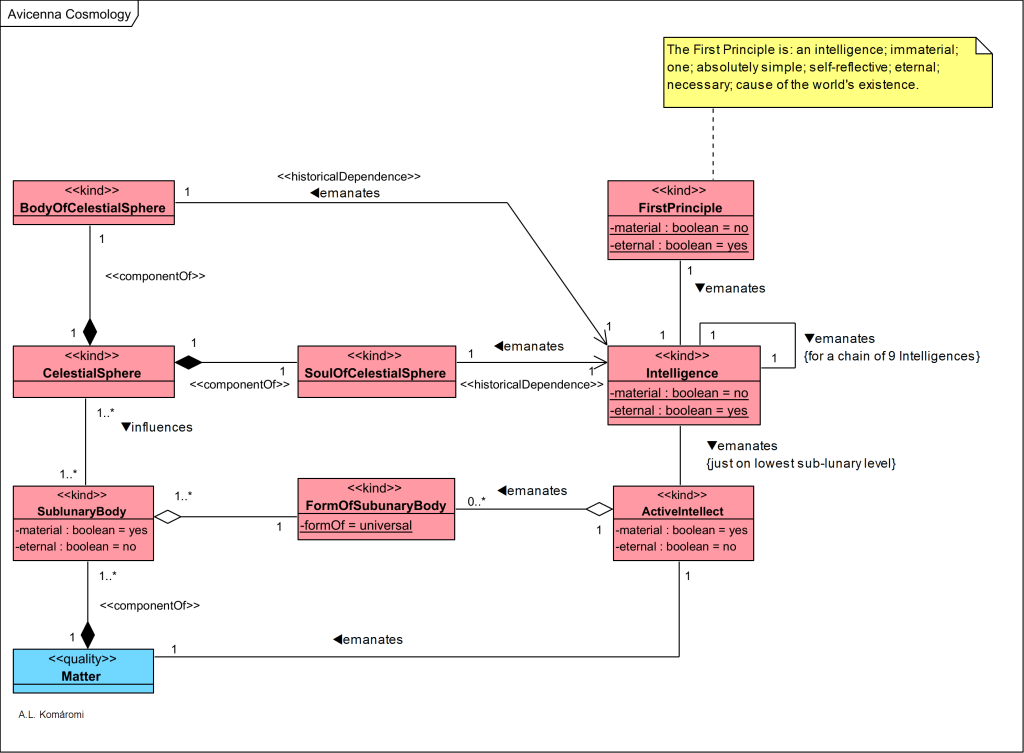
Ibn Sina (Avicenna, 980-1037 AD) writes about cosmology and metaphysics in Ilāhiyyāt of Kitāb al-Šifā’ (known in English as the Metaphysics of the Book of the Healing or the Book of the Cure). The basis of his theory is a necessary chain of causation starting at the First Principle (as cause), continuing with the chain of Intelligencies and Active Intellect (as effects and intermediaries), and ending with the Sublunary Bodies (as final effects) – as shown in the following OntoUML diagram:

Avicenna cosmology
Class DescriptionRelations
FirstPrincipleThe main attributes of the First Principle are: intelligence; immaterial; one; absolutely simple; self-reflective; eternal; necessary; cause of the world’s existence.
“Avicenna considers the world to be ‘instaured” or absolutely created (mubdaʿ) and at the same time establishes that it is eternal and eternally in motion, as Aristotle’s physics and metaphysics teach. He therefore posits a Principle of the world’s existence (wuǧūd) […] the final cause is […] the same efficient cause that makes things exist (mūǧid). The First Principle is therefore a cause in every respect.

The First Principle is also referred as Necessary Existent.
associated with the (first) Intelligence of the chain
IntelligenceA chain of nine Intelligencies is necessarily emanated (fayḍ) from the First Principle, one from the other for the Heavens – the outermost sphere, one for the fixed stars, Saturn, Jupiter, Mars, Sun, Venus, Mercury, and the Moon. Each Intelligence:
“- thinks of the First Principle and aims at it, a further intelligence originates;
– from the act by which it thinks of itself and aims at itself, two entities originate: a soul, which is an intelligence bound to a body and which is, in some texts, equated to the practical intellect;
– and the celestial body to which this intelligence is bound.”
emanates: next level of Intelligence; SoulOfCelestialSpere; BodyOfCelestialSpere. Lowest level emanates ActiveIntellect
ActiveIntellectActive Intellect (or Agent Intellect) is the last, tenth member of the chain of intelligencies, which emanates universal (unified, undifferentiated) forms of Sublunary Bodies, and Matter, which combines into Sublunary Bodies. Since the forms are universal, the differences, particularities of the Sublunary Bodies are caused by the influence of the Celestial Spheres.

Due to the fact, that the members of the chain of intelligencies lose their power with the increasing distance from the First Principle, the Active Intellect is not able to emanate eternal entities, so the sublunary bodies are not eternal, yet in a structure similar to celestial bodies.
emanates FormsOf
SublunaryBody; Matter
SoulOfCelestial
Sphere
Soul of Celestial Sphere is emanated by the Intellect when thinks of itself.part of CelestialSphere
BodyOfCelestial
Sphere
Body of Celestia Sphere is emanated by the Intellect when thinks of itself.part of CelestialSphere
CelestialSphereCelestial Sphere contains Soul of Celestial Sphere and Body of Celestia Sphere.influences SublunaryBody
FormOf
SublunaryBody
Form of Sublunary Body is a universal (unified, undifferentiated) form emanated by Active intellect.
E.g. Form of sea, Soul of man
part of SublunaryBody
MatterMatter is emanated by Active Intellect, has the potentiality to be actualized by Form.contained by SublunaryBody
Sublunary BodySublunary Body is composed of Form and Matter. Its particularity is due to the influence of the Celestial Spheres.

His cosmological scheme Neoplatonist, and very similar with al-Farabi’s (see [3.2.1]), but with some notable differences:

  • the Forms of Sublunary Bodies contained and emanated by Active Intellect are undifferentiated universals, not Particulars, as at al-Farabi
  • Matter is emanated by the Active Intellect (not by the Celestial Sphers as at al-Farabi)
  • the existence of the First Cause is necessary by itself, the existence of the chain of Intellects is necessary by the First Cause and contingent by itself (aspects not analyzed by al-Farabi)

Sources

  • All citations from: Lizzini, Olga, “Ibn Sina’s Metaphysics”The Stanford Encyclopedia of Philosophy (Summer 2019 Edition), Edward N. Zalta (ed.)
  • Davidson, Herbert A., “Alfarabi, Avicenna, and Averroes, on Intellect”, Oxford University Press 1992

First published: 08/08/2019