[3.2.4] Al-Farabi on Actualization of the Intellect

Al-Fārābī’s (872-950 AD) views on the different phases of the intellect are to be found in The Treatise on the Intellect (Risālah fi’l-‘aql). He borrows the idea from Alexander (however, he wrongly attributes it to Aristotle) that the human intellect’s evolution progresses in three phases: material, actual, and acquired. For the realization of the last – acquired – phase, the help of higher, non-human intellect – the active intellect is needed (see also [3.2.2]). 

These phases are presented in the following OntoUML diagram:
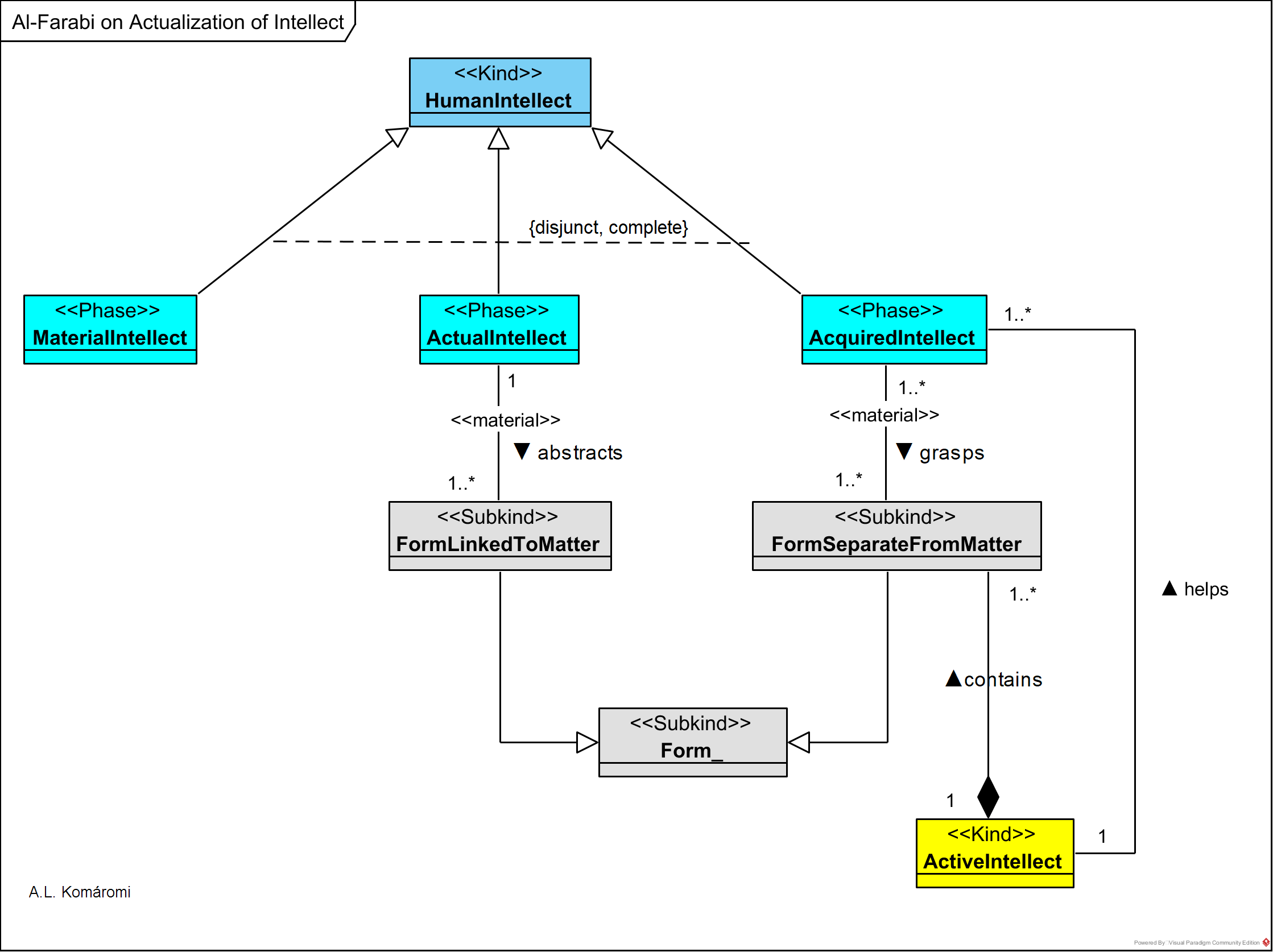
Al-Farabi on actualization of the intellect
ClassDescriptionRelations
HumanIntellectHuman intellect (arabic: aql, greek: νοῦς) “is understood as a faculty of the soul by means of which certainty about necessary, true, and universal premises is attained. Premises of this kind are not arrived at by means of syllogisms, but are present in the subject in a prior way, either by nature or without one being aware of how these premises were acquired. Hence, this faculty is some part of the soul by which humans have access to the first principles of the theoretical sciences.”   
MaterialIntellectMaterial intellect (arabic:‘”aql bi-l-quwah“): “Following Aristotle and the Aristotelian tradition, al-Fārābī describes the intellect as being itself potential or, using Alexander’s terminology, an innate ‘natural disposition’ […]. This kind of intellect is frequently called “potential”, “material”, or “passive”, and is simply the rational faculty with which all human beings are endowed.
In The Treatise on the Intellect al-Fārābī refers to the material intellect (νοῦς ὑλικὸς, a Greek term coined by Alexander) as a soul or part of the soul, or one of the faculties of the soul, or something that is in potency to abstract the forms from their matter and turning these into forms for itself”
is phase of HumanIntellect
ActualIntellectActual intellect (arabic: ‘aql bi’l-fi‘l): “When these forms are abstracted, they become intelligibles or forms for the material intellect. It can be rightly said that for al-Fārābī the material intellect is like the matter where the abstracted forms come to be, where the material intellect itself becomes the abstracted forms, just as the imprinted object leaves its mark on a piece of wax.
Before a form of the objects outside the soul has been abstracted, the material intellect is just in potency to receive those forms or potential intelligibles; but when these latter come to be in the material intellect, the material intellect becomes an actual intellect, and the potential intelligibles are actualized. Now, the existence of actual intelligibles is different from their existence as potential intelligibles or forms in matter. When external to the soul and linked to matter, forms are affected by place, time, position, quantity, and the like. But when forms are actualized in the soul, many of these qualities are removed and their existence thus becomes different from their former existence as forms of bodies outside the soul.”
is phase of HumanIntellect; abstracts FormLinkedToMatter
AcquiredIntellectAcquired intellect (arabic: ‘aql al-mustafāḍ): “the process of abstraction is not required in the case of forms separate from matter, that is, the separate entities that belong to the supralunar realm. These separate forms are grasped by the intellect not as actual intellect but as the acquired intellect, and thus become forms for it. Moreover, the acquired intellect is a perfection of the human intellect because it has no need to perform the activity of abstraction in order to grasp forms existing separately from matter. In other words, it is the acquired intellect that enables the grasping of separate forms through the assistance of the active intellect.” is phase of HumanIntellect; grasps FormSeparate
FromMatter
FormForm (arabic: ‘aql al-fa ‘‘āl): “In The Political Regime al-Fārābī deals with the relation between matter and form, and explains that form is the actualization of matter in the sense that form is more excellent than matter; however, matter is the substratum of form and without matter there is no form […]. As can be seen, al-Fārābī is a partisan of Aristotelian hylomorphism” (see also [1.3.5])
FormLinkedToMatterForms linked to matter are external to the soul, and “are affected by place, time, position, quantity, and the like. […] forms linked to matter have to be abstracted in order to become actual intelligibles in the actual intellect.”is subkind of Form
FormSeparate
FromMatter
Forms separate from matter can be e.g. the forms of celestial bodies (see [3.2.1]): “the process of abstraction is not required in the case of forms separate from matter, that is, the separate entities that belong to the supralunar realm.”is subkind of Form
ActiveIntellectActive intellect is emanated by the second intellect (see [3.2.1]), and helps the grasping of forms separated from matter by the acquired intellect.contains FormSeparate
FromMatter; helps AcquiredIntellect

Sources

First published: 6/2/2020

[3.2.1] Al-Farabi’s Cosmology

In The Political Regime and The Virtuous City, al-Fārābī (872-950 AD) provides a metaphysical and ontological model of the universe, combining:

  • Neoplatonic emanationism (see [2.4.2])
  • Aristotelian views on the celestial spheres
  • and hylomorphism (see [1.3.5], [1.3.7])

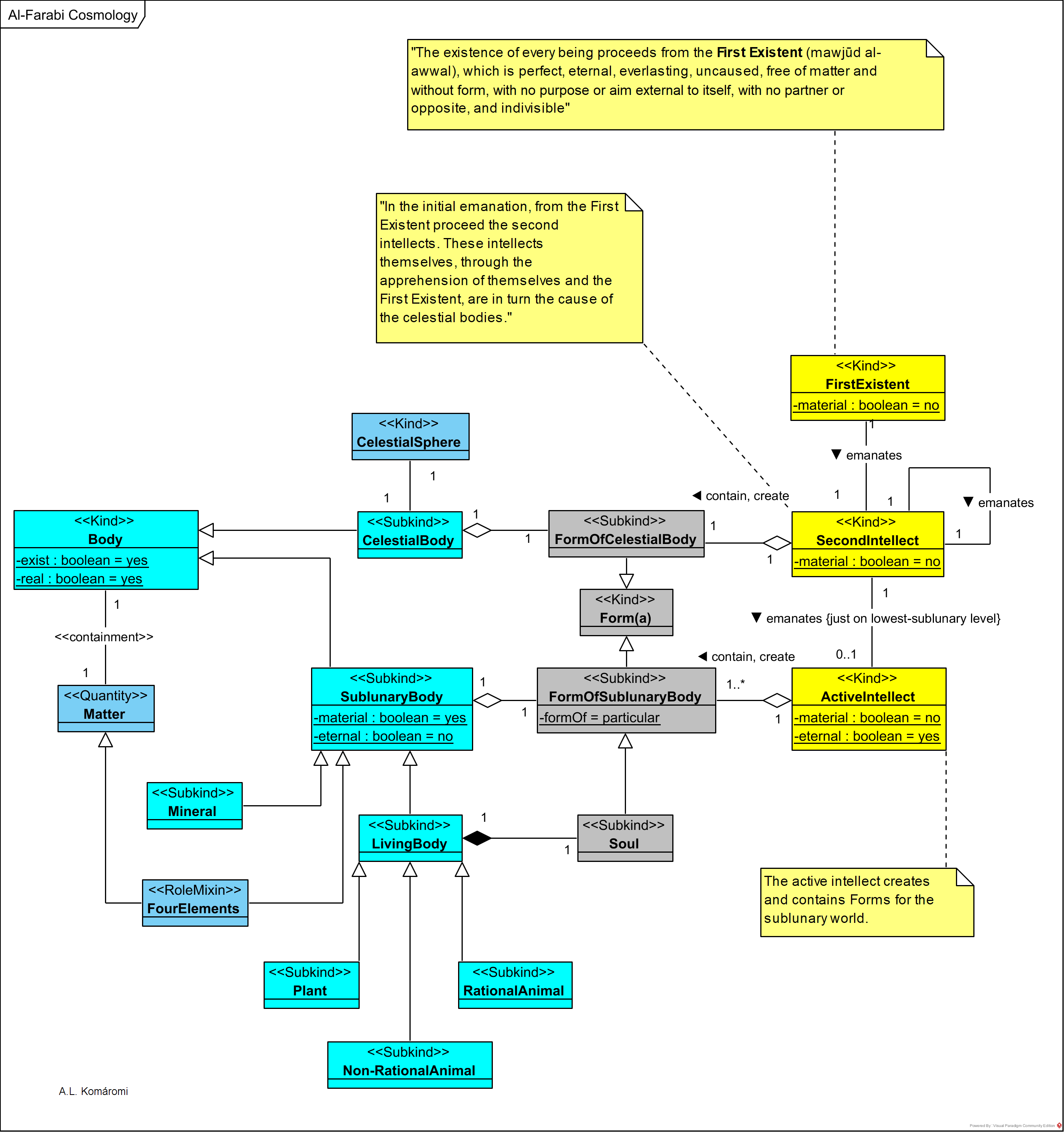
as can be observed in the following OntoUML diagram:

Al-Farabi’s cosmology
ClassDescriptionRelations
FirstExistentAl- Fārābī identifies the First Existent with God, who is the source of revelation for Rational Animals (Man) through the Active Intellect.
“According to the emanation (fayḍ) process described by al-Fārābī, the existence of every being proceeds from the First Existent (mawjūd al-awwal), which is perfect, eternal, everlasting, uncaused, free of matter and without form, with no purpose or aim external to itself, with no partner or opposite, and indivisible. The First Existent is distinguished from all other beings due to its oneness, which is its essence. This description seems very close to the Neoplatonic conception of the One, but it is not exactly the same. Al-Fārābī instead argues that, given that this First Existent is not in matter and has no matter, it should be an actual intellect (‘aql bi’l fi‘l). The First Existent is also intelligible (ma‘qūl) through its substance, and its identity consists in simultaneously being the act, the subject, and the object of its own intellection.”
emanates highest SecondIntellect
SecondIntellectEach Second Intellect creates and contains a Form for a CelestialBody (e.g. the form of Saturn), and emanates a next level of Intellect.

“Every existent comes to be, according to al-Fārābī, by the First Existent. This takes place through a sort of expansion or emanation through which the First Existent necessarily gives existence to every being in the universe. Yet this does not imply any addition to its own perfection. In the initial emanation, from the First Existent proceed the second intellects. These intellects themselves, through the apprehension of themselves and the First Existent, are in turn the cause of the celestial bodies.”
contains FormOfCelestialBody; emanates next level of SecondIntellect
ActiveIntellect The active intellect creates and contains particular Forms for the particular Bodies in the sublunary world. E.g. creates the form of the Mont Blanc.

“There is a tenth intellect, namely, the active intellect (‘aql al-fa ‘‘āl), whose activity is very relevant mainly for two reasons: (1) this intellect governs together with the celestial spheres the sublunary world, and is even involved in the processes of generation and corruption (al-Fārābī LI: 29–30; OI: 75); (2) furthermore… this intellect also provides the first principles of understanding through which human beings can attain happiness (al-Fārābī VC: 204–205)”
contains FormsOfSublunaryBody; is emanated by the lowest SecondIntellectIntellect (Moon)
FormOf
Celestial
Body
The Form of Celestial Body is created by the corresponding Second Intellect.contained by a SecondIntelect; part of a CelestialBody
CelestialBody “..fixed stars, Saturn, Jupiter, Mars, the sun, Venus, Mercury, and the Moon.” is subkind of Body; Composed of FormOfCelestialBody and Matter
Celestial
Sphere
“In The Virtuous City he explicitly enumerates nine spheres starting with the first heaven, and then the fixed stars, Saturn, Jupiter, Mars, the sun, Venus, Mercury, and the Moon.”associated with 1 CelestialBody
FormOf
Sublunary
Body
A multidude of Forms of particular sublunary bodies are created by the ActiveIntellect. E.g. form of the Mont Blanc. contained by a ActiveIntelect; part of a SublunaryBody
Soul
The soul is the Form of particular a Living Body.
“Al-Fārābī describes the soul as Aristotle did in On the Soul 2.1, 412a19, that is, as the form or actualization (ἐντελέχεια / antalāshiyā or at-tamām) of a natural organic body that potentially has life. Living beings have different faculties: the nutritive, sensitive, appetitive, and rational faculties.”
E.g. the soul of Aristotle, created and contained by the Active Intellect.
FormForms can be of Celestial and Sublunary Bodies.
“there are also different kinds of forms, some of them of lower perfection, as the form of minerals or plants, and others more perfect, as the form of rational animals. This perfection is given by the faculties that each body has according to its natural disposition: while plants have basic faculties such as nutrition or reproduction, rational animals have a higher faculty, the intellect, which enables human beings to attain intelligibles in act.Forms can be of Celestial and Sublunary Bodies.”
Body“Al-Fārābī explains that the universe contains six kinds of body. In decreasing order of perfection, there are: (1) celestial bodies, (2) rational animals, (3) non-rational animals, (4) plants, (5) minerals, and (6) the four elements (al-Fārābī KS: 31; PR: 29).”contains Matter
SublunaryBodySublunary Bodies can be:
– Living Bodies: rational animals, non-rational animals, plants,
– minerals, and the four elements
E.g. Mont Blanc
contains FormOfSublunaryBody
LivingBodyLiving Bodies: rational animals, non-rational animals, plants
E.g. Aristotle as a human being, with Soul created by the Active Intellect and body created from matter.
contains Soul
RationalAnimalrational animals have a higher faculty, the intellect, which enables human beings to attain intelligibles in act.”is LivingBody
Non-Rational
Animal
Non-Rational Animal is Living Body.is LivingBody
Plant Plant is Living Body.is LivingBody
MineralMinaral is Sublunary Body.is SublunaryBody
FourElementsThe FourElements are Sublunary Body and Matter at the same time.
“The four elements proceed from prime matter and, when these elements combine and mix in different ways and undergo the influence of the heavenly bodies, they generate numerous kinds of bodies: minerals, plants, non-rational animals, and rational animals (al-Fārābī VC: 112–115).”
is Sublunary Body and Matter
Matter“Concerning the origin and composition of matter, al-Fārābī explains that the circular motion of the celestial spheres generates prime matter (al-madda al-ūlā), which is common to all bodies in the sublunary world… Given that matter is the substratum of form, the different forms appear when the combination of the elements takes place, giving rise to different kinds of bodies.”

Hylomorphism (see [1.3.5], [1.3.7]) can be observed in the following relations:

  • Matter – CelestialBody – FormOfCelestialBody
  • Matter – SublunaryBody – FormOfSublunaryBody
  • Matter – LivingBody – Soul

Sources

  • All citations from: López-Farjeat, Luis Xavier, “Al-Farabi’s Psychology and Epistemology”The Stanford Encyclopedia of Philosophy (Summer 2018 Edition), Edward N. Zalta (ed.)
  • Herbert A. Davidson, “Alfarabi, Avicenna, and Averroes, on Intellect”, Oxford University Press 1992
  • Amelia Carolina Sparavigna, “The Ten Spheres of Al-Farabi: A Medieval Cosmology, Article in International Journal of Sciences January 2014

First published: 11/07/2019