[3.3.3] Ibn Sina on the Soul

Ibn Sina (Avicenna, 980-1037 AD) elaborates on the Soul in the book De anima of the Shifā or Healing, according to which:

  • The Soul is immaterial, separated from the body, however, linked to it.
  • Exterior and interior senses serve the Intellect as a source of knowledge, through a process of abstraction from sense perception.
  • Knowledge – Forms – is also received from the Active Intellect

The following UML Use Case diagram presents the main concepts in Avicenna’s theory of the human soul, strongly related with his Cosmology (see [3.3.2]), and Aristotle’s Psychology (see [1.3.6]):
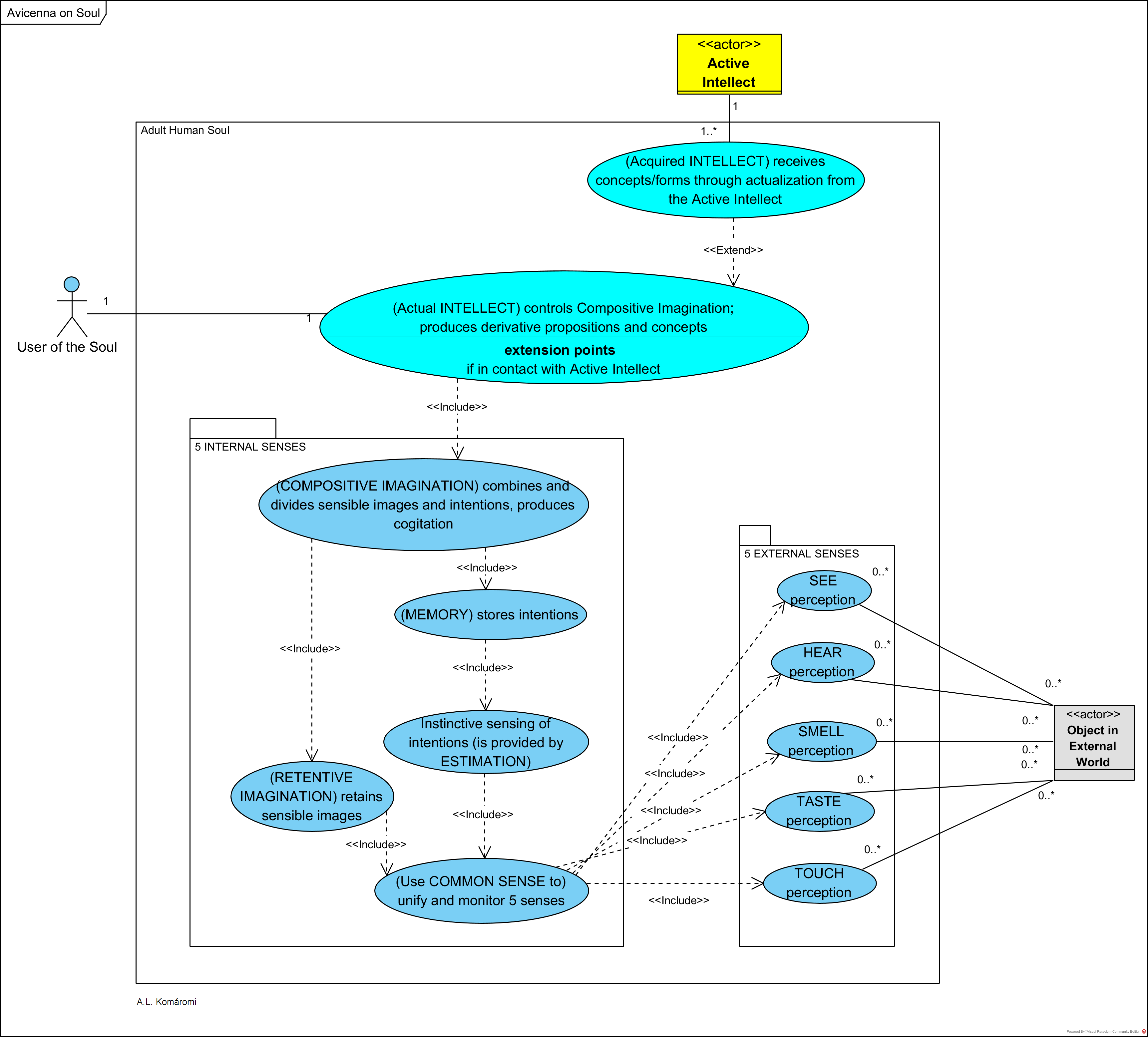
Avicenna on the soul
FacultyUse CaseRelations
EXTERNAL SENSESUse TASTE, TOUCH, SMELL, HEAR, SEE perception: are shared by non-rational and rational animals. impressed by Object in External World
COMMON SENSE (receptive)
(al-mushtarak)
(Use COMMON SENSE to) unify and monitor 5 senses, present in animals also.Includes all 5 extenal senses
RETENTIVE IMAGINATION (retentive)
(al-khayyāl/ al-mutasawwira)
(RETENTIVE IMAGINATION) retains sensible images provided by the External Senses and Common Sense.Includes “Use COMMON SENSE to) unify and monitor 5 senses”
ESTIMATION (receptive)
(wahm)
Instinctive sensing of intentions (is provided by ESTIMATION): “While the range of properties included under the rubric of estimative intentions appears to be quite broad, the most vivid and well-known examples that Avicenna gives are of affective qualities, such as the sheep‘s grasp of the fact that the wolf is her natural enemy, and her recognition of her offspring as an object of affection.”
Estimation is present in animals also.
Includes “Use COMMON SENSE to) unify and
MEMORY (retentive)
(ḏikr)
(MEMORY) stores intentions – whether of good or of evil.Includes “Instinctive sensing of intentions (is provided by ESTIMATION)”
COMPOSITIVE IMAGINATION (al-mutakhayyila) (COMPOSITIVE IMAGINATION) combines and divides sensible images and intentions, produces cogitation: “The compositive imagination is posited to account for the capacity to combine and divide sensible forms and images with estimative intentions without reference to the actual configuration of things in the external world, that is, without any stipulation that the external senses have previously been affected by such combinations. […] So it is necessary for there to be a faculty in us by which we do this, and this is the faculty which is called cogitative (mufakkirah) when the intellect employs it, and imaginative (mutaḫayyilah) when the animal faculty uses it.”
Compositive Imagination is present in animals also, but in humans – when controlled by the Intellect – produces cogitative thought. This, through the generalization of the images and intentions and using syllogisms, prepares the Intellect to receive forms from Agent Intellect through emanation/actualization.
Includes “(MEMORY) stores intentions”; Includes “(RETENTIVE IMAGINATION) retains sensible images”
INTELLECT (Actual INTELLECT) controls Compositive Imagination; produces derivative propositions and concepts through cogitation.Includes “(COMPOSITIVE IMAGINATION) combines and divides sensible images and intentions, produces cogitation”
INTELLECT(Acquired INTELLECT) receives concepts/forms through actualization from the Active Intellect: “…all new intelligibles must ultimately be explained with reference to a direct emanation from the Agent [Active] Intellect.”Extends “(Acquired INTELLECT) receives concepts/forms through actualization from the Active Intellect”;
Communicates with Active Intellect
Use Cases

ActorDescriptionRelations
Object in External WorldA sensible object in the external world.
Active IntellectActive (or agent) intellect is the last, tenth member of the chain of celestial intelligencies emenated by the First Pronciple (see [3.3.2]).
User of the SoulA human person.uses (Actual INTELLECT) controls Compositive Imagination; produces derivative propositions and concepts
Actors

Sources

  • All citations from: Black, Deborah, “Rational Imagination: Avicenna on the Cogitative Power”, University of Toronto
  • Gutas, Dimitri, “Ibn Sina [Avicenna]”The Stanford Encyclopedia of Philosophy (Fall 2016 Edition), Edward N. Zalta (ed.)
  • Herbert A. Davidson, “Alfarabi, Avicenna, and Averroes, on Intellect”, Oxford University Press 1992

First published: 15/8/2019
Updated: added use case related to Acquired Intellect on 7/3/2021
Updated: added table with Actors 7/3/2021
[3.2.4] Al-Farabi on Actualization of the Intellect

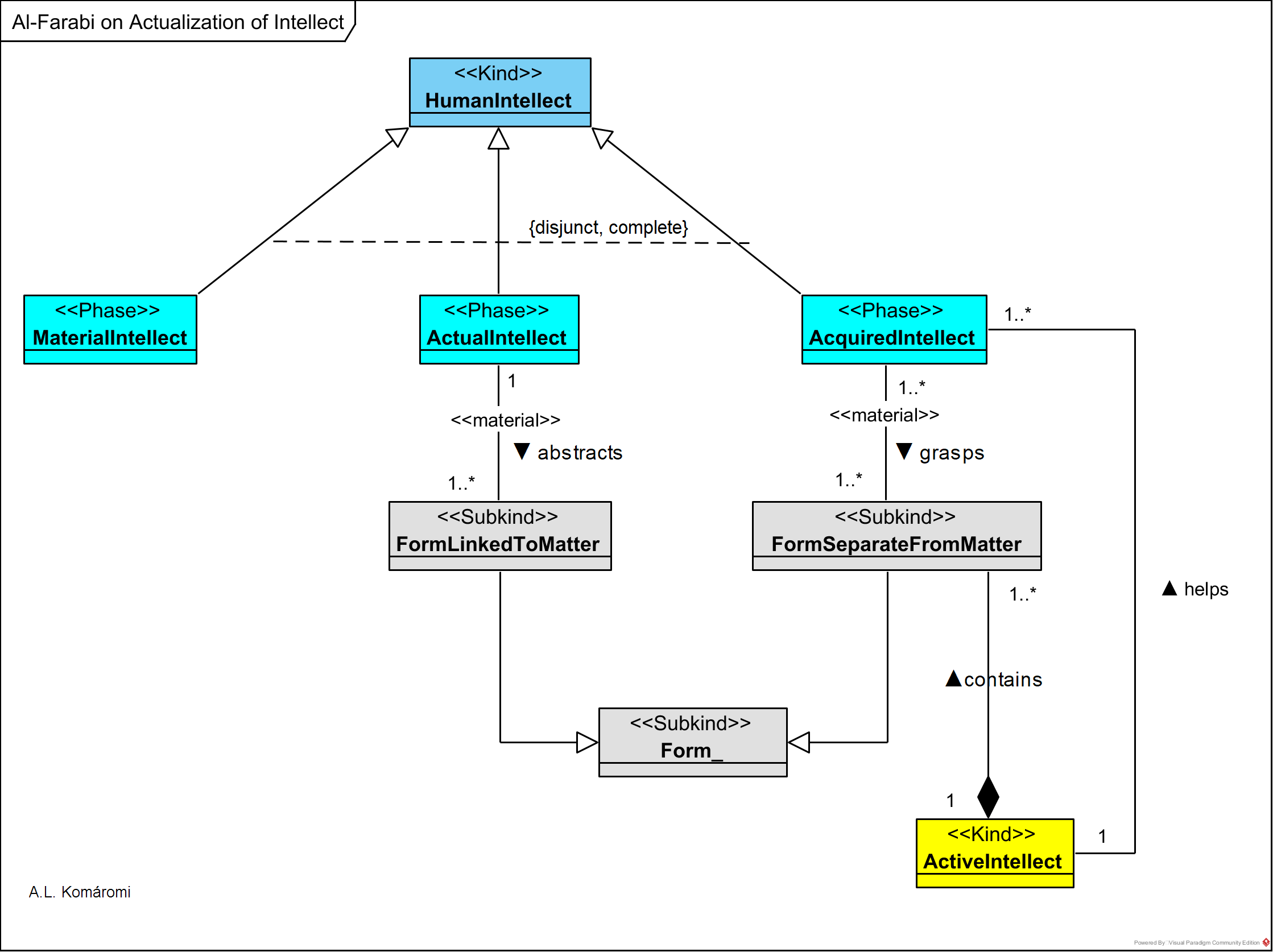
Al-Fārābī’s (872-950 AD) views on the different phases of the intellect are to be found in The Treatise on the Intellect (Risālah fi’l-‘aql). He borrows the idea from Alexander (however, he wrongly attributes it to Aristotle) that the human intellect’s evolution progresses in three phases: material, actual, and acquired. For the realization of the last – acquired – phase, the help of higher, non-human intellect – the active intellect is needed (see also [3.2.2]). 

These phases are presented in the following OntoUML diagram:

Al-Farabi on actualization of the intellect
ClassDescriptionRelations
HumanIntellectHuman intellect (arabic: aql, greek: νοῦς) “is understood as a faculty of the soul by means of which certainty about necessary, true, and universal premises is attained. Premises of this kind are not arrived at by means of syllogisms, but are present in the subject in a prior way, either by nature or without one being aware of how these premises were acquired. Hence, this faculty is some part of the soul by which humans have access to the first principles of the theoretical sciences.”   
MaterialIntellectMaterial intellect (arabic:‘”aql bi-l-quwah“): “Following Aristotle and the Aristotelian tradition, al-Fārābī describes the intellect as being itself potential or, using Alexander’s terminology, an innate ‘natural disposition’ […]. This kind of intellect is frequently called “potential”, “material”, or “passive”, and is simply the rational faculty with which all human beings are endowed.
In The Treatise on the Intellect al-Fārābī refers to the material intellect (νοῦς ὑλικὸς, a Greek term coined by Alexander) as a soul or part of the soul, or one of the faculties of the soul, or something that is in potency to abstract the forms from their matter and turning these into forms for itself”
is phase of HumanIntellect
ActualIntellectActual intellect (arabic: ‘aql bi’l-fi‘l): “When these forms are abstracted, they become intelligibles or forms for the material intellect. It can be rightly said that for al-Fārābī the material intellect is like the matter where the abstracted forms come to be, where the material intellect itself becomes the abstracted forms, just as the imprinted object leaves its mark on a piece of wax.
Before a form of the objects outside the soul has been abstracted, the material intellect is just in potency to receive those forms or potential intelligibles; but when these latter come to be in the material intellect, the material intellect becomes an actual intellect, and the potential intelligibles are actualized. Now, the existence of actual intelligibles is different from their existence as potential intelligibles or forms in matter. When external to the soul and linked to matter, forms are affected by place, time, position, quantity, and the like. But when forms are actualized in the soul, many of these qualities are removed and their existence thus becomes different from their former existence as forms of bodies outside the soul.”
is phase of HumanIntellect; abstracts FormLinkedToMatter
AcquiredIntellectAcquired intellect (arabic: ‘aql al-mustafāḍ): “the process of abstraction is not required in the case of forms separate from matter, that is, the separate entities that belong to the supralunar realm. These separate forms are grasped by the intellect not as actual intellect but as the acquired intellect, and thus become forms for it. Moreover, the acquired intellect is a perfection of the human intellect because it has no need to perform the activity of abstraction in order to grasp forms existing separately from matter. In other words, it is the acquired intellect that enables the grasping of separate forms through the assistance of the active intellect.” is phase of HumanIntellect; grasps FormSeparate
FromMatter
FormForm (arabic: ‘aql al-fa ‘‘āl): “In The Political Regime al-Fārābī deals with the relation between matter and form, and explains that form is the actualization of matter in the sense that form is more excellent than matter; however, matter is the substratum of form and without matter there is no form […]. As can be seen, al-Fārābī is a partisan of Aristotelian hylomorphism” (see also [1.3.5])
FormLinkedToMatterForms linked to matter are external to the soul, and “are affected by place, time, position, quantity, and the like. […] forms linked to matter have to be abstracted in order to become actual intelligibles in the actual intellect.”is subkind of Form
FormSeparate
FromMatter
Forms separate from matter can be e.g. the forms of celestial bodies (see [3.2.1]): “the process of abstraction is not required in the case of forms separate from matter, that is, the separate entities that belong to the supralunar realm.”is subkind of Form
ActiveIntellectActive intellect is emanated by the second intellect (see [3.2.1]), and helps the grasping of forms separated from matter by the acquired intellect.contains FormSeparate
FromMatter; helps AcquiredIntellect

Sources

First published: 6/2/2020