“The contribution for which Carneades (214-129/8 BC) is best known, however, came in response to the Stoics’ counter-argument in defense of the cognitive impression [2.2.1]. They contended that, without cognitive impressions, human beings would be deprived of any basis for action or inquiry. In reply Carneades argued that such a basis could be found in so-called probable impressions (from “probabilis,” that which lends itself to or invites approval, Cicero’s Latin for the Greek “pithanos,” persuasive).”
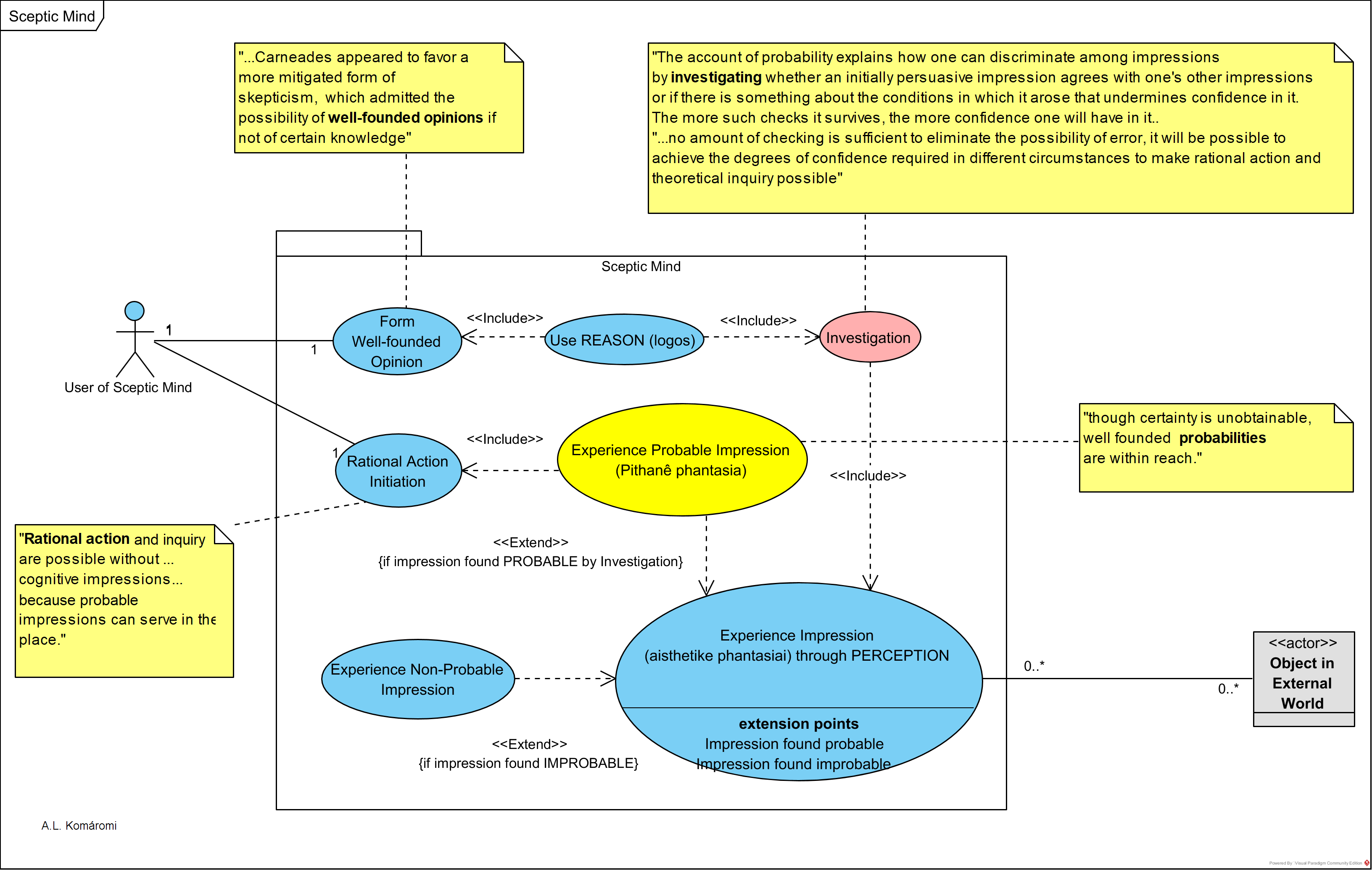
The following UML Use Case diagram shows the main concepts in the Sceptic epistemology:
The sceptic mind according to Carneades
Faculty
Related Use Case
PERCEPTION
Experience Impression (aisthetike phantasiai) through PERCEPTION
PERCEPTION
Experience Probable Impression (Pithanê phantasia): “though certainty is unobtainable, well founded probabilities are within reach.” – Experience Non-Probable Impression
PERCEPTION
Experience Non-Probable Impression – if impression found IMPROBABLE
PERCEPTION
Rational Action Initiation: “Rational action and inquiry are possible without… cognitive impressions… because probable impressions can serve in their place.”
REASON
Use REASON (logos)
REASON
Investigation: “The account of probability explains how one can discriminate among impressions by investigating whether an initially persuasive impression agrees with one’s other impressions or if there is something about the conditions in which it arose that undermines confidence in it. The more such checks it survives, the more confidence one will have in it.. “…no amount of checking is sufficient to eliminate the possibility of error, it will be possible to achieve the degrees of confidence required in different circumstances to make rational action and theoretical inquiry possible”
REASON
Form Well-founded Opinion: “…Carneades appeared to favor a more mitigated form of skepticism, which admitted the possibility of well-founded opinions if not of certain knowledge”
The source of all citations and more about the topic in: Allen, James, “Carneades“, The Stanford Encyclopedia of Philosophy (Winter 2012 Edition), Edward N. Zalta (ed.)
First published: 02/02/2019
Updated:
06/02/2019: changed relationships of Investigation and Use Case names
20/03/2019: changes relation of Rational Action Initiation
The Stoics held that the (animal, human, and world-) soul consists of a breath-like substance, the pneuma, and the cognitive faculties are its activities. The pneuma of the human soul is a mixture of air and fire. The “activity of the soul is like a king who sends out messengers. When the messengers acquire information, they report it back to the king.”
According to Chrysippus, the human soul – which is a part of God within us -, consists of eight separate kinds of pneuma. These are:
the five senses (sight, hearing, smell, taste, touch) responsible for sense perception
the reproductive faculty,
the speech faculty,
central commanding faculty (hêgemonikon).
The most important of these is the hêgemonikon, which has four additional powers: presentation, impulse, assent, and reason. An ideal stoic sage can discern the presentations (phantasia) by firmly giving assent to those true and “withholding assent when conditions do not permit a clear and certain grasp of the truth of a matter.” In the latter cases, the stoic sage avoids forming opinions.
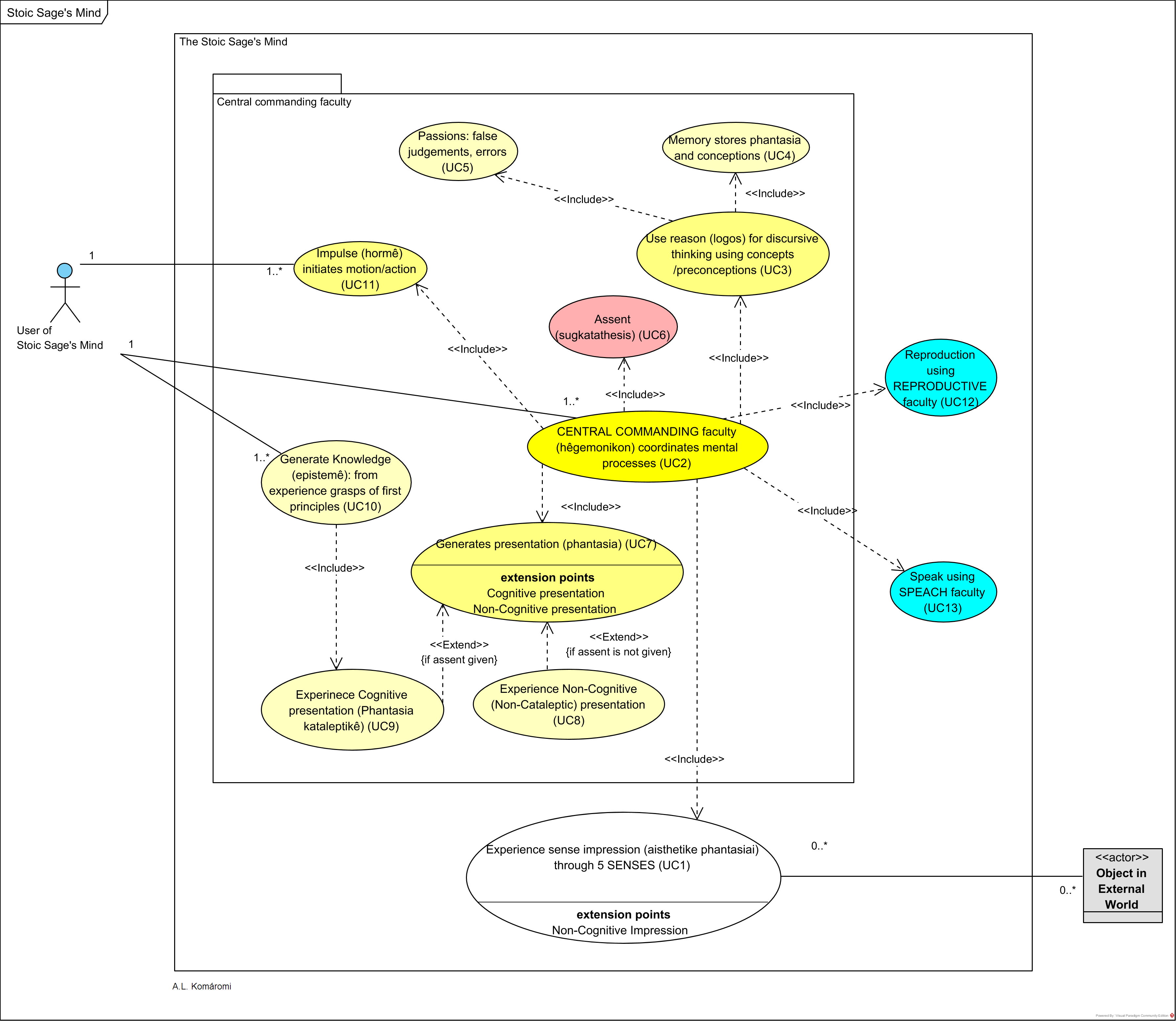
The following UML Use Case diagram shows the main concepts of the Stoic’s philosophy of mind:
Stoic sage’s mind
Use cases:
Faculty
Use Case
Relations
SENSE PERCEPTION
Experience sense impression (aisthetike phantasiai) through 5 SENSES (UC1): “The soul (a concept broader than the modern concept of mind) was believed to be a hot, fiery breath [pneuma] that infused the physical body. As a highly sensitive substance, pneuma pervades the body establishing a mechanism able to detect sensory information and transmit the information to the central commanding portion of the soul in the chest. […] the senses are passive insofar as they receive the tensional motion of a sense object and communicate it to the command center“
CENTRAL COMMANDING
CENTRAL COMMANDING faculty (hêgemonikon)coordinates mental processes (UC2): “Stoics held that the higher cognitive functions and all cognitive experience take place exclusively in the hêgemonikon. While Aristotle seemed to be comfortable with attributing the experience of touch to the flesh and sight to the eyes, the Stoics tell us that the senses merely report the information to the central faculty where it is experienced and processed. […] The idea of sensation as the transmission [diadosis] of sensory information is illustrated in the final two analogies of the soul. The first states that activity of the soul is like a king who sends out messengers. When the messengers acquire information they report it back to the king. Likewise, the hêgemonikon extends its pneuma to the sense organs, and when these in turn acquire sensory information, the pneuma transmits the information back to the heart. The second analogy states that the soul is like a spider in a web. When the web is disturbed by an insect the movement is transmitted through vibrations to the spider sitting at the center. […] The most basic power of the hêgemonikon is the ability to form presentations [phantasiai]. Other psychological states and activities such as mental assent, cognition, impulse, and knowledge are all either extensions or responses to presentations.”
includes UC3, UC6, UC7, UC11, UC12, UC13
CENTRAL COMMANDING
Use reason (logos) for discursive thinking using conceptions/preconceptions (UC3): “Only human beings and gods possess the highest level of pneumatic activity, reason [logos]. Reason was defined as a collection of conceptions and preconceptions; it is especially characterized by the use of language. In fact, the difference between how animals think and how humans think seems to be that human thinking is linguistic — not that we must vocalize thoughts (for parrots can articulate human sounds), but that human thinking seems to follow a syntactical and propositional structure in the manner of language. The Stoics considered thinking in rational animals as a form of internal speech. […]”
includes UC4, UC5
CENTRAL COMMANDING
Memory stores phantasia and conceptions (UC4): “The doctrine of presentation also provided the foundation for a theory of memory and concept formation. Memory was seen to be stored phantasiai.”
CENTRAL COMMANDING
Passions: false judgements, errors (UC5): “Passions are unruly and contrary to reason”
CENTRAL COMMANDING
Assent (sugkatathesis) (UC6): “Assent is also a specifically human activity, that is, it assume the power of reason. The sage avoids opinions by withholding assent when conditions do not permit a clear and certain grasp of the truth of a matter… Depending on the content of the presentation and the individual’s conception of what is good, the object of perception may be classified as good, evil, or indifferent. The faculty of assent in conjunction with reason will accept, reject, or withhold judgement based on the value of the object […] Although we may entertain and experience all sorts of presentations [through the senses], we do not necessarily accept or respond to them all. Hence the Stoics held that some phantasiai receive assent and some do not. Assent occurs when the mind accepts a phantasia as true (or more accurately accepts the subsisting lekton as true).”
CENTRAL COMMANDING
Generates presentation (phantasia) (UC7): “The most basic power of the hêgemonikon is the ability to form presentations [phantasiai]. Other psychological states and activities such as mental assent, cognition, impulse, and knowledge are all either extensions or responses to presentations. Zeno defined a presentation as an imprinting [tupôsis] in the commanding faculty. He suggested that the soul is imprinted by the senses much in the same way as a signet ring imprints its shape in soft wax.”
Experinece Cognitive presentation (Phantasia kataleptikê) (UC9): “Although we may entertain and experience all sorts of presentations, we do not necessarily accept or respond to them all. Hence the Stoics held that some phantasiai receive assent and some do not. […] Some presentations experienced in perceptually ideal circumstances, however, are so clear and distinct that they could only come from a real object; these were said to be kataleptikê (fit to grasp). The kataleptic presentation compels assent by its very clarity and, according to some Stoics, represents the criterion for truth. The mental act of apprehending the truth in this way was called katalepsis which means having a firm epistemic grasp.”
extends UC7
CENTRAL COMMANDING
Generate Knowledge (epistemê) – from experience grasps of first principles (UC10): “knowledge [epistemê] was defined as a katalepsis that is secure and unchangeable by reason.”
includes UC9
CENTRAL COMMANDING
Impulse (hormê) initiates motion/action (UC11): “The basic function of impulse is to initiate motion. When we perceive an object or event in the physical world, a phantasia or presentation is produced in the commanding faculty which is then evaluated by the rational faculty… If the object is deemed good, an impulse is initiated as a kind of motion in the soul substratum. If the object is bad, repulsion [aphormê] is produced, and the agent withdraws from the object under consideration.”
REPRODUCTIVE
Reproduction using REPRODUCTIVE faculty (UC12)
SPEECH
Speak using SPEECH faculty(UC13): “Speech is an expression and articulation of the tensional motion produced by the construction of thought in the hêgemonikon. Interestingly, it is the fact that speech is produced in conjunction with breath that Chrysippus used as a central argument for the location of the hêgemonikon in the heart and not the brain.”
Actors:
ACTOR
DESCRIPTION
RELATIONS
Object in External World
A material object in the external world.
in relation with UC1
User of the soul
A human person.
uses UC4, UC5, UC9
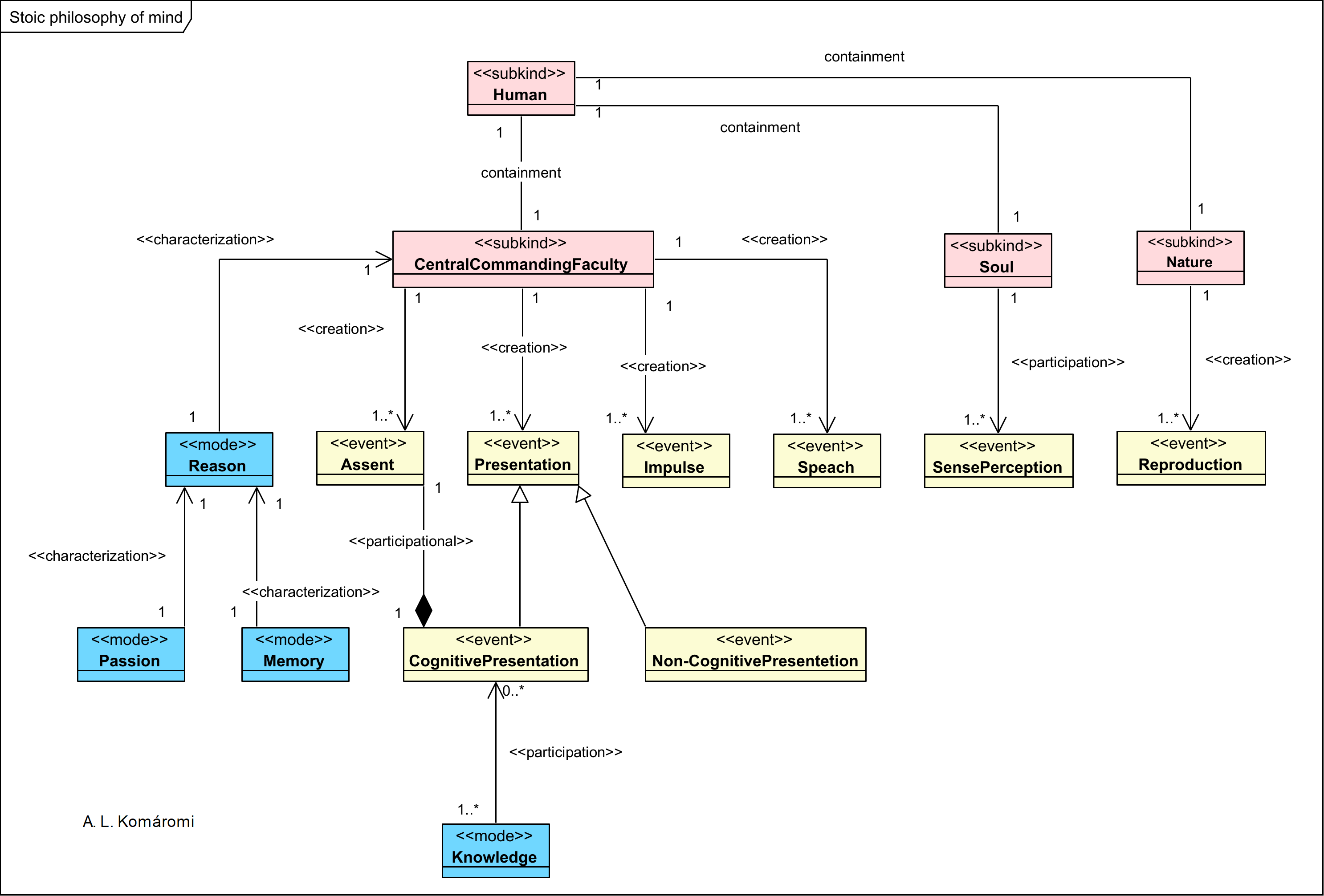
The following OntoUML diagram presents the main classes in the Stoic theory of soul:
Stoic mind
Sources:
All citations from: Scott Rubarth, “Stoic Philosophy of Mind“, Internet Encyclopedia of Philosophy
First published: 28/1/2019 Updated: 31/1/2019: added Non-Cognitive Impression/Impulse and Action Updated: 20/3/2019: clarified and described Impulse Updated: 16/4/2019: some relations changed Updated: 12/5/2021: completely re-written Updated: 15/1/2022: added OntoUML diagram

 Philosophy Models