[4.12.2] Robert Kilwardby on Active Sense Perception and Cognition

Robert Kilwardby (ca. 1215–1279 AD), in De spiritu fantastico discusses the structure of the human soul and the process which leads from sense perception to cognition:

  • He sustains that the human soul is a composite of three forms: the vegetative (common in all living beings), sensitive (present in animals and humans), and intellective (specific to humans, see also [4.12.1])
  • The powers of the sensitive soul are common sense, sensitive memory, while intellectual memory, intellect, and will are the intellective soul’s powers.
  • There is no knowledge of sensible objects without prior use of the senses, because the soul is completely empty before sensation.
  • The object present to the sense organ generates sensible species in the medium, which then changes the sense organ. For example, in the case of sight, the medium must be transparent, there must be light, and the object should be in the front of the eye.
  • The sense organ passively receives the sensible species from the objects of the surrounding environment, while the sensitive soul actively directs the attention on some of the sensible species; this is when perception occurs. Soul, through the act of attention, acts upon and controls the sense organ and not vice-versa.
  • Imagination creates images even than the object is not present; intellect abstracts universals from many images.

The following UML Use Case diagram presents Kilwarby’s model of the human soul:
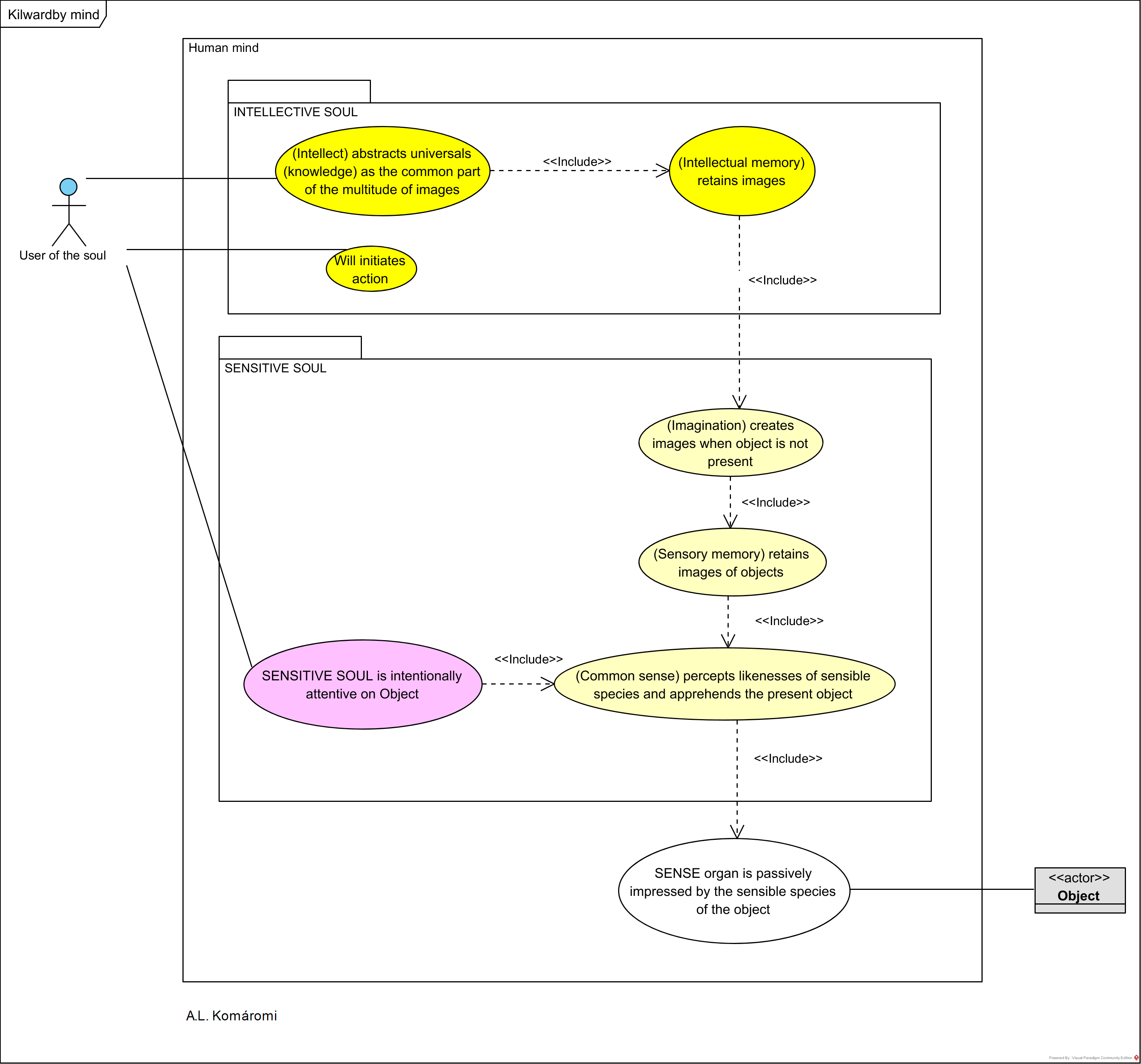
Kilwardby on sense perception and cognition

Use cases:

senses are:  touch, sight, hearing, smell and taste

PowerRelated use caseRelations
Sense organSENSE organ is passively impressed by the sensible species of the object: “The affection of the sense organ (affectio organi) by the sensible species irradiated from the sensible object (ab obiecto sensibili). The result of this motion is the impression of the sensible species in the sense organ.” (Silva, 2013)with Object
Common sense(Common sense) percepts likenesses of sensible species and apprehends the present object: “The soul involves itself with the species received in the sense organ (conuoluendo se cum illa), which results in the production by the soul of an image or likeness (similitudo) of the sensible species. According to Kilwardby, the sensory soul forms the image by natural instinct (instinctu naturali). Perception is possible due to the soul’s intentional state with respect to the affection of the organ. When human beings sleep, the sense organs continue to be impressed by the species from sense objects; however, this impression, without the attention of the soul, does not give rise to any act of perception. The sensory soul turns upon itself and sees itself as being similar (reflectendo aciei uidet se talem) to the species of the sensible object. When the soul turns its eye upon itself, the soul sees the sensible object through the image made by itself in and from itself. […]
The object is the necessary occasion and the causa sine qua non (otherwise there would be nothing to be perceived) but not the sufficient cause of perception (DSF 103; 123). The efficient cause per se of perception is the immaterial soul—the division into sensory faculties is instrumental to the process and in most of this part of the treatise Kilwardby talks of the operations of the sensory soul (which he also calls the ‘incorporeal sensitive spirit’) as a unified entity. spiritus sensitivus thing. The image in the soul is not the same as the one in the sense organ.” (Silva, 2013)
includes “SENSE organ is passively impressed by the sensible species of the object
SENSITIVE SOULSENSITIVE SOUL is intentionally attentive to objectincludes “Common sense) percepts likenesses of sensible species and apprehends the present object
Sensory memory(Sensory memory) retains images: “Kilwardby argues that the power of memory is responsible for receiving the images of objects of knowledge by natural assimilation, for preserving the images of sensible objects, and for making them available for the powers of imagination” (Silva, 2016)includes “(Common sense) percepts likenesses of sensible species and apprehends the present object
Imagination(Imagination) creates images when object is not presentincludes “(Sensory memory) retains images
Intellectual memory(Intellectual memory) retains images: “Kilwardby argues that the power of memory is responsible for receiving the images of objects of knowledge by natural assimilation, for preserving the images of sensible objects, and for making them available for […] intellect” (Silva, 2016)includes “(Imagination) creates images when object is not present
IntellectIntellect abstracts universals as the common part of the multitude of images: “The universal is reached by the intellect considering that which is common (the ratio uniuersalis or ratio commune) to the multitude of images (or likenesses or phantasms or species) of sensible things (corporalia) retained by memory, without the particular circumstances of the images. […]
Scientific knowledge is certain and necessary because it is about what always is (De ortu scientiarum 47, 437–38). There is no science of individual sensible things existing here and now (hic et nunc), but only of universals. However, there is a continuity between the knowledge of images of particular objects in imagination and universals abstracted from them (the cognition of the former is directed to the cognition of the latter).” (Silva, 2013)
includes “(Intellectual memory) retains imagest
WillWill initiates action

Actors:

ActorDescriptionRelations
ObjectAn object in the external world
User of the soulA person.uses Intellect abstracts universals as the common part of the multitude of images; Will initiates action; SENSITIVE SOUL is intentionally attentive to object

Sources

  • Silva, José Filipe, “Robert Kilwardby“, The Stanford Encyclopedia of Philosophy (Winter 2016 Edition), Edward N. Zalta (ed.)
  • Silva, José Filipe, “Robert Kilwardby on the Theory of the Soul and Epistemology”, A Companion to the Philosophy of Robert Kilwardby, Christopher Henrik Lagerlund and Paul Thom (ed), Brill, 2013
  • J.F. Silva & J. Toivanen, “The Active Nature of the Soul,” Vivarium 48 (2010): 245–278.

First published: 4/2/2021
Updated: 14/3/2021
Updated: 30/05/2021 added actors

[4.12.1] Robert Kilwardby’s Theory of Soul and Plurality of Substantial Forms

Robert Kilwardby (ca. 1215–1279 AD), in a series of works (De ortu scientiarumNotulae super librum PorphyriiEpistola Roberti Kilwardby Archiepiscopi Cantuarensis ad Petrum de Confleto Archiepiscopum CorinthiQuaestiones in Librum Secundum SententiarumQuaestiones in Librum Tertium Sententiarum) explains the structure of the human being and the soul:

  • Humans (living human bodies) are composites of body and soul, like at Aristote, however, the hylomorphic structure (see [1.3.7]) is not followed, since not the entire soul is the form of the body.
  • Body and soul are substances, and as such, the spiritual substance like the soul also contains metaphysical matter.
  • Contrary to Aquinas, who sustains that the human soul is simple (see [4.9.6]), characterized by one form, he thinks that the human soul is a composite of three forms: the vegetative, sensitive and intellective. “All composite things have unity, even though they do not have simplicity.”
  • The vegetative and sensitive forms are naturally generated in the embryo and coexist with the human body.
  • God creates the intellective form, which can exist without the body. The intellective soul has the potency to know everything and to get sensory impressions necessary for knowledge; so it has the tendency to join a body.
  • “Once infused by God, the intellective form connects the previous forms inherent in the body of the embryo (vegetative and sensitive) and constitutes with them a human rational soul”.

The following OntoUML diagram presents Kilwardby’s explanation of the structure of the human being:

Kilwardby’s on the soul and plurality of forms

ClassDescriptionRelations
Human“A human being [a living human body] is a composite of two substances, the body and the soul. The soul is the act and form of the whole (totius) human body, and it is present wholly in every part of the body (in qualibet parte corporis tota). To be present wholly in every part does not require simplicity, as absence of composition, but spirituality (that is, immateriality).”
HumanSoul“According to Kilwardby, the human soul is a composite of three forms: vegetative, sensitive, and intellective. Like most of his contemporaries, Kilwardby claims a double origin for the parts of the human soul: the vegetative and sensitive result from natural generation, that is, they are educed from the active potentiality of matter, whereas the intellective soul is created directly by God.”
Human soul is a substance, and as such the spiritual substance like the soul contains also metaphysical matter.
is Subkind of Substance; exclusive part of Human
VegetativeForm; SensitiveForm“Like most of his contemporaries, Kilwardby claims a double origin for the parts of the human soul: the vegetative and sensitive [form] result from natural generation, that is, they are educed from the active potentiality of matter […]
This difference in genesis explains the different nature of the intellective soul with respect to the other souls: whereas the vegetative and the sensitive souls are defined as forms or acts of the body […]”
is Subkind of Form; exclusive part of HumanSoul; is act of HumanBody
IntellectiveFormintellective [form] soul is created directly by God. […] The intellective soul is a spiritual substance, a hoc aliquid, created as to exist quasi personaliter. The relation of the intellective form to the body is that of the sailor to the ship (sicut nauta navi), but this union is accidental only from the point of view of its operations—such as in understanding, where the intellective soul does not need bodily organs—but not from the point of view of the essence of the intellective soul. […]
It is created as the perfection of the human body and as a hoc aliquid, that is, an individual in the genus of substance. The intellective soul is a spiritual substance, a hoc aliquid, created as to exist quasi personaliter. The soul is not a person because, even though it is a complete substance of the rational kind and exists in act, it is part of another thing—a human being . A human being is constituted by the rational soul and the body. The soul constitutes a person only when united with the body in an actual existing human being. […]
An essential feature of the intellective soul is its natural desire and inclination (appetitus et inclinatio naturalis) to be united to a body capable of sensation (as it “hates” being separated from it). The intellective soul can exist without the body, but it is not created to exist without it, as it has, on the contrary, a natural inclination to be united with it. It is this ‘unibility’ that differentiates it from the angelic intellective soul (in the same way as the human body is differentiated from the bodies of other animals). In Kilwardby’s own words, “the [human] soul is born to move and to perfect the body, and in this way it differs from an angel” (see also QLIIS 6; in this he follows Bonaventure). The intellective soul is the specific (completive) difference in both, but it differs in species: whereas the human intellective soul is created to be united with a body, the angelic intellective soul is non-united with a body. This unibility (unibilitas) or aptitude to be united with the body is not an accidental feature but something essential to the human intellective soul.
The utmost justification for this unibility is the intellective soul’s natural capacity to know everything—an application of the Aristotelian principle that human beings desire to know everything. The rational soul is born (nata est) to know things in a twofold manner. The intellect turns its attention both to the images of sensible things received through the senses and abstracted from the phantasms, but it can also turn itself to the eternal, superior reasons. Thus, because the intellective soul is the perfection of the sensitive body, it can only fulfill its perfection, that is, the knowledge of all things, by means of its union with the body. […]
the intellective soul is the act of the sensitive body in the sense of being its perfection: it is the completion of the process of development; it is the actuality of no part of the body and does not require bodily organs for its operations. The relation of the intellective form to the body is that of the sailor to the ship (sicut nauta navi), but this union is accidental only from the point of view of its operations—such as in understanding, where the intellective soul does not need bodily organs—but not from the point of view of the essence of the intellective soul.”
is Subkind of Form; shared part of HumanSoul
HumanBodyHuman bodyis Subkind of Substance; exclusive part of Human
SensitiveBody“The sensitive body is not perfect and needs to be completed by the intellective form, and the intellective form is created to be the perfection of the sensitive body.”is phase of HumanBody
SubstanceSubstances are enduring existents.
FormForm in Aristotelian sense (see [1.3.5])

Sources

  • All citations from: Silva, José Filipe, “Robert Kilwardby“, The Stanford Encyclopedia of Philosophy (Winter 2016 Edition), Edward N. Zalta (ed.)

First published: 28/1/2021