[6.7.2] Bernardino Telesio’s Theory of Knowledge

According to Telesio, the “conservatio sui is the foundation from which all sensitive and cognitive functions arise. Defending an empirical approach in epistemology, Telesio tried to annul the traditional distinction between sense perception and reason, and he denied that there exists something like a purely mental sphere and a corresponding intellect which Aristotle in De anima III had called nous

  • Sense perception and memory are historically depending on the brain
  • Sense perception and memory participate in understanding
  • Memory is not visual

The following OntoUML diagram shows Bernardino Telesio’s model of knowledge
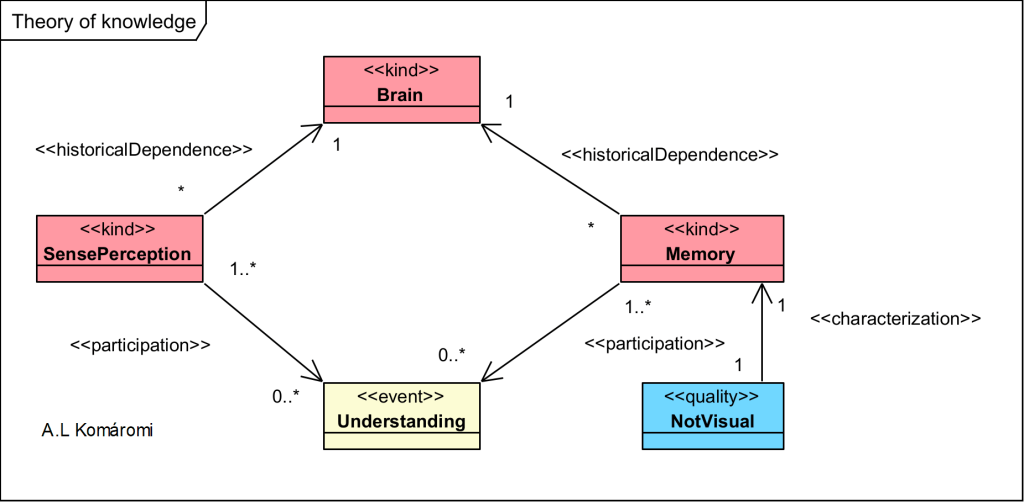
Bernardino Telesio’s model of knowledge
ClassDescriptionRelations
Brain“Telesio combined the medical theory of spirit with a basically Stoic notion, that of the hegemonikon, according to which the spirit in the brain is responsible for all the states and operations traditionally ascribed to the tripartite soul: “the animal … is governed by one substance residing in the brain” (Quod animal universum ch. XXV; Var. lib. p. 254). Whereas in Quod animal universum he went on to explain the affects in terms of physiology, in De rerum natura he added a theory of sense perception and a theory of knowledge on physical grounds.”
Understanding“Understanding is a process which requires sense perception and memory. 
According to Telesio, our memory is not visual.
What we remember are movements which our spirit has experienced and given out when being in contact with external forces. If now the spirit undergoes a similar experience, for example the pain of getting burned, it will ascribe this perception to a similar or identical cause and call it ‘fire’ (DRN book VIII, ch. 1; vol. III, p. 160). The ability of making rational conclusions (ratiocinari) consists in comparing new expierences to old ones and in supplementing hidden or unknown aspects when refering them to former experiences”
SensePerceptionUnderstanding is a process which requires sense perceptionhistoricalDependence on Brain; participation Understanding
Memory“Understanding is a process which requires memory. According to Telesio, our memory is not visual.”historicalDependence on Brain; participation Understanding
NotVisualAccording to Telesio, our memory is not visual.characterizes Memory

Sources

  • Boenke, Michaela, “Bernardino Telesio“, The Stanford Encyclopedia of Philosophy (Winter 2018 Edition), Edward N. Zalta (ed.).

First published: 01/12/2022

[6.7.0] Bernardino Telesio on Cosmology

Bernardino Telesio (1509–1588) “belongs to a group of independent philosophers of the late Renaissance who left the universities in order to develop philosophical and scientific ideas beyond the restrictions of the Aristotelian-scholastic tradition. [… ] Telesio’s vision of the genesis of nature is simple to the point of being archaic, yet at the same time astonishingly modern in the sense that he seems to have been one of the very first defenders of a theory of natural evolution without metaphysical or theological presuppositions.”

  • According to Telesio things are characterized by nature
  • Things can be of three subkinds: martter, vacuum and force.
  • Force can be: heat and cold.
  • “The primary activity of warmth [heat] is to move fast and to dilate and rarefy matter, whereas that of cold is to hinder movement and to condense matter.”

The following OntoUML diagram shows Bernardino Telesio’s model on cosmology:

Telesio ontology
ClassDescriptionRelations
Nature
All things act solely according to their own nature, starting from the primary forces of cold and heat. The Epicurean chance is enclosed in Telesio’s Stoic-influenced philosophy of nature (Kessler 1992): everything can produce everything, an idea which was soon to be sharply rejected by Francesco Patrizi da Chierso, one of the most important contemporary readers of Telesio (“Obiectiones”, in the appendix of Telesio’s Varii libelli, p. 467 f.). In order to sustain themselves, these primary forces and all beings which arise through their antagonistic interaction must be able to sense themselves as well as the opposite force, that is, they must sense what is convenient and what is inconvenient or damaging for their survival and well-being. Sensation, therefore, is not the property of embodied souls. Telesio’s philosophy can thus be described as a pansensism in the sense that all beings, animate or inanimate, are said to have the power of sensation.
ThingTelesio’s vision of the genesis of nature is simple to the point of being archaic, yet at the same time astonishingly modern in the sense that he seems to have been one of the very first defenders of a theory of natural evolution without metaphysical or theological presuppositions. According to his De rerum natura, the only things which must be presupposed are passive matter and active force, the latter of which Telesio thought of as twofold, heat and cold.characterizes
Thing
Matterthe only things which must be presupposed are passive matter and active force, the latter of which Telesio thought of as twofold, heat and coldsubkind of Thing
VacuumThe existence of vacuum within space is admitted, but things are said to have a natural
inclination to avoid empty space.
subkind of Thing
Forcethe only things which must be presupposed are passive matter and active force, the latter of which Telesio thought of as twofold, heat and cold.subkind of Thing
Heatthe only things which must be presupposed are passive matter and active force, the latter of which Telesio thought of as twofold, heat and cold.subkind of Force
Coldthe only things which must be presupposed are passive matter and active force, the latter of which Telesio thought of as twofold, heat and cold.subkind of Force
Move&DilateThe primary activity of warmth is to move fast and to dilate and rarefy matter, whereas that of cold is to hinder movement and to condense matter. Things differ according to the amount of heat or cold they possess (and therefore according to their density and derivative qualities such as velocity and colour). The quantity of matter is not changed through the action of these forces upon it. The role of heat, cold and matter as ‘natural principles’ had been highlighted before by Girolamo Fracastoro in the first version of the de natura.characterizes Heat
Hinter& CondenseThe primary activity of warmth is to move fast and to dilate and rarefy matter, whereas that of cold is to hinder movement and to condense matter. characterizes
Cold

Sources

  • Boenke, Michaela, “Bernardino Telesio“, The Stanford Encyclopedia of Philosophy (Winter 2018 Edition), Edward N. Zalta (ed.).

First published: 05/11/2022