[4.12.2] Robert Kilwardby on Active Sense Perception and Cognition

Robert Kilwardby (ca. 1215–1279 AD), in De spiritu fantastico discusses the structure of the human soul and the process which leads from sense perception to cognition:

  • He sustains that the human soul is a composite of three forms: the vegetative (common in all living beings), sensitive (present in animals and humans), and intellective (specific to humans, see also [4.12.1])
  • The powers of the sensitive soul are common sense, sensitive memory, while intellectual memory, intellect, and will are the intellective soul’s powers.
  • There is no knowledge of sensible objects without prior use of the senses, because the soul is completely empty before sensation.
  • The object present to the sense organ generates sensible species in the medium, which then changes the sense organ. For example, in the case of sight, the medium must be transparent, there must be light, and the object should be in the front of the eye.
  • The sense organ passively receives the sensible species from the objects of the surrounding environment, while the sensitive soul actively directs the attention on some of the sensible species; this is when perception occurs. Soul, through the act of attention, acts upon and controls the sense organ and not vice-versa.
  • Imagination creates images even than the object is not present; intellect abstracts universals from many images.

The following UML Use Case diagram presents Kilwarby’s model of the human soul:
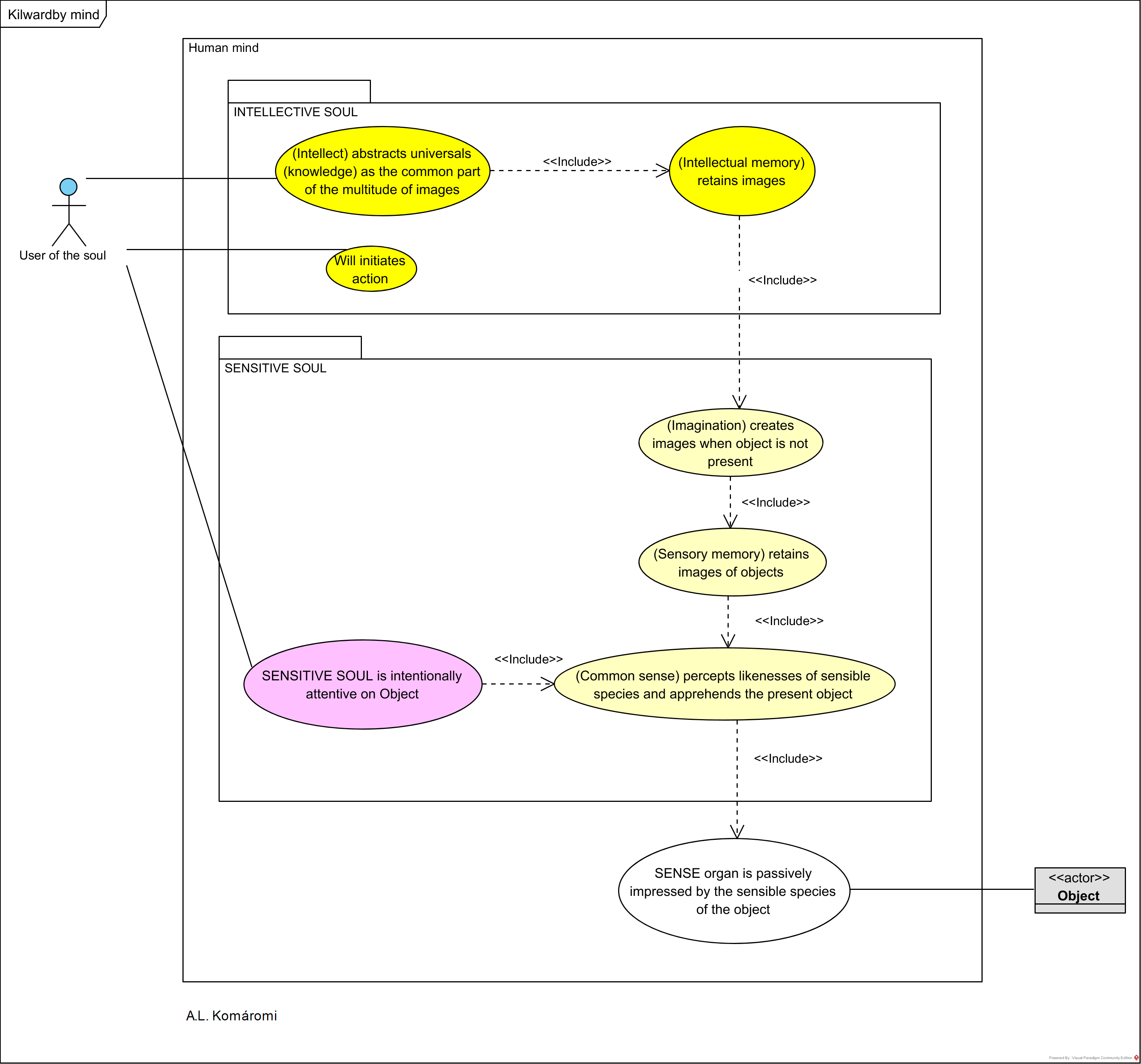
Kilwardby on sense perception and cognition

Use cases:

senses are:  touch, sight, hearing, smell and taste

PowerRelated use caseRelations
Sense organSENSE organ is passively impressed by the sensible species of the object: “The affection of the sense organ (affectio organi) by the sensible species irradiated from the sensible object (ab obiecto sensibili). The result of this motion is the impression of the sensible species in the sense organ.” (Silva, 2013)with Object
Common sense(Common sense) percepts likenesses of sensible species and apprehends the present object: “The soul involves itself with the species received in the sense organ (conuoluendo se cum illa), which results in the production by the soul of an image or likeness (similitudo) of the sensible species. According to Kilwardby, the sensory soul forms the image by natural instinct (instinctu naturali). Perception is possible due to the soul’s intentional state with respect to the affection of the organ. When human beings sleep, the sense organs continue to be impressed by the species from sense objects; however, this impression, without the attention of the soul, does not give rise to any act of perception. The sensory soul turns upon itself and sees itself as being similar (reflectendo aciei uidet se talem) to the species of the sensible object. When the soul turns its eye upon itself, the soul sees the sensible object through the image made by itself in and from itself. […]
The object is the necessary occasion and the causa sine qua non (otherwise there would be nothing to be perceived) but not the sufficient cause of perception (DSF 103; 123). The efficient cause per se of perception is the immaterial soul—the division into sensory faculties is instrumental to the process and in most of this part of the treatise Kilwardby talks of the operations of the sensory soul (which he also calls the ‘incorporeal sensitive spirit’) as a unified entity. spiritus sensitivus thing. The image in the soul is not the same as the one in the sense organ.” (Silva, 2013)
includes “SENSE organ is passively impressed by the sensible species of the object
SENSITIVE SOULSENSITIVE SOUL is intentionally attentive to objectincludes “Common sense) percepts likenesses of sensible species and apprehends the present object
Sensory memory(Sensory memory) retains images: “Kilwardby argues that the power of memory is responsible for receiving the images of objects of knowledge by natural assimilation, for preserving the images of sensible objects, and for making them available for the powers of imagination” (Silva, 2016)includes “(Common sense) percepts likenesses of sensible species and apprehends the present object
Imagination(Imagination) creates images when object is not presentincludes “(Sensory memory) retains images
Intellectual memory(Intellectual memory) retains images: “Kilwardby argues that the power of memory is responsible for receiving the images of objects of knowledge by natural assimilation, for preserving the images of sensible objects, and for making them available for […] intellect” (Silva, 2016)includes “(Imagination) creates images when object is not present
IntellectIntellect abstracts universals as the common part of the multitude of images: “The universal is reached by the intellect considering that which is common (the ratio uniuersalis or ratio commune) to the multitude of images (or likenesses or phantasms or species) of sensible things (corporalia) retained by memory, without the particular circumstances of the images. […]
Scientific knowledge is certain and necessary because it is about what always is (De ortu scientiarum 47, 437–38). There is no science of individual sensible things existing here and now (hic et nunc), but only of universals. However, there is a continuity between the knowledge of images of particular objects in imagination and universals abstracted from them (the cognition of the former is directed to the cognition of the latter).” (Silva, 2013)
includes “(Intellectual memory) retains imagest
WillWill initiates action

Actors:

ActorDescriptionRelations
ObjectAn object in the external world
User of the soulA person.uses Intellect abstracts universals as the common part of the multitude of images; Will initiates action; SENSITIVE SOUL is intentionally attentive to object

Sources

  • Silva, José Filipe, “Robert Kilwardby“, The Stanford Encyclopedia of Philosophy (Winter 2016 Edition), Edward N. Zalta (ed.)
  • Silva, José Filipe, “Robert Kilwardby on the Theory of the Soul and Epistemology”, A Companion to the Philosophy of Robert Kilwardby, Christopher Henrik Lagerlund and Paul Thom (ed), Brill, 2013
  • J.F. Silva & J. Toivanen, “The Active Nature of the Soul,” Vivarium 48 (2010): 245–278.

First published: 4/2/2021
Updated: 14/3/2021
Updated: 30/05/2021 added actors
[4.10.5] St Bonaventure on Mind

St Bonaventure ( the “Seraphic Doctor”, 1217 – 1274 AD), in his work “The Journey of the Mind Into God”, presents a model of the human soul (inspired from St. Francis of Assisi’s mystical vision of a six-winged Seraph) from the perspective of one’s knowledge of God – and the world, as a side effect:

  • The human soul is composed of three main parts, the senses, the spirit, and the mind.
  • The senses are aimed to exterior corporeal (objects), the spirit is preoccupied with the self, and the mind with above the self.
  • This threefold structure is then divided into six central powers, which are paralleled with six steps that lead to God’s knowledge. These steps are: “sense, the imagination, the reason, the intellect, the intelligence, and the apex of the mind or the spark of synderesis.”
  • Besides these six powers, others, like memory, elective virtue, are also included in the model.
  • The object of the knowledge as shadow and vestige, and the knower human soul, as image and similitude, both point to God (see [4.10.1])
  • Knowledge of the world and God starts from sense perception and evolves through the spiritual and intellectual powers of the human soul, however for certain knowledge the illumination of the divine light is needed (see also [4.10.3][4.10.4]).

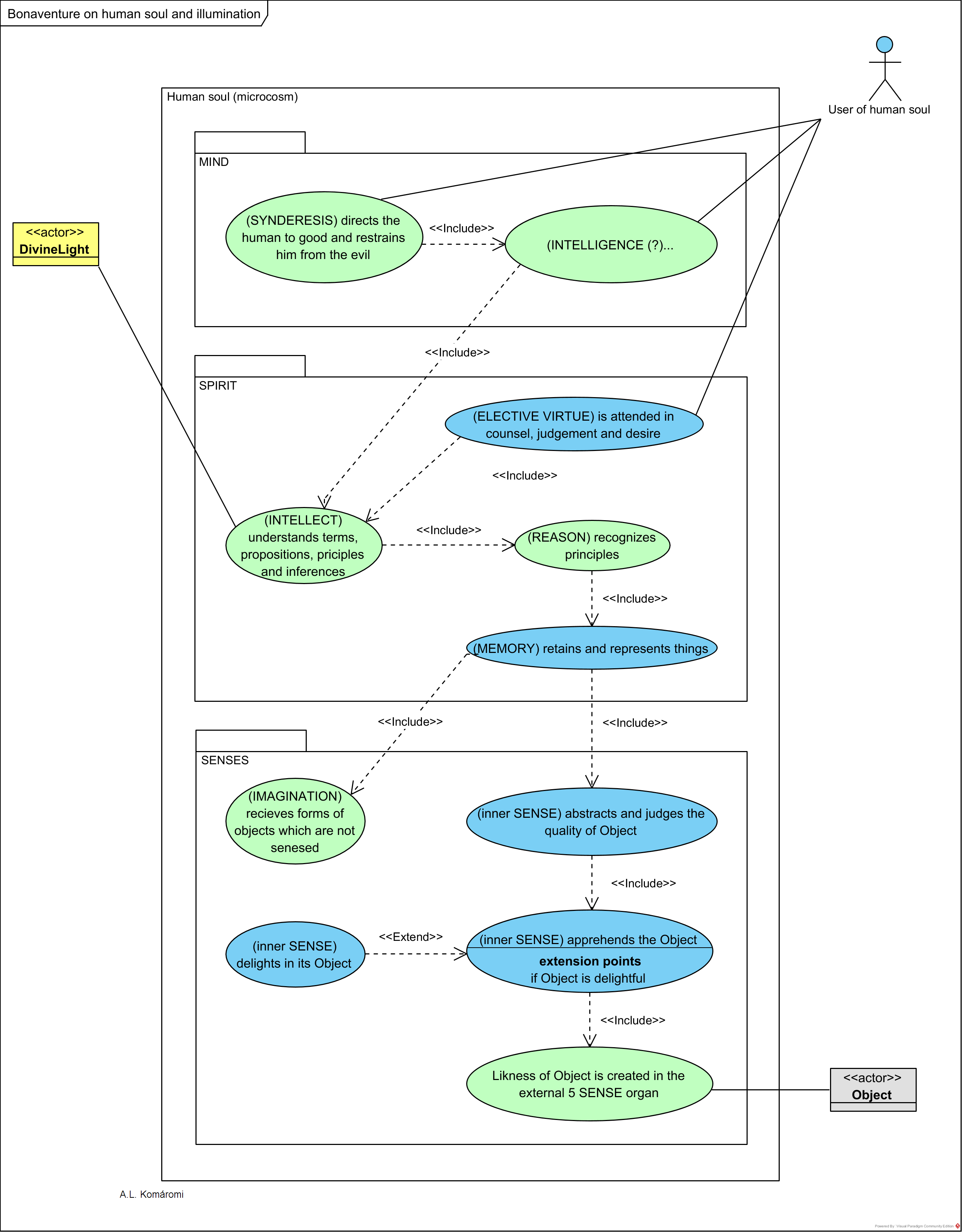
The following UML Use Case diagram presents Bonaventure’s model of the human soul:

Bonaventure on mind
PowerUse caseRelations
external 5 SENSELikeness of Object is created in the external 5 SENSE organ: “Man therefore, who is called the microcosm, has five senses like five gates, through which aquaintance with [cognitio] all things, which are in the sensible world, enters into his soul. For through vision there enters bodies sublime and luminous and the other colored things, but through touch bodies solid and terrestrial, indeed through the three intermediary senses there enters intermediary things, as through taste liquids [aquea], through hearing gases [aërea], through smell vapours [vaporabilia], which have something of the humid nature, something of the gaseous [aërea], something of the fiery [ignea] or hot (nature), as is clear in the smoke released from aromatics [aromatibus]. Therefore there enters through these gates both simple bodies and also composite ones, from these (which are) mixted. But because in sensing [sensu] we perceive no only these particular sensibles, which are light, sound, odor, taste and the four primary qualities, which apprehend (our) touch; […]
Moreover these exterior sensibles are those which at first step into the soul through the gates of the five senses; they enter, I say, not through substances, but through their similitudes [likenesses] at first generated in the midst and from the midst in the organ and from the exterior organ in the interior, and from this into the apprehensive power; and thus the generation of the species in the midst and from the midst in the organ and the conversion of the apprehensive power over it causes [facit] the apprehension of all these which the soul apprehends exteriorly.”
relates to Object
inner SENSE(inner SENSE) apprehends the Object and its properties: “Therefore there enters through these gates both simple bodies and also composite ones, from these (which are) mixted. But because in sensing [sensu] we perceive no only these particular sensibles, which are light, sound, odor, taste and the four primary qualities, which apprehend (our) touch; but also the common sensibles, which are number, magnitude, figure, rest and movement [motus]; both “all, which is moved is moved by another” and certain things are moved by themselves and rest, as are the animals: while through those five senses we apprehend the movement of bodies, we are lead by hand towards aquaintance with spiritual movers as through an effect towards acquaintance with its causes. […] Therefore there enters, as much as regards three genera of things, into the human soul through apprehension, that whole sensible world.”includes “Likeness of Object is created in the external 5 SENSE organ”
inner SENSE(inner SENSE) delights in the Object: “To this apprehension, if it belongs to something agreeable [rei convenientis], there follows enjoyment. Moreover the sense takes delight [delectatur] in the object perceived through the abstract similitude and/or [vel] by reason of its beauty [speciositatis], as in sight, and/or by reason of its savor, as in smell and hearing, and/or by reason of its wholesomeness [salubritatis], as in taste and touch, respectively [appropriate loquendo]. Moreover every delectation is by reason of its proportionality. But since the species holds the reason for the form, virtue and activity, according to which it has a relation [respectum] to the begining, from which it flows [manat], to the middle, through which it passes over, and to the end, in which it acts; for that reason proportionality either is attended in similitude, according to which it accounts [habet rationem] for the species or form, and so is called beauty [speciositas], because ‘beauty [pulchritudo] is nothing other than numeric [numerosa] equality’, or ‘a certain one of the parts of position [situs] together with the savor of color’.”extends “(inner SENSE) apprehends the Object and its properties”
inner SENSE(inner SENSE) abstracts and judges the quality of Object: “After this apprehension and enjoyment there occurs [fit] dijudication, by which not only is it distinguished [diiudicatur], whether this be white, and/or black, because this pertains [pertinet] to a particular sense; not only, whether it be holesome, and or noxious [nocivum], because this pertains to interior sense; but also, because it is distinguished and an account [rationem] is rendered, why it takes delight in this; and in this act one inquires for [inquiritur de] a reason for the delectation, which in the sense is perceived from the object. This is moreover, when the reason for the beautiful [pulcri], savory and wholesome is sought: and one finds [invenitur] that this is the proportion of equality. Moreover the reason for equality is the same in great things and in small and it neither is extended in dimensions nor succeeds or passes over with those things passing over nor is it altered by movements. Therefore it abstracts [abstrahit] from place, time and movement, and for this reason it is thoroughly unchangeable [incommutabilis], uncircumscribable and entirely spiritual. Therefore dijudication is an action, which causes [facit] the sensible species, accepted sensibly through sense, to go into the intellective power by pruning [deputando] and abstracting (it). And thus, this whole world has to go into [introire habet] the human soul through the gates of the senses according to the three aforesaid activities. […]
Moreover by a more excellent and immediate manner dijudication leads us to gaze upon [in speculandam] eternal truth with more certainty [certius].”
includes “(inner SENSE) apprehends the Object and its properties”
MEMORY(MEMORY) retains and represents things/priciples: “Moreover the activity of the memory is the retention and representation not only of things present, corporal and temporal, but also of things coming afterwards succendentium], simple and sempiternal. For the memory retains things past [praeterita] through remembrance, things present through capture [susceptionem], things future through foresight [praevisionem]. It also retains simple things, like the principles of continuous and discrete quantities, such as [ut] point, presence [instans] and unity, without which it is impossible to remember or think of those things which are derived [principiantur] by means of them…”includes “(inner SENSE) abstracts and judges the quality of Object”; “(IMAGINATION) receives forms of Objects which are not sensed”
IMAGINATION(IMAGINATION) receives forms of Objects which are not sensed: From the second it appears, that it not only has to be itself formed from the exterior through phantasms, but also from the superior by taking up simple forms, which cannot not enter through the gates of the senses and the phantasies of sensibles. From the third is had, that it has itself a thoroughly unchangeable light present to itself, in which it remembers the truth of invariables. And thus through the activities of memory it appears, that the soul itself is an image and similitude of God, to this extent, that present to itself and having Him present, it seizes Him by act and through power ‘it is capable of Him and can be a participant’ (in Him). “
REASON(REASON) recognizes principles: “reason, on the contrary [quin] it approves those things heard and assents to them, perceives (them) not as from something new, but recognizes [recognoscat] them as things innate and familiar to itself; as is clear, is the self-evident [se proponatur alicui]: ‘The affirmation and/or negation of anything’; and/or ‘Every whole is greater than its part’, and/or whatever other rank, for which there is no contradiction [contradicere] ‘in accord with internal reason’.”includes “(MEMORY) retains and represents things/priciples”
INTELLECT(INTELLECT) understands terms, propositions, priciples and inferences: “Moreover the activity of intellective virtue is in the perception of the understanding [intellectus] of terms, propositions, and illations. Moreover it siezes what is signified by the understanding of terms, when it comprehends, what each thing [unumquodque] is by definition.
Moreover the activity of intellective virtue is in the perception of the understanding [intellectus] of terms, propositions, and illations. Moreover it siezes what is signified by the understanding of terms, when it comprehends, what each thing [unumquodque] is by definition.”
inludes “(REASON) recognizes principles
ELECTIVE VIRTUE(ELECTIVE VIRTUE) is attended in counsel, judgement and desire. “Moreover the activity of elective virtue is attended in counsel, judgement and desire. Moreover counsel is in inquiring, what be better this or that. But it is not called better unless through access to the best; however access is according to the greater assimiliation; therefore no one knows whether this be better than that, unless he knows, that it is more assimilated to the best. However, no one knows, that anything is assimilated more to another, unless he becomes acquainted with it; for not I do not know [scio], that this is like Peter, unless I know [sciam] or become acquainted with Peter; therefore upon everyone giving counsel there is necessarily impressed the notion of the Most High Good. Moreover certain judgement from those able to give counsel es through some law. However no one judges with certainty through law, unless he be certain that that law is upright [recta], and
that one ought not judge it; but our mind judges about [de] its very self: therefore since it cannot judge about the law, through which it judges; that law is superior to our mind, and it judges through this, according to that which is impressed upon itself.”
includes “(INTELLECT) understands terms, propositions, priciples and inferences”
INTELLIGENCEINTELLIGENCE (?)…”For from memory there arises intelligence as its offspring [proles], because we next understand, since the similitude, which is in the memory, results in the keeness [acies] of the intellect, which is nothing other than a word”
There is no definition, description of this power in the original text.
includes “(INTELLECT) understands terms, propositions, priciples and inferences”
SYNDERESIS(SYNDERESIS) directs the person to good and restrains him from the evilincludes “INTELLIGENCE (?)”

Sources

  • All citations from: St Bonaventure of Bagnoregio: “The Journey of the Mind Into God”, Christian Classic Ethreal Library, Grand Rapids, MI
  • John R. White, “The Illumination of Bonaventure: Divine Light in Theology, Philosophy and History According to Bonaventure”, Fides quaerens intellectum, 2001, vol. 1, no. 2, 201-223
  • Noone, Tim and R. E. Houser, “Saint Bonaventure“, The Stanford Encyclopedia of Philosophy (Winter 2020 Edition), Edward N. Zalta (ed.)
  • John R White, “Divine light and human wisdom: Transcendental elements in Bonaventure’s illumination theory,” International Philosophical Quarterly, Vol. 48, no. 2, June 2008, 175-185

First published: 14/1/2021