
Bernardino Telesio (1509–1588) “With regard to psychology, Telesio took a materialist standpoint. According to his general rejection of the metaphysical (and therefore inappropriate) principles of matter and form, he rejected Aristotle’s definition of the soul as forma corporis, i.e. as form and entelechy of an organic body (Aristotle, De anima II,1).
According to Telesio, the soul is a separate being, but not in the sense of the Platonists, who define it as an immortal essence acting as the governor and mover of the body during its embodied life. Telesio held the soul to be a specific part of the body, defining it as the spiritus coursing through the nervous system and having its main seat in the brain. The spiritus which overtakes the role of the anima of the philosophical tradition is produced by the white ‘semen’. Telesio calls it the spiritus e semine eductus” So,
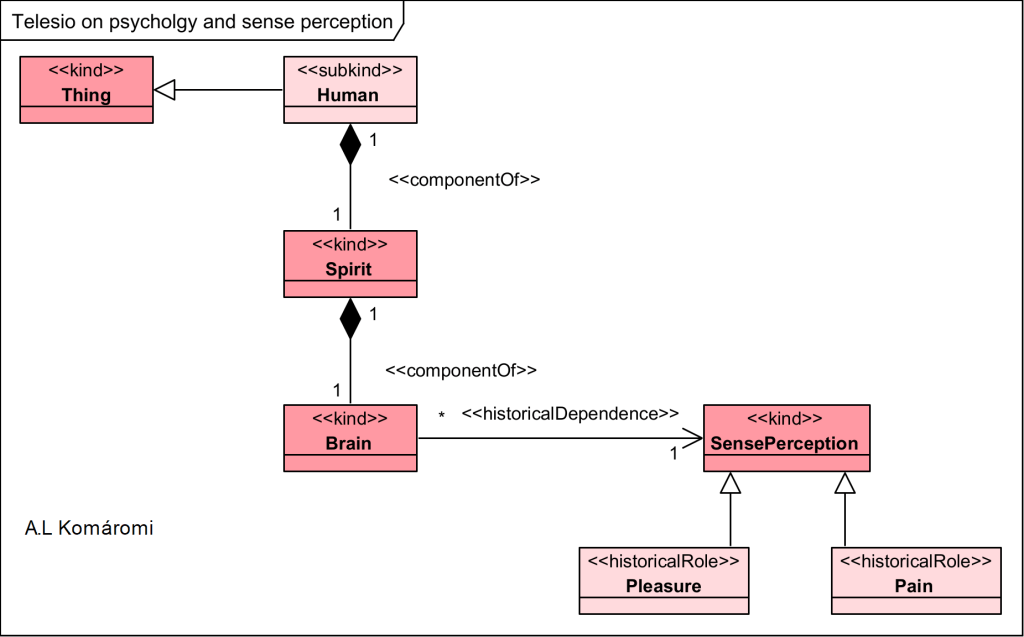
- Human is a subkind of thing
- Spirit is a component of human
- The brain is a component spirit
- Sense perception depends on the brain, it can take the form of pleasure and pain.
The following OntoUML diagram shows Bernardino Telesio’s model psychology:
| Class | Description | Relations |
|---|---|---|
| Thing | “Telesio’s vision of the genesis of nature is simple to the point of being archaic, yet at the same time astonishingly modern in the sense that he seems to have been one of the very first defenders of a theory of natural evolution without metaphysical or theological presuppositions. According to his De rerum natura, the only things which must be presupposed are passive matter and active force, the latter of which Telesio thought of as twofold, heat and cold.” | |
| Human | “And just as there is no metaphysical difference between living and non-living bodies, there also does not exist a qualitative difference between animals and humans—in both, it is the same spirit which coordinates the functions and operations of the different bodily parts.” | subkind of Thing |
| Spirit | “With regard to psychology, Telesio took a materialist standpoint. According to his general rejection of the metaphysical (and therefore inappropriate) principles of matter and form, he rejected Aristotle’s definition of the soul as forma corporis, i.e. as form and entelechy of an organic body (Aristotle, De anima II,1). According to Telesio, the soul [ie spirit] is a separate being, but not in the sense of the Platonists, who define it as an immortal essence acting as the governor and mover of the body during its embodied life. Telesio held the soul to be a specific part of the body, defining it as the spiritus coursing through the nervous system and having its main seat in the brain. The spirits [spirit] which overtakes the role of the anima of the philosophical tradition is produced by the white ‘semen’. Telesio calls it the spiritus e semine eductus. “This [separate substance] will therefore be the spiritus, which took its origin from the semen, as we will explain elsewhere (and it is to be found in all things made from semen, namely those which are white and bloodless, with the exception of the bones and similar things); and only the spirit is what perceives in the animal, and moves sometimes with the whole body, sometimes with single parts thereof, and solely governs the whole animal. That is to say, it performs those actions which, according to the concurring opinion of all, are typical of the soul.” (Vol. II, p. 208).” | componentOf Human |
| Brain | “Telesio combined the medical theory of spirit with a basically Stoic notion, that of the hegemonikon, according to which the spirit in the brain is responsible for all the states and operations traditionally ascribed to the tripartite soul: “the animal … is governed by one substance residing in the brain” (Quod animal universum ch. XXV; Var. lib. p. 254). Whereas in Quod animal universum he went on to explain the affects in terms of physiology, in De rerum natura he added a theory of sense perception and a theory of knowledge on physical grounds.” | componentOf Spirit |
| SensePerception | Sense perception: ‘In his opinion, to speak of sense organs is inappropriate, as the so-called sense organs are nothing else than “parts of the body which are either more subtle or soft than others, or perforated and open. One should not believe in the slightest that they are made thus in order to offer some capacity or support of perceiving to the sensitive soul (which seems to be the duty of organs), but in order to provide an easy and open entry to the forces of external things and to those things themselves.” […] As the sense of touch provides the most narrow contact between outer object and sensing spirit, it assumes the role of the primary sense, which was traditionally identified with the sense of vision (DRN book VII, ch. IX, vol. III, p. 34.) The informatio theory being rejected, Telesio comes close to a neuronal explanation of sense perception, which is a mechanical process arising from the transfer of tactile impressions through the nerves to the brain.” | historicalDependence on Brain |
| Pleasure; Pain | “It is the spirit residing in the brain which experiences nervous dilatations and contractions, and which judges these sensations according to the basic scheme of pleasure and pain, giving out corresponding reactions like moving towards something or avoiding contact (DRN book VII ch. II–V). “ | historicalRole of SensePerception |
Sources
- Boenke, Michaela, “Bernardino Telesio“, The Stanford Encyclopedia of Philosophy (Winter 2018 Edition), Edward N. Zalta (ed.).
First published: 05/11/2022

 Philosophy Models