[1.3.3] Aristotle About the Language in De Interpretatione

“The philosophical context in which Aristotle addresses these issues is provided by his predecessors, most importantly by Plato, and thus the first order of business is to look at Plato’s Cratylus on meaning and reference.
The Cratylus is a sustained attack on the theories of meaning that were currently in vogue. Two theories are canvassed there and shown to be inadequate. These theories, moreover, would appear to exhaust the possibilities: either words are conventional signs and meanings are assigned by human beings and can be changed at the whim of the language user(s), or words are natural signs. Naturalism is shown to be required in order to give an adequate account of truth; conventionalism, however, is shown to provide a more satisfactory account of the way in which the words of a natural language acquire, maintain, and change their meanings.

Aristotle’s (384-322 BC) language model in De Interpretatione
ClassDescriptionRelations
NameBearerObject“the object in the world (pragma) that is the referent of the name (word)”
MentalState“the name-bearing mental state (pathema)refers to NameBearerObject
Meaning“The meaning is the intentional content of the psychological state for which the word stands…” component of MentalState
Convention“The relation between written and spoken words is conventional, as is the relation between spoken words and the mental states that are the vehicles of meaning; different languages correlate different sounds with the same intentional content and the same sound with different contents.” mediates between MentalState and SpokenWord; WrittenWord
SpokenWordThe spoken form of a wordsubkind of Word
WrittenWordThe written form of a word subkind of Word
WordA word in a given languagein material relation with Word

In the De Interpretatione, Aristotle chooses to negotiate a compromise between the two rejected alternatives. The relation between written and spoken words is conventional, as is the relation between spoken words and the mental states that are the vehicles of meaning; different languages correlate different sounds with the same intentional content and the same sound with different contents. Notwithstanding, the relation between the mental state and the object it represents is natural – the same for all humans – and reference is secured by resemblance.”

For better understanding please check the post [1.2.3] about Plato’s Cratylus.

The souce of all citations: Deborah K. W. Modrak, Aristotle’s Theory of Language and Meaning, Cambridge University Press, 2001, p. 4.

First published: 20/3/2019
Updated: 7/12/2021 minor changes

[1.3.2] Aristotle’s Categories: the Ten-Fold Division

“What then is Aristotle’s second classificatory system? Quite simply, it is a list of highest kinds, which are also known as categories. That there are highest kinds (or perhaps that there is one single highest kind) can be motivated by noticing the fact that the ordinary objects of our experience fall into classes of increasing generality. Consider, for instance, a maple tree. It is in the first instance a maple and so belongs in a class with all and only other maples. It is also, however, a tree and so belongs in a broader class, namely the class of trees, whose extension is wider than the class of maples. Continuing on, it is also a living thing and so belongs in a class whose extension is wider still than the class of trees. And so on. Now, once this basic pattern is before us, we can ask the following question: does this increase in generality go on ad infinitum or does it end at a class that is the most general possible? Does it end, in other words, at a highest kind?… According to Aristotle, every genus must be differentiated by some differentia that falls outside that genus. Hence, if being were a genus, it would have to be differentiated by a differentia that fell outside of it. In other words, being would have to be differentiated by some non-being, which, according to Aristotle, is a metaphysical absurdity. Although he does not explicitly make this claim, Aristotle’s argument, if cogent, would generalize to any proposal for a single highest kind. Hence, he does not think that there is one single highest kind. Instead, he thinks that there are ten: (1) substance; (2) quantity; (3) quality; (4) relatives; (5) somewhere; (6) sometime; (7) being in a position; (8) having; (9) acting; and (10) being acted upon”

The following OntoUML Diagram presents the main entities of Aristotle’s (384-322 BC) ten-fold division:

Aristotle’s ten fold division
ClassDescriptionRelations
SupremeGenus
-HighestKind
“every genus must be differentiated by some differentia that falls outside that genus. Hence, if being were a genus, it would have to be differentiated by a differentia that fell outside of it. In other words, being would have to be differentiated by some non-being, which, according to Aristotle, is a metaphysical absurdity. Although he does not explicitly make this claim, Aristotle’s argument, if cogent, would generalize to any proposal for a single highest kind. Hence, he does not think that there is one single highest kind. Instead, he thinks that there are ten.”
Supreme genus (highest kind) can be of have 10: (1) substance; (2) quantity; (3) quality; (4) relatives; (5) somewhere; (6) sometime; (7) being in a position; (8) having; (9) acting; and (10) being acted upon.
Genus“every genus must be differentiated by some differentia that falls outside that genus. Hence, if being were a genus, it would have to be differentiated by a differentia that fell outside of it.”subkind of SupremeGenus-HighestKind; is in a recursive association with itself; each level splits the superior level in 2 or more, based on the attributes marked in DifferentiaForGenus
Species“the essence of any species, according to Aristotle, consists in its genus and the differentia that together with that genus defines the species.” subkind of Genus
DifferentiaDifferentia is an attribute, a mode.
DifferentiaForGenus; DifferentiaForSpeciesDifferentia is an attribute, question which is able to differentiate the Genus/Species to the next level. role of Differentia; characterizes Genus and Species
ParticularParticular is the real existent, at the bottom of the hierarchy.subkind of Species

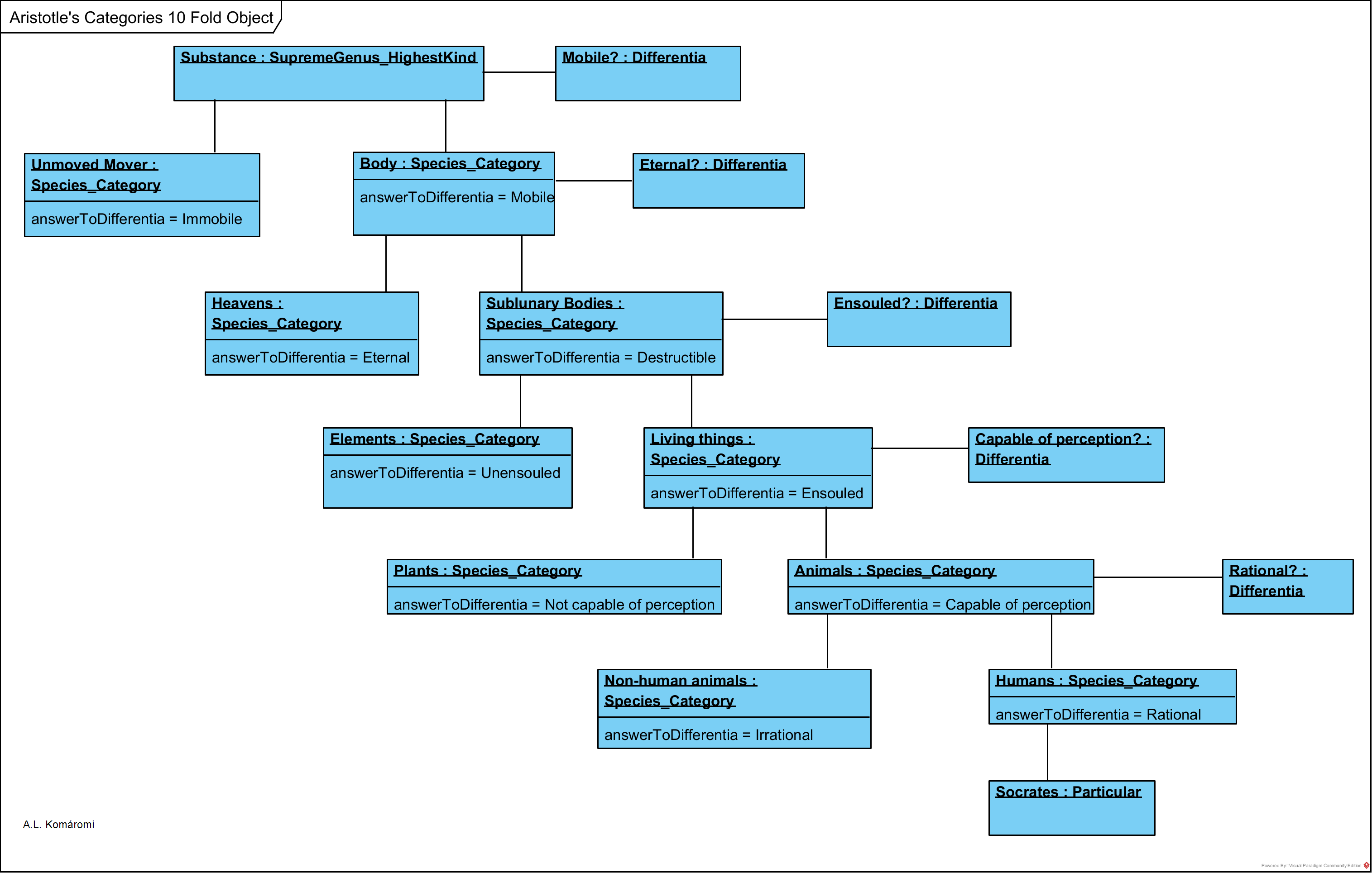
A classical example of the ten fold division is the Porphyrian tree – presenting the ontological hierarchy of substance as Highest kind (UML Object Diagram).

Substance as Supreme Genus presented in UML Object Diagram
(Porphyrian tree)
Tree of Porphyry in Henry Stanislas Nowlan’s “Rationalis philosophia” in a copy of the work completed in 1756, and now held in the Palazzo Falson Historic House Museum

Related posts in theory of Universals:[1.2.2][1.3.1][1.3.2][2.5][2.7.3][4.3.1][4.3.2][4.4.1][4.5.2][4.9.8][4.11], [4.15.6], [4.18.8]

The source of all citations and more about the topic in: Studtmann, Paul, “Aristotle’s Categories“, The Stanford Encyclopedia of Philosophy (Fall 2018 Edition), Edward N. Zalta (ed.)

First published: 12/2/2019
Updated: 27/5/2020 separated Supreme Genus and Genus
Updated: 8/7/2020 re-designed for OntoUML
Updated: 7/12/2021 added differentia for genus and species, manuscript illustration