[1.3.14] Aristotle on Cosmology

On the Heavens (De caelo) is Aristotle’s (384-322 BC) main cosmological work. In the elaboration of his astronomical theories, he relies on concepts like motion [1.3.13], elements [1.3.12], hylomorphism [1.3.5].
The following OntoUML diagram shows the main classes in this model:

Aristotle’s cosmology
ClassDescriptionRelations

UnmovedMover
“In the De caelo Aristotle posits an unchanging intelligent being that exists beyond the heavens, enjoying there ‘the best and most selfsufficient life’ (1. 9, 279121-2). In Physics 8 and Metaphysics this entity becomes the Prime Unmoved Mover, ultimately responsible for all movement, change, and generation in the universe…
The Prime Mover is the unmoved mover (see [1.3.13]) of the sublunary elements. So it seems natural to assume that the self-mover responsible for the motion of fire and earth has the Prime Mover as its unmoved part. The Prime Mover moves the aether, and as we have seen, the aether moves the sublunary elements.” (Matthen, 2001)
moves Aether
ObjectObjects, according to Aristotle are primary existents, compounds of Matter and Form.
FormThe form is that which unifies the Matter into a single object, and which provides actuality. characterizes Object
MatterThe matter (substance) is that which persists in the object, and which provides potentiality.
Universe “in the De caelo Aristotle treats of the universe as a single individual substance [object] with form and matter… ‘Since the universe is perceptible, it is an individual thing [object]; for every perceptible thing exists in matter…
Aristotle’s assertion, in De caelo 1. 9, that the universe is individual occurs in the context of his rejecting the atomist’s many-worlds thesis: ‘Such a plurality is impossible if this world is made from the entirety of matter, as it is’. In general, form admits of plural instantiations, he concedes. However, when a form is instantiated in all matter, it can be instantiated only once.” (Matthen, 2001)
subkind of Object
CelestialBody Celestial Bodies are the stars, the planets, the Sun, and the Moon. These are the most perfect realities, composed of unperishable and incorruptible aether.subkind of Object; component of the Universe; located on CelestialSphere
AetherAether is the matter/element for celestial bodies, moved by the Prime Unmoved Mover. It is a perfect element, not generated, and not corruptible.subkind of Matter; contained in CelestialBody; moves Element
CelestialSphereThe Celestial Bodies, are located on the (perfect) celestial spheres. The stars are fixed on their own sphere; each planet, the Sun and the Moon circulates on its own sphere. This movement is circular, regular and continuous.
SublunaryBodySublunary bodies are located under the Celestial Sphere of the Moon. They include the Earth – the center of the universe, ad all the natural (e.g. minerals, living beings, humans) and man-made objects (e.g. houses, statues) in the Earth.
Sublunary bodies can move naturally – depending on the Nature of the Sublunary Matter they are composed of -, and can have forced movements.
subkind of Object; component of the Universe
SublunaryMatter Sublunary matter, at the bottom level, is composed of a mix of the four elements, is generated and corruptible.contained in SublunaryBody
Element“Aristotle believes that everything is made of earth, air, fire and water. These elements are defined by their possession of one of each of the two fundamental pairs of opposites, hot/cold and wet/dry. Aristotle also thinks that these elements can change into one another” (Ainsworth, 2016)subquantity of the SublunaryMatter
Water; Earth; Fire; Air Water; Earth; Fire; Air are the elements of sublunary bodies.
They all have their Nature, e.g.
– Fire and Air tend to move upwards;
– Water and Earth tend to move downwards.
subkinds of Elemenet

Sources

  • Ainsworth, Thomas, “Form vs. Matter“, The Stanford Encyclopedia of Philosophy (Spring 2016 Edition), Edward N. Zalta (ed.)
  • Bodnar, Istvan, “Aristotle’s Natural Philosophy”The Stanford Encyclopedia of Philosophy (Spring 2018 Edition), Edward N. Zalta (ed.)
  • Matthen, Mohan,The Holistic Presuppositions of Aristotle’s Cosmology”, in Oxford Studies in Ancient Philosophy 20:171-199 January 2001

First published: 3/10/2019
Updated: 7/12/2021
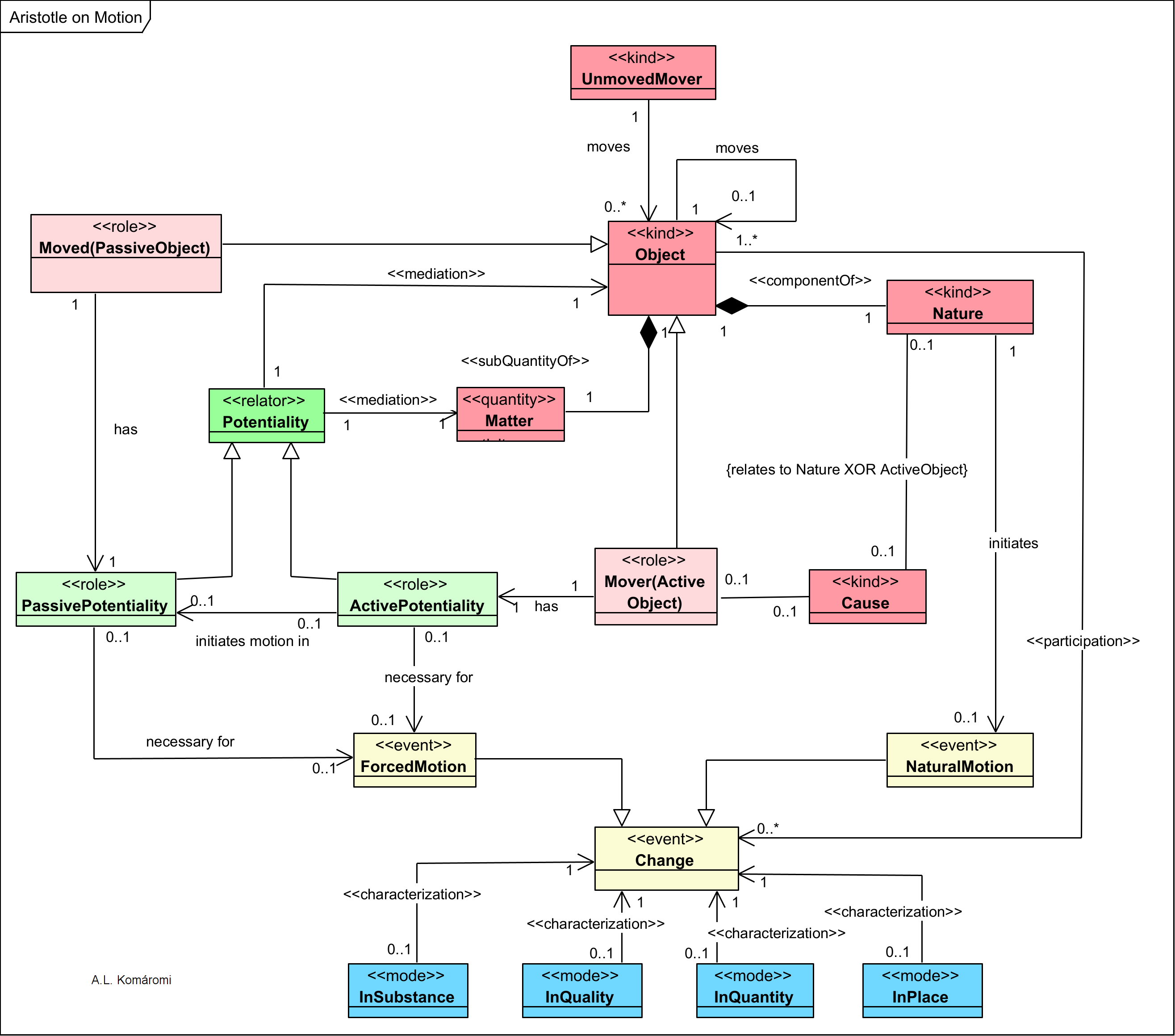
[1.3.13] Aristotle on Motion

Aristotle (384-322 BC) writes about motion in the books 5-8 of his Physics. In his analysis he uses the concepts of Potentiality, Actuality, and Causes (see in [1.3.4]), and introduces the idea of Nature (of a thing, object), based on which he sets apart natural from forced motion.
“A major presupposition on Aristotle’s part is that this division is exhaustive: there are no changes to which the nature of the entity would be indifferent or neutral. The major consideration behind such a presupposition is that natures regulate the behaviour of the entities to which they belong in a comprehensive manner, and not merely partially. Any influence the entity is exposed to interacts with its nature in a substantive manner. The entity does not possess potentialities for change which would not be directly related to the tendencies emerging from its nature.”

The following OntoUML diagram shows the main classes in this model:

Aristotle on change (motion)
ClassDescriptionRelations
UnmovedMoverThe unmoved movers are methaphysiscal, non-material entities, which are not part of the physical world.
“Aristotle postulates that the processes of the universe depend on an eternal motion (or on several eternal motions), the eternal revolution of the heavenly spheres, which in turn is dependent on one or several unmoved movers”
moves Object
ObjectObjects are essential particulars (see [3.1]), like statues and houses, horses, and humans. moves Object; participates in Change
Mover (ActiveObject)Mover (Active Object) includes (Active) Potentiality which initiates motion, change in a Passive Object through its Passive Potentiality.is role of Object; has ActivePotentiality
Moved
(PassiveObject)
Moved (Passive Object) is set in motion, changed by the Active Object.is role of Object; has PassivePotentiality
NatureNature [of an Object], according to Aristotle, is an inner principle of change and being at rest… This means that when an entity moves or is at rest according to its nature reference to its nature may serve as an explanation of the event…
Natures, then, in a way do double duty: once a nature is operative, neither a further active, nor a further passive capacity needs to be invoked.”
is component of the Object; initiates NaturalMotion
Cause“Natures,.. can feature in any… four causal functions. However, when the matter of an entity functions as its nature—i.e., when its natural motion and rest are explained in terms of the matter it is made of—this matter must possess some causally relevant features, bestowed upon it by its own formal aspect.” relates to Nature XOR ActiveObject
MatterMatter provides the Potentiality for the Object.is sub-quantity of the Object
Potentiality“change always requires the existence of a potentiality which can be actualised… Aristotle’s formulation strongly suggests that the potentiality actualised in the process of change is not a separate and independent potentiality for motion… Accordingly, potentialities of change are admitted into the ontology. They, nevertheless, do not need to feature as potentialities in their own right, but as the incomplete variants of the fundamental potentiality for an end result…
The definition of motion as the actuality of a potentiality of the entity undergoing motion in so far as it is potential requires that in each case the passive potentiality for the change is present in the changing object.”
relates between Matter and Object
ActivePotentiality active powers or potentialities (dunameis),,, are external principles of change and being at rest (Metaphysics 9.8, 1049b5–10), operative on the corresponding internal passive capacities or potentialities (dunameis again, Metaphysics 9.1, 1046a11–13)… role of Potentiality; initiates motion in PassivePotentiality
PassivePotentiality“the passive potentiality, is in the object undergoing change”role of Potentiality;
Change Change is “the actuality of a potentiality of the entity undergoing motion.”
“Aristotle speaks about four kinds of motion and change only—those in substance, in quality, in quantity and in place…”
event
NaturalMotion“when the matter of an entity functions as its nature—i.e., when its natural motion and rest are explained in terms of the matter it is made of—this matter must possess some causally relevant features, bestowed upon it by its own formal aspect…
The presence of the potentiality can, nevertheless, be in accordance with the nature of the object—in which case the change is natural (phusei)”
is a Change
ForcedMotion“When a change, or a state of rest, is not natural [is Forced Motion], both the active and the passive potentiality need to be specified…
The presence of the potentiality… can happen in the face of a contrary disposition on the part of the nature of the entity—in which case the change is forced (biâi) or contrary to nature (para phusin).”
is a Change; relates to ActivePotentiality and PassivePotentiality
InSubstance is a characterization of the Motion (Change)characterizes Change
InQuantity is a characterization of the Motion (Change) characterizes Change
InQuality is a characterization of the Motion (Change) characterizes Change
InPlaceis a characterization of the Motion (Change) characterizes Change

Sources

First published: 26/9/2019
Updated: 8/12/2021
Updated: 28/12/2021