[1.3.8] Aristotle’s Knowledge/Science Generating Process

In this UML Activity Diagram, I propose a reconstruction of the scientific “business” process using the following Aristotelian (384-322 BC) concepts elaborated in the works Physics, Metaphysics, Posterior Analytics, related to psychology (see [1.3.6]), logic (see [1.3.9]), and scientific inquiry:

  • sense perception
  • observation
  • memory
  • induction (epagôgê)
  • generalization
  • intuition
  • first things (archai) or priori, premise, hipothesis
  • deduction, syllogism (sullogismos ) (see [1.3.9])
  • causation (aition); four causes (material, efficient, formal, final) (see [1.3.4])
  • knowledge (which is about universal, necessary things with identified causes) (epistemê)
Aristotle’s knowledge/science generating process
Activity Action/Description
Start
Careful OBSERVATION• Sense-perception of object
• Store & Recollect the facts
Inference using INDUCTION“it is induction (epagôgê), or at any rate a cognitive process that moves from particulars to their generalizations, that is the basis of knowledge of the indemonstrable first principles of science.” (R. Smith)

• Organize the facts
• Sort out irrelevant facts
• Generalization
• Use bottom-up syllogism
: “there is an induction as a kind of syllogism. We can describe it as a bottom-up syllogism. Induction in this sense means finding out an appropriate middle term where both extreme terms are given” (R. Smith)
• Identify first things (archai; a priori; premise; hypothesis) with the help of intuition
Inference using DEDUCTION“A deduction is speech (logos) in which, certain things having been supposed, something different from those supposed results of necessity because of their being so. Each of the “things supposed” is a premise (protasis) of the argument, and what “results of necessity” is the conclusion (sumperasma).” (R. Smith)
In Aristotle’s model, there is no observational/experimental verification of the knowledge (loop back to the beginning of the process).

• Generate new knowledge using dialectical syllogism
• Identify the Four Causes with demonstrative syllogism (apodeixis):
“The demonstrative syllogism, (apódixis) which produces genuine knowledge, science or epistemé, does not aim to lead from premises to a conclusion up to then unknown. On the contrary, in the demonstrative syllogism, also, the conclusion is an observed fact previously known. The scientific explanation, the reason why, the (dióti), or “cause”, will when found form the premise from which that observed fact can be demonstrated as a conclusion. Thus the scientific syllogism derives facts already known through observation, from reasons why, or archai. It is not a logic of the discovery of new facts, but a logic of proof, of formalizing or systematizing facts already known.” (S. Sfekas)
• Record Scientific knowledge (episteme)
End

NOTE: This is the first UML Activity Diagram I present on this blog. For modelling business processes there is an alternative standard also in use: BPMN, (Business Process Model and Notation) managed also by OMG.

Sources:

  • Andersen, Hanne and Hepburn, Brian, “Scientific Method“, The Stanford Encyclopedia of Philosophy (Summer 2016 Edition), Edward N. Zalta (ed.)
  • Galik, Dusan. “Induction in Aristotle’s System of Scientific Knowledge”. Organon F. 13. 495-505., 2006
  • S. Sfekas: Aristotelian Fundamentals of the Practice of Knowledge and Information, conference paper, 2017
  • Shields, Christopher, “Aristotle’s Psychology“, The Stanford Encyclopedia of Philosophy (Winter 2016 Edition), Edward N. Zalta (ed.)
  • Smith, Robin, “Aristotle’s Logic“, The Stanford Encyclopedia of Philosophy (Winter 2018 Edition), Edward N. Zalta (ed.)

First published: 18/04/2019

[1.3.6] Aristotle on the Soul and Mind

Aristotle (384-322 BC), in his work De Anima investigates the soul’s faculties and the relation between them. He sustains, that all living beings have soul, and constructs a hierarchical model of the types of souls: 

FacultyPlant’s soulAnimal soulHuman soul
Nutritionincludesincludesincludes
Reproductionincludesincludesincludes
Perceptionincludesincludes
Desireincludes
Imaginationincludes
Mind (intellect, nous)includes

“The reasons why this should be so are broadly teleological. In brief, every living creature as such grows, reaches maturity, and declines. Without a nutritive capacity, these activities would be impossible… So, Aristotle concludes, psychology must investigate not only perceiving and thinking, but also nutrition.”

The following UML Use Case diagram shows the main concepts in Aristotle’s philosophy of mind:

Aristotle on the soul and mind

Use cases:

FacultyUse CaseRelations
NUTRITIONUse NUTRITION (UC7): “Mind includes the non-human animal level sense-perception, which includes the plant level nutrition.”
REPRODUCTION Use REPRODUCTION (UC8): “… any creature with perception will also have the ability to take on nutrition and to reproduce
PERCEPTIONUse TASTE, TOUCH, SMELL, HEAR, SEE (UC1-UC5) perception to recieve sensible species: “Aristotle claims that [sense] perception is best understood on the model of hylomorphic change generally: just as a house changes from blue to white when acted upon by the agency of a painter applying paint, so ‘perception comes about with <an organ’s> being changed and affected… for it seems to be a kind of alteration’. So in line with his general account of alteration, Aristotle treats perception as a case of interaction between two suitable agents: objects capable of acting and capacities capable of being affected.”
Sensible species is the representation of the object in the sense-organs.
PERCEPTIONUse COMMON SENSE (koine aisthesis) to unify and monitor 5 senses (UC6)includes UC1-UC5, UC7, UC8
MIND (or intellect)Use MIND (intellect, nous) for knowing an understanding (UC9): Mind or intellect is a faculty posessed just by humans; it has 2 sub-types: Theoretical and Practical mind.
“Human minds do more than understand, however. It is equally essential to the human being to plan and deliberate, to ponder alternatives and strategize, and generally to chart courses of action.”
includes UC6, UC12, UC14
MIND (or intellect) Use THEORETICAL MIND (sophia): from experience grasps of first principles (ta próta); generate Knowledge (epistemê) (UC10)inherits from UC9
MIND (or intellect) Use PRACTICAL MIND (phronēsis) to initiate change (UC11): “desire and practical reason (De Anima iii 10, 433a17–19), though they do not work in isolation from one another. Rather, practical reason, broadly construed to incorporate the kind of image-processing present in non-human animals, is a source of movement when it focuses upon an object of desire as something desirable. So, practical reason and desire act corporately as the sources of purposive motion in all animals, both human and non-human (De Anima iii 10, 433a9–16), even though, ultimately, it is desire whose objects prick practical intellect and set it in motion (De Anima iii 10, 433a17–2).”inherits from UC9; includes UC15
MIND (or intellect) Use MEMORY for storing and recollection of images (UC13).
MIND (or intellect) Create Experience (empiria) (UC12):experience (empiria)—…a technical term in this connection, reflecting the point at which a single universal comes to take root in the mind” includes UC13
IMAGINATIONUse IMAGINATION (phantasia) to produce images (UC14): “Aristotle identifies imagination as ‘that in virtue of which an image occurs in us’, where this is evidently given a broad range of application to the activities involved in thoughts, dreams, and memories…”
Aristotle regards the images used in cognitive processes in two ways:
● as having its very form in the mind (conformity),
● a mental image in the mind that naturally resembles the object (resemblance). 
DESIREUse DESIRE (orektikon) to initiate motion (UC15): “Aristotle concludes, there is a faculty of desire whose activities and objects are primarily, if not autonomously or discretely, responsible for initiating end-directed motion in animals. What animals seek in action is some object of desire which is or seems to them to be good.”

Actors:

ACTORDESCRIPTIONRELATIONS
Object in External WorldAn object in the external world.UC1, UC2, UC3, UC4, UC5
User of the SoulA human person.uses UC10, UC11

Observations:

  • Aristotle in the analysis of the Soul uses the hylomorphic model (see in [1.3.5]) for explaining the unity of the body and soul, and the working mechanism of perception and mind.
  • All living things have Soul, as their Form. Hence the Human Soul encompasses the faculty of mind (reason), which includes the non-human animal level sense-perception, which includes the plant level nutrition. Mind, sense-perception, and nutrition are the differentia specifica in Aristotle’s 10-fold categorization (see in [1.3.2]).
  • The existence of the living things is teleological (see in [1.3.4]).

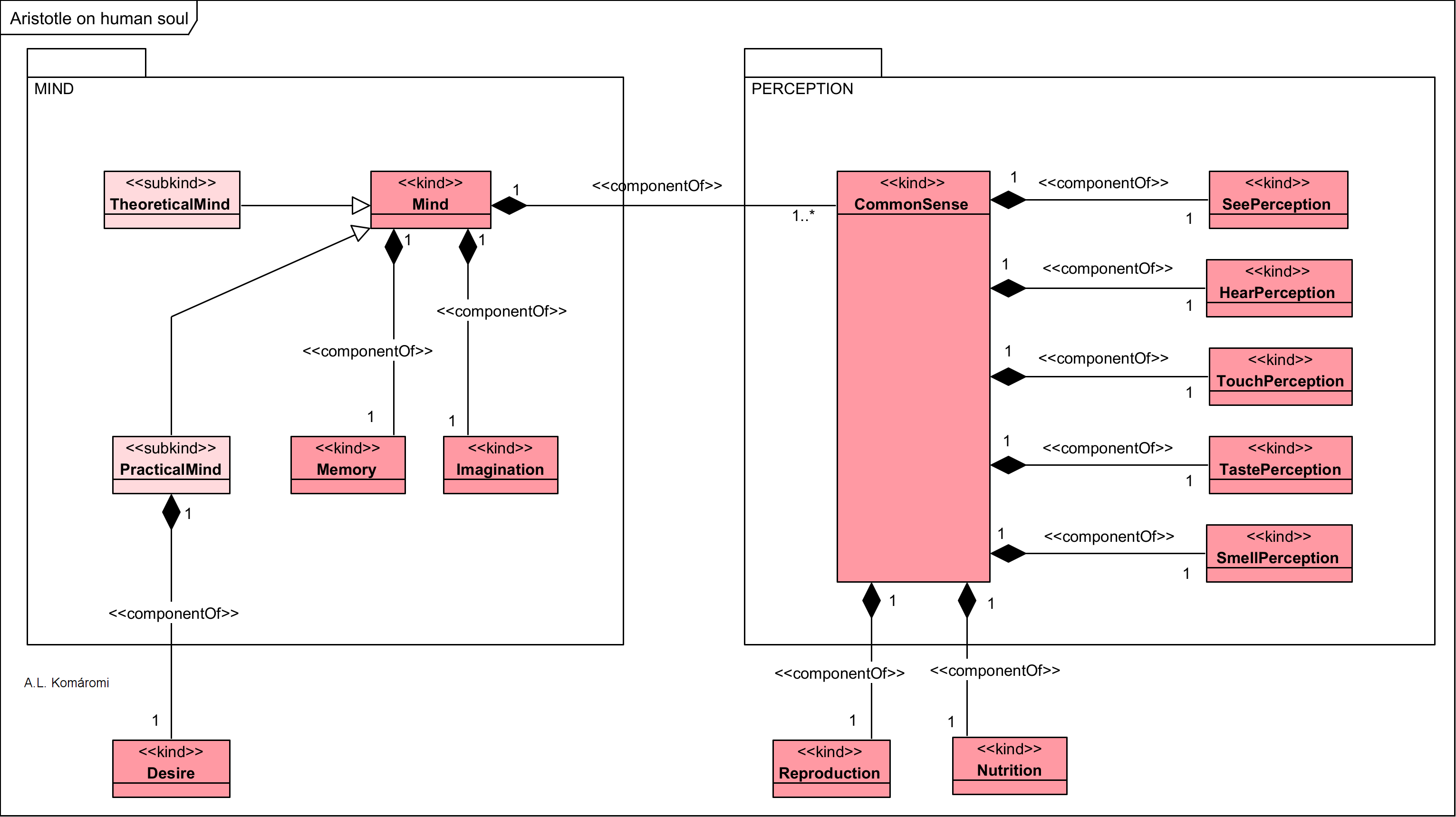
The following OntoUML diagram presents the main classes in Aristotle’s theory of soul:

Sources:

  • All citations and more about the topic in: Shields, Christopher, “Aristotle’s Psychology“, The Stanford Encyclopedia of Philosophy (Winter 2016 Edition), Edward N. Zalta (ed.)
  • Richard Sorabji, “Aristotle on demarcating the five senses”, Philosophical Review, 1971

First published: 11/4/2019
Updated: 16/4/2019: some use case relations changed
Updated: 27/4/2019: added 5 Senses and Common Sense
Updated: 14/7/2019: added reproduction
Updated: 10/8/2020
Updated: 8/6/2021
Updated: 30/11/2021 added OntoUML diagram