
St Augustine (354-430 AD) in his work On the Trinity proposes a series of analogies to illustrate that the human (mind) is created on the image of God; and also to make the God-Trinity concept more accessible for the reader.
Augustine uses some of the faculties and functions of the human soul, like (see in [2.6.1]): Reason, Will, Memory, Understanding, Love.
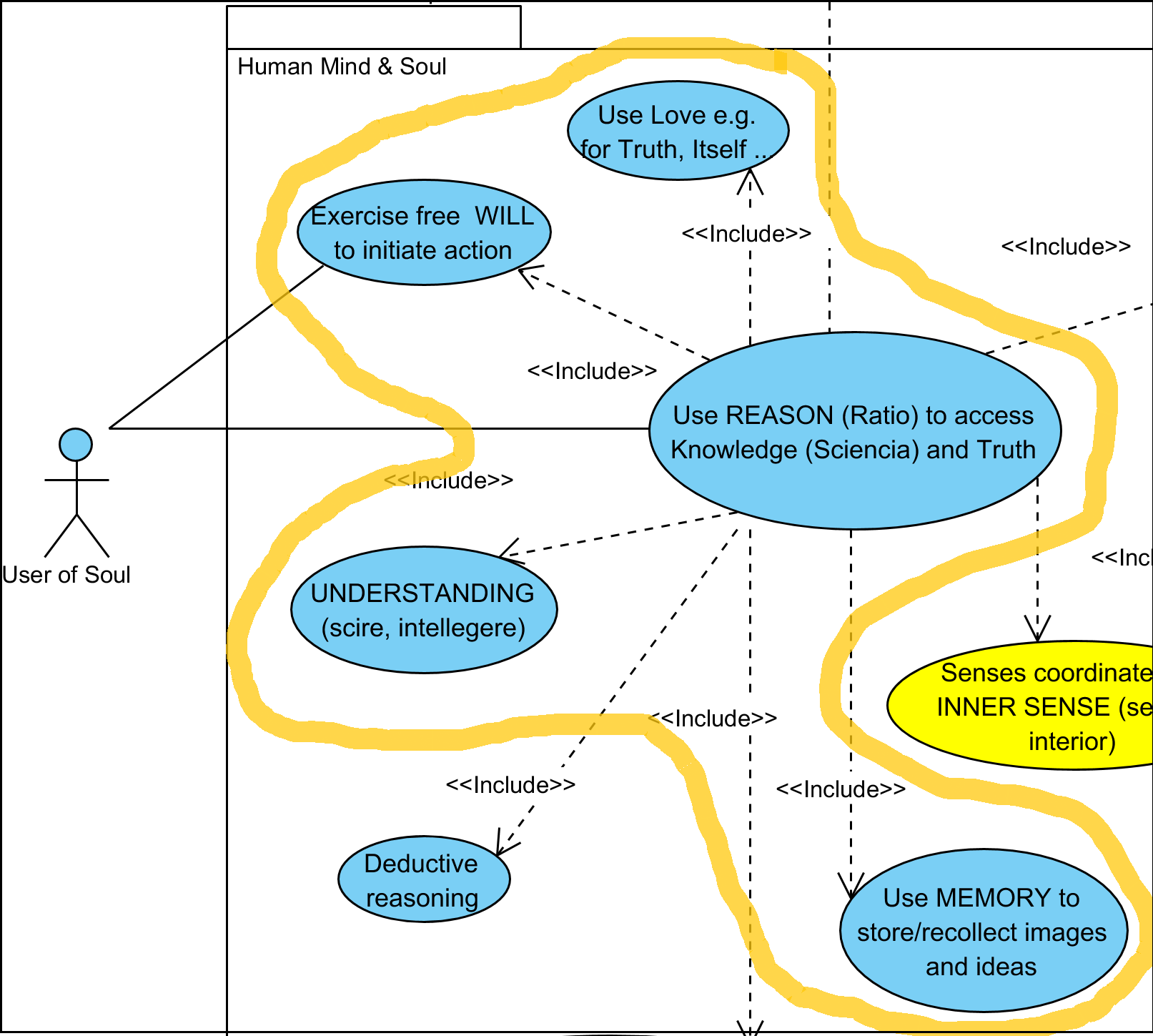
Since in God-Trinity the three persons (Father, Son, Holy Spirit) are of the same essence, he is looking for similar structures with three parts and one essence in the human mind. He finds the following analogies, in an analysis which processing from the exterior to the interior of human cognition:
- 1st: will, image received through sense perception, understanding
- 2nd: will, object of thought, understanding
- 3rd: self, love, understanding
The 1st analogy is has a severe shortcoming: the image received through sense perception depends on the exterior word, so is not internal enough to the Reason.
For the 2nd and 3rd analogy, the members have the same essence: they are all Reason, as presented in the OntoUML diagram below:
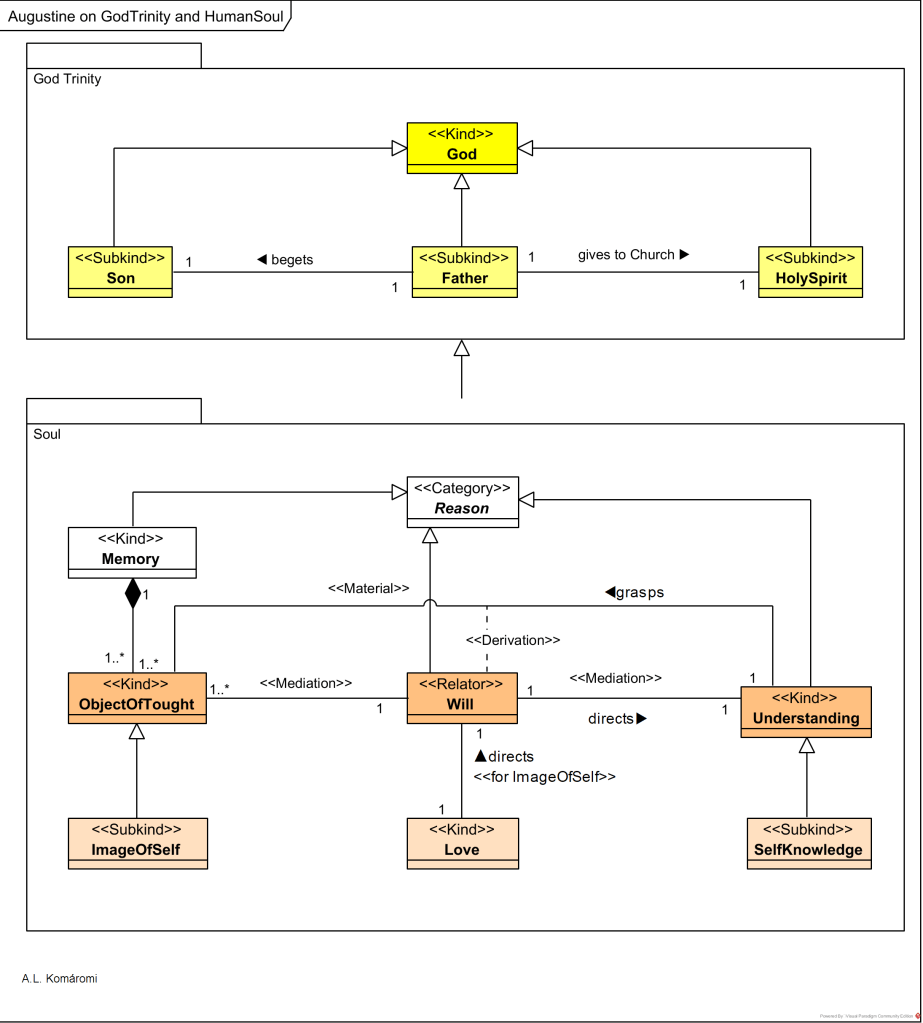
| Trinity | Members of Trinity | Explanation |
|---|---|---|
| In God | Father, Son, HolySpirit | According to Augustine the members of the Trinity – Father, Son and HolySpirit – are of one essence (essentia), but three persons (personae). |
| 2nd analogy in Reason | Will, ObjectOfThought, Understanding | The memory presents the object of thought, (e.g. an image of an object, a mathematical theorem..), which is grasped by understanding. The will directs the attention of understanding towards the object of thought. The problem with this analogy is that the presented relation is not eternal: the object of thought changes as the will changes. |
| 3rd analogy in Reason | SelfKnowledge, Love, Understanding | The memory presents the image of self, (as an object of thought), which is grasped by understanding, self-knowledge. The love of self directs through the will the attention of understanding towards the image of self. Since the love for self is unchanging, this analogy is stable and immortal, as the human soul containing it is immortal. Augustine thinks that this is the best analogy for God Trinity – human soul. “But in these three, when the mind knows itself and loves itself, a trinity remains: the mind, love, and knowledge.” “These three, therefore, are in a marvelous manner inseparable from another; and yet each of them is a substance, and all together are one substance or essence, while the terms themselves express a mutual relationship.” |
Description of the classes in Augustine’s trinity analogies:
| Class | Description | Relations |
|---|---|---|
| God | Christian God | |
| Father | Father is a person of God. | subkind of God; begets Son; gives to Church Holy Spirit |
| Son | Son is a person of God. | subkind of God |
| HolySpirit | Holy Spirit is a person of God. | subkind of God |
| Reason | The image of God in Humans consists of that part of the soul –Reason – which the animals do not have in common with us. Reason is the highest function of Soul, co-ordinates the subordinated faculties, provides deductive, logical thinking and access to Knowledge and Truth. | generalizes Memory, Will, Understanding |
| Memory | Memory stores images, sense perceptions, knowledge. | |
| ObjectOfThought | Object of thought is presented by the memory to the other faculties of the soul. | exclusive part of Memory |
| Understanding | Understanding is a cognitive state characterized posession and autonomuous usage of concepts referring to the object of thought. | grasps ObjectOfThought |
| Will | Will is the facuty of the soul which initiates action. | Mediates between Understanding and ObjectOfThought; directs the Understanding to the ObjectOfThought. |
| ImageOfSelf | The image of self is an object of thought referring to the thinker. | subkindof ObjectOfThought |
| SelfKnowledge | Self knowledge is understanding of the Self. | subkindof Understanding |
| Love | The love of self directs through the will the attention of understanding towards the image of self. Since the love for self is unchanging, this analogy is stable and immortal, as the human soul containing it is immortal. | directs Will to ImageOf Self |
Sources:;
- All citations from: Augustine, Aurelius. The Trinity. Translated by Stephen McKenna in The Fathers of the Church: A New Translation, vol. 45. Washington, DC: The Catholic University of America Press, 1963.
- Adamson, Peter, History of Philosophy without any gaps, podcast 115 – Me, Myself and I: Augustine on Mind and Memory
- Adamson, Peter, History of Philosophy without any gaps, podcast 116 – Charles Brittain on Augustine’s “On the Trinity”
First published: 6/6/2019
Updated:
 Philosophy Models