
In different works (Logica ‘ingredientibus’, Dialectica), Peter Abelard ( “Doctor Scholasticus”, 1079?-1142 AD) elaborated his philosophy of language, sustaining, that:
- words can be names (taken in a broad sense), and verbs
- sentences are compound of names connected by the special connective force of verbs,
- signification is the subjective informational content generated in a person’s mind when he/she hears a word or sentence.
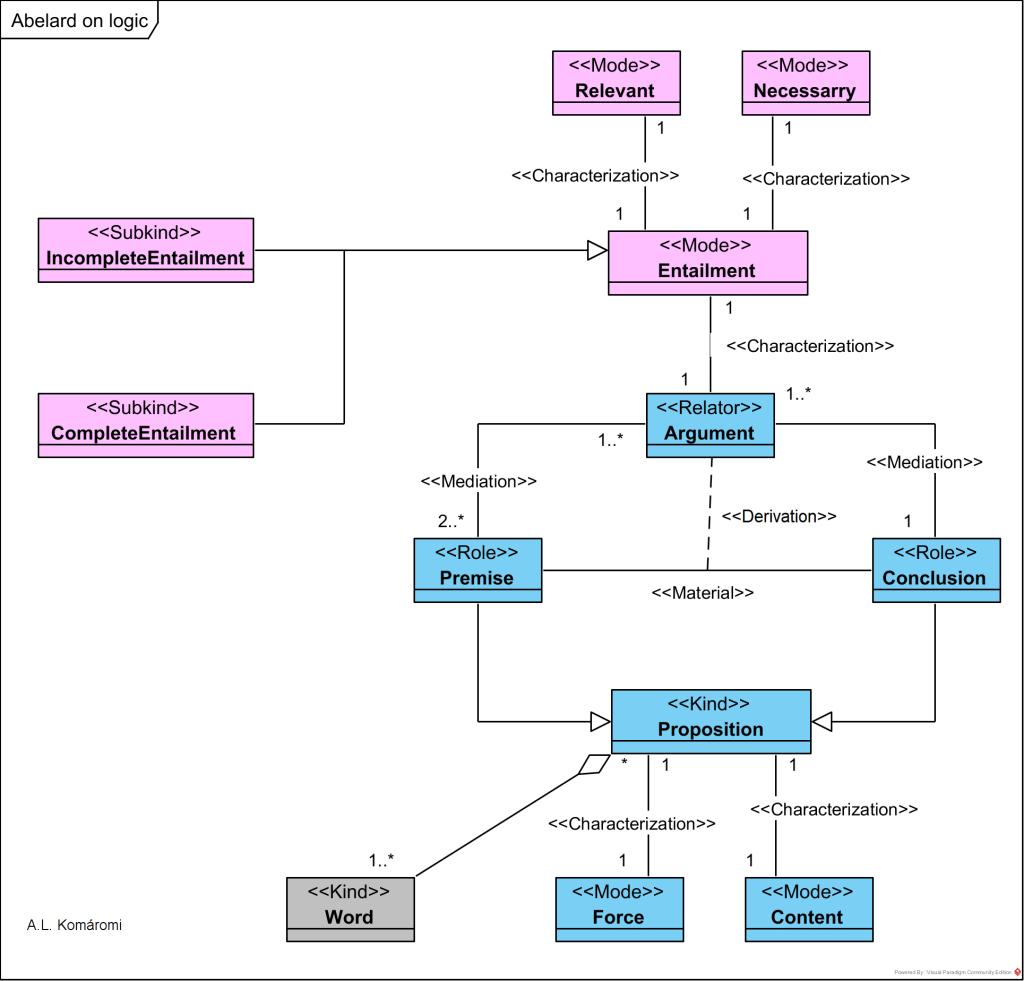
Abelard’s model of language and significaton is presented in the following OntoUML diagram:

| Class | Description | Relations |
|---|---|---|
| Word | Word (voces), or ‘utterances’ – pronounced or written words in a given language. | in material relation with Concept and Thing |
| Name | “Abelard takes names to be conventionally significant simple words, usually without tense. So understood there are a wide variety of names: proper and common names; adjectives and adverbs; pronouns, whether personal, possessive, reflexive, or relative; conventional interjections such as “Goodness!”; and, arguably, conjunctions and prepositions (despite lacking definite signification), along with participles and gerundives (which have tense). […]. In point of fact, much of Abelard’s discussion of the semantics of names turns on a particular case that stands for the rest: common names. “ | subkind of Word; non-exclusive part of Sentence |
| Verb | “What holds for the semantics of names applies for the most part to verbs. The feature that sets verbs apart from names, more so than tense or grammatical person, is that verbs have connective force (vis copulativa). This is a primitive and irreducible feature of verbs that can only be discharged when they are joined with names in the syntactically appropriate way” | subkind of Word; non-exclusive part of Sentence |
| ConnectiveForce | “verbs have connective force (vis copulativa)” | characterizes Verb |
| Concept | A concept is an idea applied to all objects in a group. It is the way people see and understand something., e.g., they grasp the Status of the individual things in the group referred by the Word (see [4.4.1]). | |
| Signification | Signification is the informational content generated in a person’s mind when he/she hears a word or sentence. | exclusive part of the Person’sMind |
| SignificationOfTerm | “signification of term is posterior to reference, [words] names do have signification as well. Abelard holds that the signification of a term is the informational content of the concept that is associated with the term upon hearing it, in the normal course of events. Since names are only conventionally significant, which concept is associated with a given name depends in part on the psychological conditioning of language-users, in virtue of which Abelard can treat signification as both a causal and a normative notion: the word ‘rabbit’ ought to cause native speakers of English to have the concept of a rabbit upon hearing it. Abelard is careful to insist that the signification is a matter of the informational content carried in the concept—mere psychological associations, even the mental images characteristic of a given concept, are not part of what the word means. Ideally, the concept will correspond to a real definition that latches onto the nature of the thing, the way ‘rational mortal animal’ is thought to be the real definition of ‘human being’, regardless of other associated features (even necessary features such as risibility) or fortuitous images (as any mental image of a human will be of someone with determinate features). Achieving such clarity in our concepts is, of course, an arduous business, and requires an understanding of how understanding itself works […]). Yet one point should be clear from the example. The significations of some names, such as those corresponding to natural-kind terms, are ‘abstractions’ in the sense that they include only certain features of the things to which the term refers. They do not positively exclude all other features, though, and are capable of further determinate specification: ‘rational mortal animal’ as the content of the concept of ‘human being’ signifies all humans, whatever their further features may be—tall or short, fat or thin, male or female, and so on.” | mediates between Word and Concept; inherits from Signification |
| SignificationOfSentence | Signification of sentences (propositiones): “must signify more than just the understandings of the constituent name and verb. First, a sentence such as “Socrates runs” deals with Socrates and with running, not with anyone’s understandings. We talk about the world, not merely someone’s understanding of the world. Second, sentences like “If something is human, it is an animal” are false if taken to be about understandings, for someone could entertain the concept human without entertaining the concept animal, and so the antecedent would obtain without the consequent. Third, understandings are evanescent particulars, mere mental tokenings of concepts. But at least some consequential sentences are necessary, and necessity can’t be grounded on things that are transitory, and so not on understandings. Sentences must therefore signify something else in addition to understandings, something that can do what mere understandings cannot. Abelard describes this as signifying what the sentence says, calling what is said by the sentence its dictum (plural dicta).” | inherits from Signification |
| Sentence | “Sentences are made up of names and verbs in such a way that the meaning of the whole sentence is a function of the meaning of its parts. That is, Abelardian semantics is fundamentally compositional in nature. The details of how the composition works are complex. Abelard works directly with a natural language (Latin) that, for all its artificiality, is still a native second tongue. Hence there are many linguistic phenomena Abelard is compelled to analyze that would be simply disallowed in a more formal framework. For example, Abelard notes that most verbs can occur as predicates in two ways, namely as a finite verbal form or as a nominal form combined with an auxiliary copula, so that we may say either “Socrates runs” or “Socrates is running”; the same holds for transitive predication, for instance “Socrates hits Plato” and “Socrates is hitting Plato.” Abelard argues that in general the pure verbal version of predication is the fundamental form, which explains and clarifies the extended version; the latter is only strictly necessary where simple verbal forms are lacking. (The substantive verb ‘is’ requires special treatment.) Hence for Abelard the basic analysis of a predicative statement recognizes that two fundamentally different linguistic categories are joined together: the name n and the simple verbal function V( ), combined in the well-formed sentence V(n).” | has SignificationOf Sentence |
| Reference | “reference (nominatio), a matter of what the term applies to.” […] “A name ‘has a definition in the nature of its imposition, even if we do not know what it is.’ Put in modern terms, Abelard holds a theory of direct reference, in which the extension of a term is not a function of its sense. We are often ‘completely ignorant’ of the proper conceptual content that should be associated with a term that has been successfully imposed.” | mediates between Word and Thing |
| Person’sIntellect | The intellect of the person, who hears the word/sentence. | |
| Thing | Thing |
Sources
- All citations from: King, Peter and Arlig, Andrew, “Peter Abelard”, The Stanford Encyclopedia of Philosophy (Fall 2018 Edition), Edward N. Zalta (ed.)
- Harjeet Singh Gill, “The Abelardian Tradition of Semiotics”, Conference Adress, 1993
First published: 06/08/2020
 Philosophy Models