[1.2.5] Plato on Psychological Constitutions in the Republic

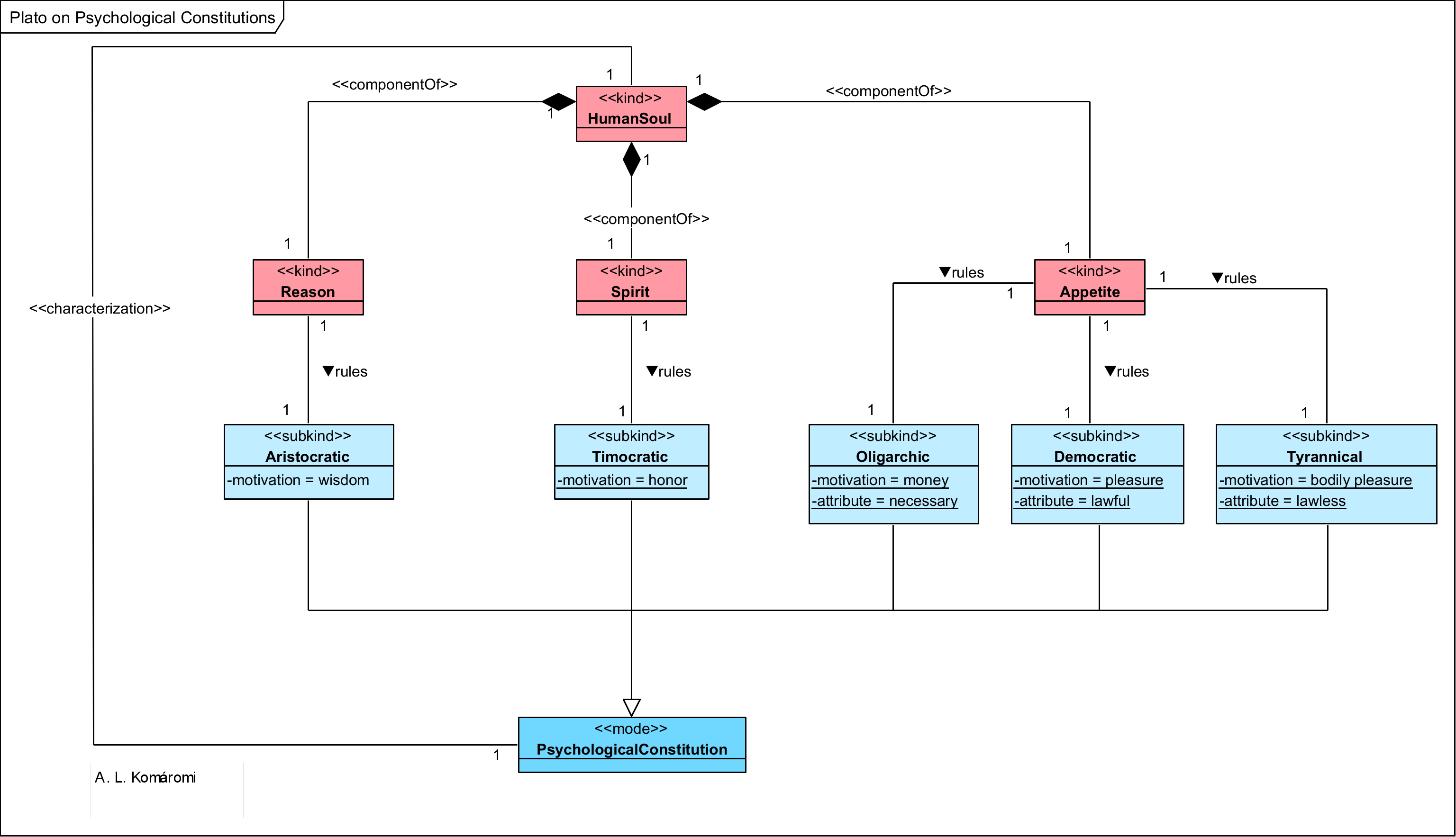
Plato (429?-347 BC) (through Socrates) in Book 4 of the Republic presents a theory, which states that the human soul has three main faculties: reason, spirit, and appetite (see also [1.2.2]). Based on this, he works out a typology of five pure types of humans souls, depending on two factors: the faculty which rules the soul, and in the case of the rule of the appetite, the necessary, lawful, or lawless character of the motivation.

The OntoUML diagram below shows this typology:
Plato on psychological constitutions
ClassDescriptionRelations
HumanSoul“But the arguments from conflict treat reason, spirit, and appetite as distinct subjects of psychological states and events, and it seems best to take Socrates’ descriptions at face value unless there is compelling reason not to. At face value, Socrates offers a more robust conception of parts, wherein each part is like an independent agent.
Indeed, this notion of parts is robust enough to make one wonder why reason, spirit, and appetite are parts at all, as opposed to three independent subjects. But the Republic proceeds as though every embodied human being has just one soul that comprises three parts. No embodied soul is perfectly unified: even the virtuous person, who makes her soul into a unity as much as she can, has three parts in her soul. (She must, as we shall see, in order to be just.) But every embodied soul enjoys an unearned unity: every human’s reason, spirit, and appetite constitute a single [human] soul that is the unified source of that human’s life and is a unified locus of responsibility for that human’s thoughts and actions.”
ReasonReason is the part of the soul that is, of its own nature, attached to knowledge and truth. It is also, however, concerned to guide and regulate the life that it is, or anyhow should be, in charge of, ideally in a way that is informed by wisdom and that takes into consideration the concerns both of each of the three parts separately and of the soul as a whole.” (Lorenz)is exclusive part of HumanSoul; rules Aristocratic
Spirit “The natural attachment of spirit is to honor and, more generally, to recognition and esteem by others.” (Lorenz) is exclusive part of HumanSoul; rules Timocratic
AppetiteAppetite gives rise to desire for instant gratification through food, drink, sex… is exclusive part of HumanSoul; rules Oligharic, Democratic, Tyrannical
Psychological Constitution “there are in fact five kinds of pure psychological constitutions: aristocratically […], timocratically […], oligarchically […], democratically […], and tyrannically constituted persons… The first three of these constitutions are characteristically ordered toward simple aims (wisdom, honor, and money, respectively), but the last two are not so ordered, because there is no simple aim of the unnecessary appetites, be they lawful or lawless.”characterizes HumanSoul
Aristocratic Aristocratically constituted persons are ruled by their reason, and are motivated by the attendance of wisdom.is Psychological Constitution
Timocratic Timocratically constituted persons are ruled by their spirited attitudes, and motivated mainly by honor.is Psychological Constitution
OligarchicOligharically constituted persons are ruled by their apetite in a necessary way, and motivated mainly by honor. is Psychological Constitution
Democratic “the democratic… souls treat desire-satisfaction itself and the pleasure associated with it as their end. The democrat treats all desires and pleasures as equally valuable and restricts herself to lawful desires” is Psychological Constitution
Tyrannicaltyrannical souls treat desire-satisfaction itself and the pleasure associated with it as their end…the tyrant embraces disordered, lawless desires and has a special passion for the apparently most intense, bodily pleasures”is Psychological Constitution

Sources

First published: 31/10/2019

[1.2.4] Plato’s Cosmology in Timaeus

Plato (429?-347 BC) presents its views about cosmology in the dialogue Timaeus.  He identifies this cosmology as a whole as a myth (eikōs muthos) – a real and probable explanation of the history and structure of the Universe. In his work, he uses and combines different ideas from its predecessors:

  • the existence of a divine mind, intellect (Anaxagoras)
  • the four elements (Empedocles)
  • the world is based on mathematics; the elements are made up of triangles (Pythagoras)
  • the Universe is constantly changing, is in state of becoming (Heraclitus)

The following OntoUML diagram shows the main classes of his cosmology:

Plato’s cosmology
ClassDescriptionRelations
Intellect“It is reasonable to conclude that Intellect is a sui generis substance that transcends the metaphysical dichotomy of being and becoming—possibly not unlike the Judaeo-Christian conception of God.”
GodGodgeneralizes Demiurge and LesserGod
Demiurge“The universe exists and manifests goodness because it is the handiwork of a supremely good, ungrudging Craftsman [Demiurge], who brought order to an initially disorderly state of affairs… the Craftsman seems to be an anthropomorphic representation of Intellect.”
The Demiurge looks to the Form when creates the Universe.
represents Intellect; creates Universe; creates HumanSoul; looks to the Form
Form Forms are immaterial, non-spatial and atemporal […] Forms are […] perfect and what particulars strive to be like but fall short of […] Forms are simple or incomposite, of one form (monoeidetic). Forms are the objects of knowledge, grasped by the intellect through definitions […] Forms are pure, simple or uniform (monoeidetic, hen).” (Silverman)(see [1.2.1]) is shared part of Particulars
Receptacle Receptacle is “an enduring substratum, neutral in itself but temporarily taking on the various characterizations. The observed particulars just are parts of that receptacle so characterized…
The receptacle has been seen as serving either as material substratum or as some form of space or as combining both roles. Timaeus’ account of the receptacle presents several interpretive difficulties, some of which will be discussed below. In the “pre-cosmic” state (the state “prior to” the intervention of the Craftsman) the receptacle is subject to erratic and disorderly motions, and moves its contents in turn.”
Receptacle is a third kind (triton genos) – besides Form and Particular.
is where Particular’s becoming takes place
ParticularParticulars are dependent on Forms whereas Forms are not dependent on them. Particulars strive to be such as the Forms are and thus in comparison to Forms are imperfect or deficient treat Partaking as a relation between material particulars and Forms, the result of which is that the particular is characterized by the Form of which it partakes…” (Silverman) (see [2.1])
LivingThing The universe is a living thing. subkind of Particular
UniverseUniverse “is a living thing (zô[i]on, also translatable as ‘animal’), because it is better for it to possess intelligence than to lack it, and the acquisition of intelligence by anything requires the acquisition of soul. It is complete, and thus it includes within itself all the species of living things as its parts. It is unique, because its model is unique; the uniqueness of the model follows from its completeness.”subkind of LivingThing
World’sBody “The shape of the universe’s body—a sphere—and the characteristics it possesses or lacks are all explained in terms of their various purposes.”is exclusive part of Universe
World’Soul “The composition of the world’s soul out of a harmonically proportionate series of portions of a mixture of both divisible and indivisible Sameness, Difference and Being, and the division of these portions into two intersecting circles (of the Same and of the Different) explain the cognitive powers of the soul in relation to the different types of objects of cognition: those that are and those that become.” is exclusive part of Universe
Sameness, Difference, Beingare shared parts of World’sSoulare shared parts of World’sSoul
HeavenlyBody “The heavenly bodies are divine and move in their various orbits to serve as markers of time: the fixed stars to mark a day/night, the moon to mark the (lunar) month and the sun to mark the year. Time itself came into being with these celestial movements as an ‘image of eternity.'” is exclusive part of Universe
Element “The world’s body is composed of fire (for visibility) and earth (for tangibility), but these so-called elements require the mediation of air and water in a progression of proportion to bind them together into a unified, concordant whole.”component of Particulars (e.g. LivingThing; Universe; HumanBeing
FireFire is made up of particles in form of a regular tetrahedron (four-sided geometrical solid), with 6 scalene triangles making up each equilateral face of the tetrahedron.subkind of Element
EarthEarth is made up of particles in form of cube (six-sided geometrical solid), with 4 isosceles triangles making up each square face of the cube.subkind of Element
Water Water is made up of particles in form of regular icosahedron (20-sided geometrical solid), with 6 scalene triangles making up each equilateral face of the icosahedron. subkind of Element
Air Air is made of particles in form of regular octohedron (8-sided geometrical solid), with 6 scalene triangles making up each equilateral face of the octohedron.” subkind of Element
Scalene Triangle with 30°-60°-90° angles. is Triangle; is shared part of Fire, Water, Air
Isosceles Triangle with 45°-45°-90° angles. is Triangle; is shared part of Earth
TriangleTriangle is the simplest and the most perfect polygon.
God “While the Craftsman has created the individual souls, he delegates the creation of the human bodies to the lesser, created gods.”
Gods are Chronos, Zeus, Hera etc…
is a LivingThing; creates HumanBody
HumanBeing HumanBeing is a combination of on immortal human soul and a mortal human body.
HumanSoul “Individual [human] soul is are made up of the residue (and an inferior grade) of the soul stuff of the universe, and are eventually embodied in physical bodies. This embodiment throws the previously regular motions of the soul into confusion as the soul is subjected to the forceful disturbances of internal bodily processes as well as the impact of external bodies upon it, particularly in sense experience. These disturbances gravely impair the soul’s cognitive functioning; only with appropriate nurture and education can its original motions be reestablished and proper cognitive functioning be restored. The body and its parts were designed to support that functioning, and Timaeus takes the design of the eyes and the mechanics of vision as an important case in point.” (See also [2.2].)is exclusive part of HumanBeing
HumanBody“As individual immortal (and rational) souls are embodied in mortal [human] bodies, the embodiment requires the further creation of the “mortal” parts of the soul—the spirited and appetitive parts, familiar from the Republic and the Phaedrus. These parts are assigned their respective locations in the body: the immortal and rational soul in the head, and the two parts of the mortal soul in the trunk: the spirited part in the chest (nearer to the head) and the appetitive part in the belly. The various organs in the trunk—the lungs and heart in the chest and the liver in the belly—support the functions of their resident soul parts.”is exclusive part of HumanBeing

Sources

First published: 24/10/2019
Updated: 2/1/2022