[4.10.1] St Bonaventure on Creatures as God’s Signs

St Bonaventure (the “Seraphic Doctor”, 1217 – 1274 AD), in the work Commentary on the Sentences of Lombard, writes about the ways how all created things signifies God:

  • God created all things, so the whole universe existentially depends on God.
  • All creatures act in the role of signs which point to God; these signs can be of four types.
  • Based on their properties, all creatures signify God as shadows and vestiges; more than that, rational creatures signify it as images and similitudes.
  • Rational creatures (humans, angels) have the power to look to these signs, which leads them to God. This way rational creatures “have God as their ultimate object, whereas all creatures have God as their Cause”.

Bonaventure’s model of creatures as God’s signs is pictured in the following OntoUML diagram:

Bonaventure on creations as signs of God

ClassRationalCreatureClassDescriptionRelations
GodGod creates the creatures whose existence depends on him.creates Creature; provides divine grace to RationalCreature
Creature“All creatures, from rocks to angels, are signs in the sense of shadows and traces of God, for they all bear a relation of causal dependency upon God as their source; but only rational creatures can have the divine as an object of their activities and, for that reason, can conform themselves to the divine will and become likenesses of God.”
PropertyCreatures can be vestiges or shadows based on properties which point to God.characterizes Creature
Shadow“a creature is called a shadow based on its properties which point to God in some type of causality in an indeterminate way.”role of Creature; is Sign
Vestige“a creature is called a vestige based on properties which point to God as triple cause–efficient, formal, and final cause; for example, the properties: one, true, and good.”role of Creature; is Sign
RationalCreature“[…] only rational creatures can have the divine as an object of their activities and, for that reason, can conform themselves to the divine will and become likenesses of God.”subkind of Creature; observes Sign
RationalPowerRational powercharacterizes RationalCreature; subkind of Property
Image“Bonaventure posits […] higher types of semiosis pertinent solely to rational creatures, which are ‘images’ (imago) pointing to the First Principle through its properly rational powers which have their source and highest object in God”role of RationalCreature; is Sign
Likeness“In addition, Bonaventure posits […] higher types of semiosis pertinent solely to rational creatures, which are […] ‘likenesses’ (similitudo) of God to the extent that they are recipients of divine grace and conform themselves to the divine will.” role of RationalCreature; is Sign
Sign“Bonaventure’s semiotics distinguishes four sorts of signs [wich are shadow, vestige, image, similitude...]
All creatures, from rocks to angels, are signs in the sense of shadows and traces of God, for they all bear a relation of causal dependency upon God as their source; but only rational creatures can have the divine as an object of their activities and, for that reason, can conform themselves to the divine will and become likenesses of God.”
points to God

Sources

  • All citations from: Noone, Tim and R. E. Houser, “Saint Bonaventure“, The Stanford Encyclopedia of Philosophy (Winter 2020 Edition), Edward N. Zalta (ed.)

First published: 10/12/2020
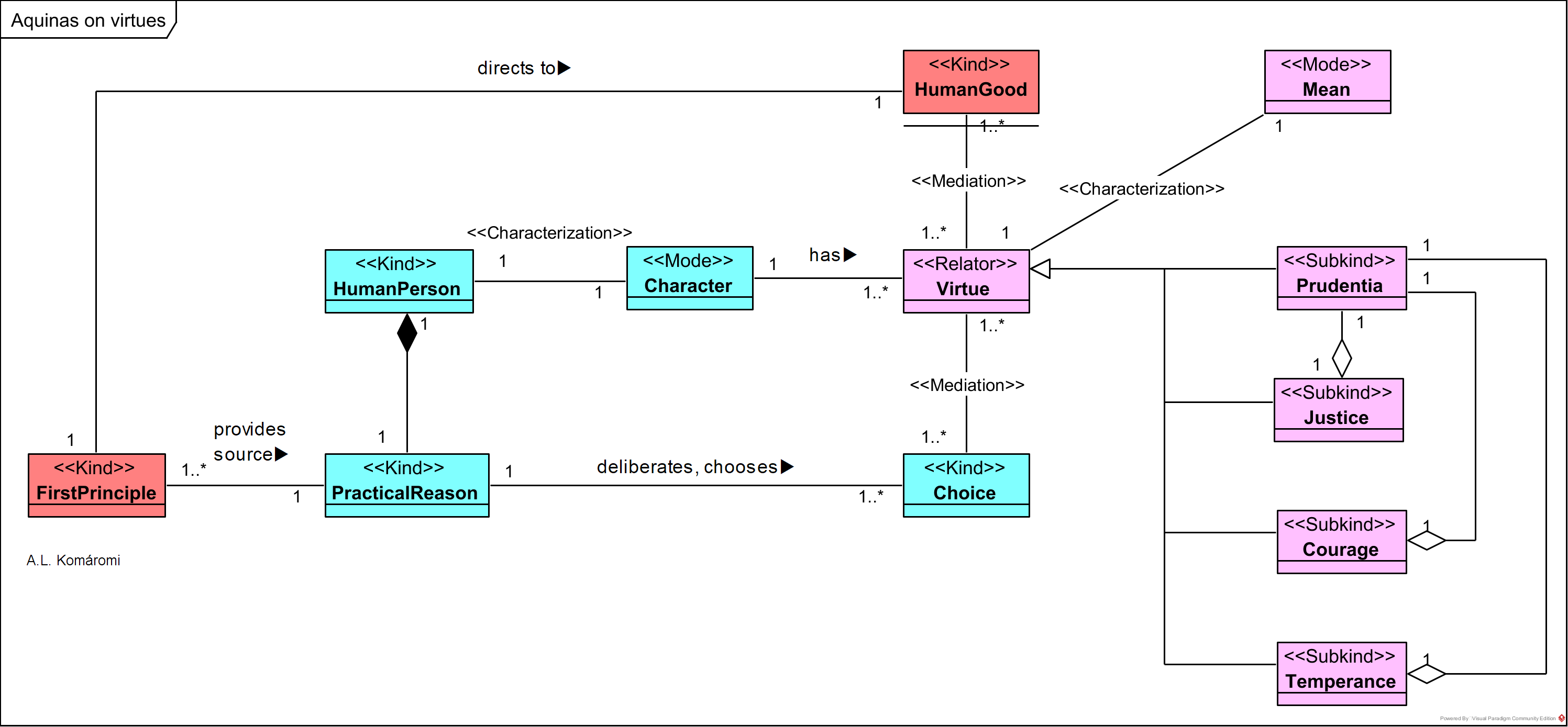
[4.9.13] St Thomas Aquinas on Virtues

St Thomas Aquinas ( “Doctor Angelicus”, 1225 – 1274 AD), in different works ([ST] Summa Theologiae and Quaestiones Disputatae de Veritate) lays out his theory of virtues. Based on that:

  • A human’s practical reason (see [1.3.6], [4.9.9]) is responsible for deliberating and freely choosing choices for the human good (or bad).
  • Practical reason uses first principles (e.g., “Good is to be done and pursued, and bad avoided”) aimed at the human good in the deliberation over the acts.
  • virtue is an element in a person’s (good) character.
  • Virtue means a stable willingness to make good choices.

Aquinas’s main model of virtues is pictured in the following OntoUML diagram:

Aquinas on virtues
CLASSDESCRIPTIONRELATIONS
HumanPersona human person
Character“A virtue is an aspect of, or constitutive element in, being a person of good character.”characterizes HumanPerson
PracticalReasonPractical reason’s central activity is deliberation about what to do. One would have no need to deliberate unless one were confronted by alternative attractive possibilities for action (kinds of opportunity) between which one must choose (in the sense that one cannot do both at the same time, if at all) and can choose. It is that one can be and often is in such a position that, confronted by two or more attractive possibilities (including perhaps the option of ‘doing nothing’), there is nothing either within or outside one’s personal constitution that determines (settles) one’s choice, other than the choosing: Mal. q. 6. This conception of free choice (liberum arbitrium or libera electio) is much stronger than Aristotle’s, on whose conception free choices are free only from external determining factors.”exclusive part of HumanPerson; deliberates, chooses Choice
ChoiceThe practical reason’s free choice of something.
Virtue“To have the virtues is to have a stable and ready willingness to make choices that are morally good because in line with the bonum rationis, the basic good of practical reasonableness. […]
Aquinas firmly holds the Platonic-Aristotelian theses (i) of the connexio virtutum: that to have any of the virtues in its full and proper form one must have all of them, and (ii) of the governing and shaping role of (the good of) practical reasonableness (bonum rationis), that is, of the intellectual and moral virtue of prudentia.”
relates Choice with Good
Prudentia“the master virtue of bringing practical reasonableness into all one’s deliberations, choices, and carrying out of choices – the virtue of prudentia, a virtue both intellectual (of one’s intelligence) and moral (of one’s whole will and character) – is part of the definition, content, and influence of every other moral virtusubkind of Virtue; shared part of ustice, Courage, and Temperance
Justice, Courage, Temperance“Aquinas accepts the Platonic-Aristotelian thesis that there are four virtues which are cardinal, that is on which the moral life and all other virtues hinge or depend: prudentia, justice, courage, and temperantia. Each is a strategic element in one’s integrating of the good of practical reasonableness into one’s deliberations, choices and execution of choices (prudentia), in one’s dealings with others justice), and in integrating and governing one’s desires by genuine reasons (temperantia) and enabling one to face down intimidating obstacles (courage, fortitudo).”subkind of Virtue
Mean“Aquinas accepts Aristotle’s notion that every virtue is a mean between too much and too little, and he constantly stresses that it is reason – with the principles and rules (regulae) it understands – that settles the mean and thus determines what is too much or too little.”characterizes HumanAct
FirstPrinciple“practical reasons (i.e. reasons for action) are propositional: they can be stated as principles and other standards, more or less specific. So principles, ultimately the first principles of practical reason (that is, of natural law), are more fundamental to ethics than virtues are. […]
Ethical standards, for which practical reason’s first principles provide the foundations or sources, concern actions as choosable and self-determining. […]
Practical reason, in Aquinas’ view, has both one absolutely first principle and many truly first principles: ST I-II q. 94 a. 2. […] Aquinas articulates it as ‘Good is to be done and pursued, and bad avoided’ (ibid.).
This has often been truncated to (i) ‘Good is to be done, and evil avoided’ or even, more drastically, (iia) ‘Do good and avoid evil’ or yet more drastically (iib) ‘Avoid evil and seek the good‘”
provides source to PracticalReason; directs to HumanGood
HumanGood“The basic human goods which first practical principles identify and direct us to are identified by Aquinas as (i) life, (ii) “marriage between man and woman and bringing up of children [coniunctio maris et feminae et educatio liberorum]” (not at all reducible to “procreation”), (iii) knowledge, (iv) living in fellowship (societas and amicitia) with others, (v) practical reasonableness (bonum rationis) itself, and (vi) knowing and relating appropriately to the transcendent cause of all being, value, normativity and efficacious action (ST I-II q. 94 aa. 2 & 3). His lists are always explicitly open-ended.”characterizes and directs FirstPrinciple

Sources

  • All citations from: Finnis, John, “Aquinas’ Moral, Political, and Legal Philosophy“, The Stanford Encyclopedia of Philosophy (Summer 2020 Edition), Edward N. Zalta (ed.)
  • The Cambridge Companion to Aquinas, CAMBRIDGE UNIVERSITY PRESS, Edited by  Norman Kretzmann and Eleonore Stump, 2010
  • McInerny, Ralph and John O’Callaghan, “Saint Thomas Aquinas”The Stanford Encyclopedia of Philosophy (Summer 2018 Edition), Edward N. Zalta (ed.)

First published: 3/12/2020