[4.9.12] St Thomas Aquinas on Emotions

St Thomas Aquinas ( “Doctor Angelicus”, 1225 – 1274 AD), in his works Summa Theologiae II-1.22–48 presents a theory of emotions (passiones animae), according to which:

  • Emotions are reactions, changes of the state of the subject initiated by the presence of an object.
  • Aquinas locates emotions in the lower level of the soul, in the sensory appetite (see [4.9.7]).
  • Emotions have a hylomorphic structure (see [1.3.5] and [1.3.7]), where the appetitive reaction is the formal, and the physical reaction is the material element.
  • Aquinas divides emotions into irascible and concuscible sub-kinds and identifies eleven of them.

Aquinas’s model of emotions is represented in the following OntoUML diagram:

Aquinas on emotions
ClassDescriptionRelations
Reaction“In mediæval philosophical jargon, an emotion is a potency whose principle of actualization is external to its subject; in contemporary terms, an emotion is a reaction.” (King)
AppetitiveReaction“In the emotions […] the formal element is an appetitive reaction.” (Aquinas)
“’the lower appetitive power does not naturally tend to anything until after that thing has been presented to it under the aspect of its proper object’ […], since in the case of animals ‘the sensitive appetite is apt to be moved by the estimative power, as when a sheep esteems a wolf as inimical and is then afraid’ The sensitive appetite, as a passive power, is reduced from potency to act when it ‘inherits’ objectual content from the evaluative response-dependent concept (which is the actualization of the estimative power). That is to say, the sheep has an act of the sensitive appetite directed at the wolf, which is presented to the sensitive appetite as a hard-to-avoid imminent evil.” (King)
inseparable part of Emotion; inherits from Reaction
PhysicalReaction“In the emotions […] the […] the material element a physical reaction.” (Aquinas)
Physical reactions can be like: tightness in the chest,
flushing of the face, perspiring etc.
inseparable part of Emotion; inherits from Reaction
EmotionEmotion, according to Aquinas, is an objectual non-volitional affective
psychological state. […] For an emotion is a passio animae, literally something that the soul ‘undergoes’ or ‘experiences’ — a capacity for being in a given psychological state — rather than something the soul ‘does’ (the way it reasons, for instance). In mediæval philosophical jargon, an emotion is a potency whose principle of actualization is external to
its subject; in contemporary terms, an emotion is a reaction.
First, if an emotion is a reaction, it is therefore passive as regards whatever brings it about, that is, whatever prompts the reaction. (King)

“In Aquinas’ theory there is a conception of passion [emotion] which permits him to deal with passions as single events: the hylomorphic approach. At times he deals with it directly: ‘In the emotions […] the formal element is an appetitive reaction and the material element a physical reaction. There is a certain ordered arrangement between the two, in which the physical reaction reproduces (secundum similitudinem) the characteristics of the appetitive reaction’ It would be wrong to concentrate on either side of a passion, to the exclusion of the other. If we try to reduce them to the material side, we will be left with the physiological aspects of emotion, while if we ignore that dimension, passion will have become a quasi intellectual ‘point of view’ which we would take up in a detached style, without any involvement on our part. If we take St. Thomas’ approach and successfully blend the two, then we find that there is a union rather like that between the formal and material side of the subject of the passion, and the various aspects of the emotion will all point, together, at the good of the individual. This union reflects the hylomorphic theory of soul and body; but the passion itself has this structure of matter and form for Aquinas. The material or generic considerations correspond to what is common to all the passions, notably the fact that they involve alteration or exchange of forms and are corporeal; the specific consideration has to do with the identity of each individual passion. This permits Aquinas to say that passions are acts of the sense appetite but also passions of the soul. In St. Thomas’ brief introduction to his treatise on the passions he stresses that he will be studying the ‘passiones animae’, not merely passions of the body. And of course they are passions of the soul, since they belong to the matter soul composite, and so, per accidens, they belong to the soul.” (Gorevan)
has Object; inherits from Reaction
ObjectEmotios have objects, theí are “initialized” by external objects.
“emotion involves a ‘conquest’ of the subject by its object in passion and that this is at home in the appetite, since the appetite acts by being drawn or moved to its object.” (Gorevan)
IrascibleEmotionirascible emotions are directed at objects insofar as they present
something good or evil that might be hard to achieve or to avoid.” (King)
“Aquinas emotion follows perceptual cognition and is definitely evaluative; this is particularly noticeable in the irascible emotions, which are distinguished from one another in terms of intending the object as a good or as an evil.” (Gorevan)
subkind of Emotion
Hope, Despair Hope, Despairsubkind of IrascibleEmotion; are contraries
Courage, FearHope, Despairsubkind of IrascibleEmotion; are contraries
AngerAngersubkind of IrascibleEmotion
ConcuscibleEmotionconcupiscible emotions are directed at objects insofar as they appear to be good or evil” (King)subkind of Emotion
Love, HateLove, Hate
“Cognition is not drawn to things as they are in themselves, but aims rather to generate within us representations of external things. The known, in fact, is drawn to the knower and comes, intentionally, to have the mode of being of the knower. This is why love can achieve greater objectivity, or more exactly, a more complete identity with the being of the object than knowledge can, for it undergoes the influence of things precisely as they are in reality. Love can reach things which cannot (because of the knower’s condition here and now) be known in themselves” (Gorevan)
subkind of ConcuscibleEmotion; are contraries
Desire, AversionDesire, Aversionsubkind of ConcuscibleEmotion; are contraries
Pleasure, PainPleasure, Painsubkind of ConcuscibleEmotion; are contraries

Sources

  • Aquinas, Summa Theologiae
  • King, Peter, “Aquinas on the emotions”, in The Oxford Handbook of Aquinas, Oxford: Oxford University Press, 2012
  • Gorevan, Patrick, “Aquinas and Emotional Theory Today: Mind-Body, Cognitivism and Connaturality”, ACTA PHILOSOPHICA, vol. 9 (2000), fasc. 1 – PAGG. 141-151
  • Knuuttila, Simo, “Medieval Theories of the Emotions”The Stanford Encyclopedia of Philosophy (Summer 2018 Edition), Edward N. Zalta (ed.)
  • McInerny, Ralph and John O’Callaghan, “Saint Thomas Aquinas”The Stanford Encyclopedia of Philosophy (Summer 2018 Edition), Edward N. Zalta (ed.)

First published: 26/11/2020
[4.9.11] St Thomas Aquinas on Natural Law and Rule of Law

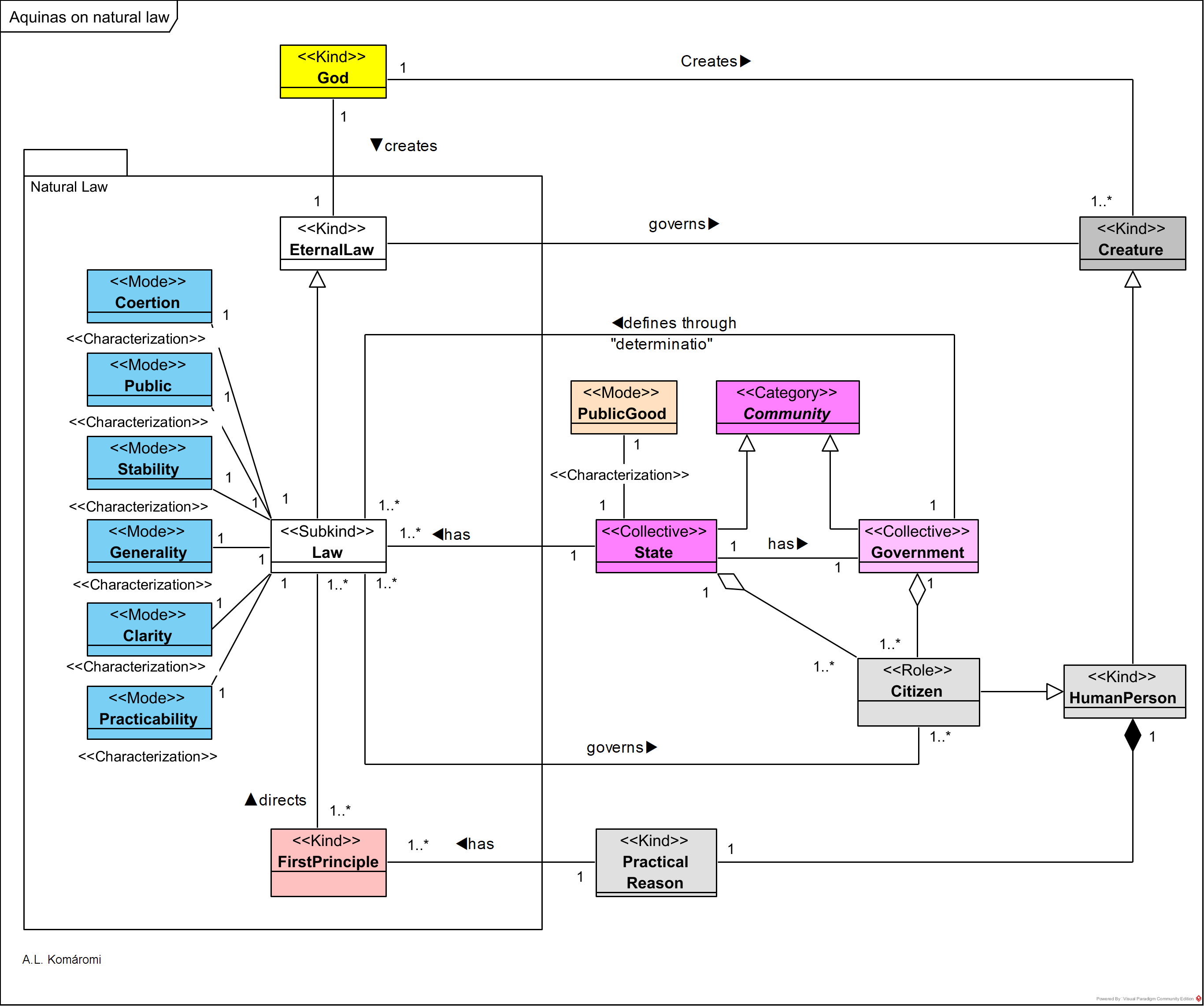
St Thomas Aquinas ( “Doctor Angelicus”, 1225 – 1274 AD), in his magnum opus Summa Theologiae analyzes the topic of natural law:

  • God governs its animate and inanimate creatures through the eternal law (including laws of nature), the natural moral laws ruling the humans “participate” in that eternal law.
  • The first principles of practical reason (see [4.9.9]) of the individual human persons aggregate into posited laws through the process of “determinatio”.
  • Natural law is “a remedy against the great evils of, on the one side anarchy (lawlessness), and on the other side tyranny.”
  • “One of tyranny’s characteristic forms is the co-optation of law to deploy it as a mask for fundamentally lawless decisions cloaked in the forms of law and legality […] Unjust laws are not laws,” This leads to the idea, that unjust laws should be disobeyed. 
  • The rule of law requires the laws to be promulgated by a rightful governement and have to be public, stable, general, clear, and practical.
  • In the real world, the law has to have a coercive force.

Aquinas’s model of natural law is represented in the following OntoUML diagram:

Aquinas on natural law and rule of law
CLASSDESCRIPTIONRELATIONS
GodGodcreates EternalLaw; creates Creature
EternalLaw“prominence is there given to the ‘eternal law‘ by which God governs even inanimate creatures (as by the laws of physics, etc.), and to the ‘participation’ of natural moral law in that eternal law.”governs Creature
Law“Natural law theory accepts that law can be considered and spoken of both as a sheer social fact of power and practice, and as a set of reasons for action that can be and often are sound as reasons and therefore normative for reasonable people addressed by them. This dual character of positive law is presupposed by the well-known slogan ‘Unjust laws are not laws.'”subkind of EternalLaw
Coertion“In a world (paradise) of saints (completely virtuous persons), there would be need for law but not for coercion; so coercion is not part of Aquinas’s definition of law and law’s directive force can be contrasted with its coercive force (and see 6.1(ii) above). But in our actual world the need for (the threat of) coercion is such that Aquinas will say without qualification that law ought to have coercive force [vis coactiva] as well as directive [vis directiva]; he even says that it is a characteristic of law [de ratione legis] (ST I-II q. 96 a. 5), despite not including it in his official definition of law’s nature [its ratio] (q. 90. a. 3).”characterizes Law
Public; Stability; Generality; Clarity; Practicability“The central case of government is the rule of a free people, and law is centrally instantiated when its fully public character (promulgation: q. 90 a. 4), and its clarity (q. 95 a.3), generality (q. 96 a. 1), stability (q. 97 a. 2), and practicability (q. 95 a. 3), enable government (law-makers and law-maintainers alike) and subjects to be partners in public reason (Aquinas has the concept though not the phrase). The features of law thus itemized by Aquinas amount to the concept of the Rule of Law, which he clearly gives a priority over the ‘rule of men’ in his treatment of judges’ subordination to legislation and of the duty of judges to adhere to law even against the evidence of their own eyes (when that evidence is not legally admissible)”characterizes Law
FirstPrinciple“Ethical standards, for which practical reason’s first principles provide the foundations or sources, concern actions as choosable and self-determining. […]
Practical reason, in Aquinas’ view, has both one absolutely first principle and many truly first principles: ST I-II q. 94 a. 2. The absolutely first principle is formal and in a sense contentless. Like the logical principle of non-contradiction which controls all rational thought, it expresses, one might say, the pressure of reason and is so far from being empty of significance and force that its form may be regarded as the frame, and its normativity the source, for all the normativity of the substantive first principles and of the moral principles which are inferable from them. Aquinas articulates it as ‘Good is to be done and pursued, and bad avoided’ (ibid.).
This has often been truncated to (i) ‘Good is to be done, and evil avoided’ or even, more drastically, (iia) ‘Do good and avoid evil’ or yet more drastically (iib) ‘Avoid evil and seek the good‘”
PracticalResonPractical reason (see [4.9.7]) is a human faculty, in the context of the natural law its importance is, that: “Aquinas is particularly clear and explicit that in this context, ‘natural’ is predicated of something (say, a law, or a virtue) only when and because that of which it is predicated is in line with reason, practical reason, or practical reason’s requirements”
CreatureGod’s creature, governed by the eternal law.
HumanPersonA human personsubkind of Creature
Citizen“Once the determinatio is validly made, fulfilling the criteria of validity provided by or under the relevant legal system’s constitutional law, it changes the pre-existing state of the law by introducing a new or amended legal rule and proposition(s) of law. The new or amended legal rule gives judges, other officials, and citizens a new or amended reason for action (or forbearance). “role of HumanPerson; shared part of State and Government
CommunityCommunities such […] are groups, each of them a whole [totum] made up of [human] persons (and perhaps of other groups), their unity being not merely one of composition or conjunction or continuity, but rather of order, in two dimensions: (i) of the parts (members) as coordinating with each other, and (ii) of the group and its members to its organizing purpose or end (finis). Of these, (ii) is the more explanatory, as Aquinas argues at the very beginning of his commentary on Aristotle’s Ethics.”
State“Love of neighbor as oneself (see [4.9.9]) requires one to live in political community with others. For the wellbeing and right(s) of all or almost all of us are dependent upon there being in place institutions of government and law of the relatively comprehensive kind we call ‘political’ and ‘state‘.”subkind of Community; has Law, has Government
GovernmentThe government defines the law based on the first principle, through the process of determinatio:

“The kind of rational connection that holds even where the architect has wide freedom to choose amongst indefinitely many alternatives is called by Aquinas a determinatio of principle(s)—a kind of concretization of the general, a particularization yoking the rational necessity of the principle with a freedom (of the law-maker) to choose between alternative concretizations, a freedom which includes even elements of (in a benign sense) arbitrariness. […]
Political communities [states] are a kind of institution whose rational status as a normally desirable and obligatory objective of and context for collaborative action (and forbearance) can easily be seen to be entailed by the foundational practical and moral principles. In such communities, the normal means for making the needed determinationes is the institution of governmental authority acting in the first instance through legislation and other forms of law-making, i.e., acting as a social-fact source of positive (posited) law.”
subkind of Community; defines Law trough “determinatio”
PublicGood”His explanation, slightly updated: this very large part of our law could reasonably have been different, in the way that every detail of a maternity hospital could have been somewhat different and large portions of the design could have been very different, even though some features (e.g., that the doors and ceilings are more than two feet high) are entailed by the commission to build a town maternity hospital, and every feature has some rational connection with the commission. The kind of rational connection that holds even where the architect has wide freedom to choose amongst indefinitely many alternatives is called by Aquinas a determinatio of principle(s)—a kind of concretization of the general, a particularization yoking the rational necessity of the principle with a freedom (of the law-maker) to choose between alternative concretizations, a freedom which includes even elements of (in a benign sense) arbitrariness.The benefits made possible by political community, with its state government and law, are such that its common good is both extensive and intensive in its reach and implications (e.g. the legitimacy of securing it by coercion). So on those occasions when “the common good” is the best translation of bonum commune, the referent will normally be the good of the political community in question (or of political communities generically), often called by Aquinas public good.characterizes State

Sources

  • All citations from: Finnis, John, “Aquinas’ Moral, Political, and Legal Philosophy“ and “Natural Law Theories“, The Stanford Encyclopedia of Philosophy (Summer 2020 Edition), Edward N. Zalta (ed.)
  • The Cambridge Companion to Aquinas, CAMBRIDGE UNIVERSITY PRESS, Edited by  Norman Kretzmann and Eleonore Stump, 2010
  • McInerny, Ralph and John O’Callaghan, “Saint Thomas Aquinas”The Stanford Encyclopedia of Philosophy (Summer 2018 Edition), Edward N. Zalta (ed.)

First published: 19/11/2020