
St Thomas Aquinas ( “Doctor Angelicus”, 1225 – 1274 AD), in ST Summa Theologiae, discusses political theory, according to which:
- Humans are “political animals” (see [1.13.15]), naturally living in communities, like families, church, and state. Both church and state are complete communities, with relative and delimited power.
- Communities are ordered and strive for the common good.
- The state has laws and government, both limited by different factors.
- The government can be political, based on laws, or regal.
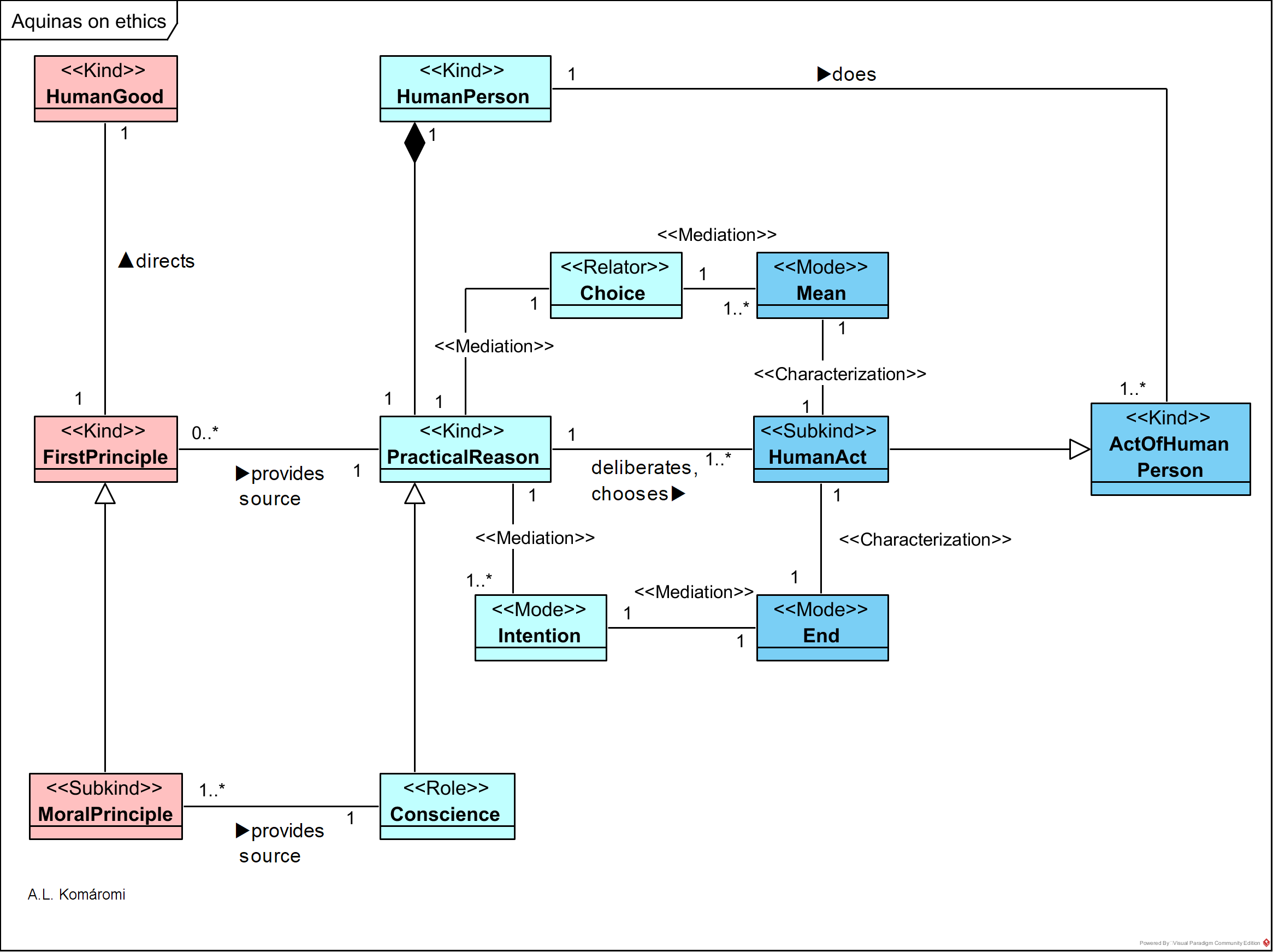
Aquinas’s model of politics is represented in the following OntoUML diagram:

| CLASS | DESCRIPTION | RELATIONS |
|---|---|---|
| HumanPerson | A human person | member of Family_cum_household |
| Citizen | Citizen is a role of a human person – an individual with political rights | role of HumanPerson; member of State and Church, and some of Government also |
| Community | “Communities such […] are groups, each of them a whole [totum] made up of [human] persons (and perhaps of other groups), their unity being not merely one of composition or conjunction or continuity, but rather of order, in two dimensions: (i) of the parts (members) as coordinating with each other, and (ii) of the group and its members to its organizing purpose or end (finis). Of these, (ii) is the more explanatory, as Aquinas argues at the very beginning of his commentary on Aristotle’s Ethics.” | |
| Order | Order characterizes communities: “in in two dimensions: (i) of the parts (members) as coordinating with each other, and (ii) of the group and its members to its organizing purpose or end (finis). Of these, (ii) is the more explanatory, as Aquinas argues at the very beginning of his commentary on Aristotle’s Ethics.” | characterizes Community |
| CommonGood | “‘Common good‘ is very often a safer translation of bonum commune than ‘the common good’. For there is the common good of a team, but equally the common good of a university class, of a university, of a family, of a neighborhood, of a city, of a state, of a church and of human kind throughout the world. The difference in each case between the group’s common good and an aggregate of the wellbeing of each of its members can be understood by considering how, in a real friendship, A wills B’s wellbeing for B’s sake, while B wills A’s wellbeing for A’s sake, and each therefore has reason to will his or her own wellbeing for the other’s sake, with the result that neither envisages his or her own wellbeing as the source (the object) of the friendship’s value, and each has in view a truly common good, not reducible to the good of either taken separately or merely summed. Inasmuch as there is possible and appropriate a kind of friendship between the members of each of the kinds of group listed (non-exhaustively) above, each such group has its own common good.” | characterizes Community |
| PublicGood | ” The benefits made possible by political community, with its state government and law, are such that its common good is both extensive and intensive in its reach and implications (e.g. the legitimacy of securing it by coercion). So on those occasions when “the common good” is the best translation of bonum commune, the referent will normally be the good of the political community in question (or of political communities generically), often called by Aquinas public good.” | subkind of CommonGood; characterizes State |
| CompleteCommunity | Aquinas “accepts that we are naturally parts of a political community, but also that we are more naturally conjugal than political (in the narrow sense), and that political community does not properly have the ultimacy it has for Aristotle. For Aquinas, political communities have been irrevocably relativized by the appropriateness for (in principle) everyone of belonging to the Church which is, in its own way, as complete [perfecta] a kind of community as any state. […] The state is a “complete community”, whose members, in the central case, are also members of another “complete community”, the Church. So this completeness is, in each case, relative and delimited.” | subkind of Community |
| State | “Love of neighbor as oneself (see [4.9.9]) requires one to live in political community with others. For the wellbeing and right(s) of all or almost all of us are dependent upon there being in place institutions of government and law of the relatively comprehensive kind we call ‘political’ and ‘state‘.” | subkind of CompleteCommunity; has Law, has Government |
| Church | The church is “established to transmit divine revelation and salvation” | subkind of CompleteCommunity |
| Government | “The best form of government (or as we would now say, constitution) is one in which, ‘well mixed’, are found ‘monarchy’, ‘aristocracy’ and ‘democracy’, that is, the rule of one person (whose “monarchy” is probably better elective rather than hereditary), governing in concert with a few high officials chosen for their excellence of character and aptitude, by an electorate comprising the many who are entitled both to vote and to stand for election: ST I-II q. 105 a. 1. Establishing and maintaining such an arrangement is a matter for laws which delimit the competences of all concerned.” | subkind of Community |
| PoliticalGovernment | “Government is properly speaking ‘political‘ when the supreme person or body ‘has power which is limited [potestas coarctata or limitata] by certain laws of the state’: Pol. I.1.5. Such rulers govern in accordance with the laws concerning the establishment of their office, their appointment and their responsibilities.” | subkind of Government |
| RegalGovernment | “When power is, by contrast, ‘plenary’, the government is said to be ‘regal’ in kind. But even regal government, in its proper forms, is the government of free and equal people who have in some sense (never made quite clear by Aquinas) the “right to resist [ius repugnandi]” the ruler(s). Even regal rulers are subject to the directive force of the laws, though there is no-one who has the legal authority to coerce them.” | subkind of Government |
| Family_cum_household | A family living in a household. | subkind of Community |
| Law | “the main concern of law [including the natural (moral) law] must be with directing towards beatitudo. Again, since every part stands to the whole as incomplete stands to complete, and individual human beings are each parts of a complete community, law’s appropriate concern is necessarily with directing towards common felicitas … that is, to common good. (ST I-II q. 90 a. 2.) The ‘complete community’ mentioned here is the political community, with its laws, but the proposition implicitly refers also to the community of all rational creatures, to whose common good morality (the moral law) directs us.” | directs Citizen |
| Limitation | Limitations: “(i) State governments and laws are subject to moral standards, especially but not only the principles and norms of justice. This does not mean that moral principles all apply to public authority in the way they do to private persons; they do not, yet there is no exemption of public authorities from the exceptionless moral norms against intentionally killing the innocent, lying, rape and other extra-marital sex, and so forth. Moreover, this limitation has no bearing on the distinct question which moral standards should, or can properly, be legally enforced by the state’s government and law (see (iii) below). (ii) State governments are subject to laws governing election or other appointment to and tenure and rotation of office, and the jurisdiction of particular offices. Even supreme rulers not subject to the coercive authority of anyone else cannot dispense themselves from the obligation of their own laws unless that is for the common good and free from favoritism. If they defy these moral restrictions they show themselves to be tyrants, and may be resisted and deposed by the concerted (‘public’) action of their people. […] (iii) State governments and laws have the authority and duty to promote and defend the common good, including the good of virtue. This responsibility brings with it the authority to use coercion for the suppression of crime and enemy attack. […] This coercive jurisdiction extends to defending persons and property both by force and by the credible threat of punishment for criminal or other unjust appropriation or damage. But it does not extend to enforcing any part of morality other than the requirements of justice insofar as they can be violated by acts external to the choosing and acting person’s will. Acts of virtues (or vices) other than such external acts of inter-personal (in)justice cannot rightly be prohibited unless they involve (in)justice. For, unlike divine law’s, ‘human law’s purpose is the temporal tranquility of the state, a purpose which the law attains by coercively prohibiting external acts to the extent that these evils can disturb the peaceful state of the state.’ ST I-II q. 98 a. 1c; likewise q. 100 a. 2c: ‘human law does not put forward precepts about anything other than acts of justice [and injustice]’. State law’s justifiedly coercive domain is not private good as such, nor the whole of the community’s common good. Rather, it is those aspects of the political community’s common good that can be called public good, and that are affected by external acts directly or indirectly affecting other members of the community. (iv) The morally significant authority of the state’s government and law is limited by the rights of the Church, though when that government and law are within their proper domain, one ought to comply with their directives rather than any purported act of administration or government (apart from general moral teaching) by Pope or bishops.” | limits Law, Government |
Sources
- All citations from: Finnis, John, “Aquinas’ Moral, Political, and Legal Philosophy“, The Stanford Encyclopedia of Philosophy (Summer 2020 Edition), Edward N. Zalta (ed.)
- The Cambridge Companion to Aquinas, CAMBRIDGE UNIVERSITY PRESS, Edited by Norman Kretzmann and Eleonore Stump, 2010
- McInerny, Ralph and John O’Callaghan, “Saint Thomas Aquinas”, The Stanford Encyclopedia of Philosophy (Summer 2018 Edition), Edward N. Zalta (ed.)
First published: 12/11/2020
 Philosophy Models